Netflix Filed a Trademark for a Product It Hasn't Named Yet — Twice in One Week
The most interesting filing on the January register doesn't match anything Netflix has announced. On Jan. 26 the company filed NETFLIX V/RTUALS (99615322); three days later, on Jan.
 By Howard Katzenberg
Founder, GleanMark
Updated October 6, 2026
The most interesting filing on the January register doesn't match anything Netflix has announced. On Jan. 26 the company filed NETFLIX V/RTUALS (99615322); three days later, on Jan. 29, it filed the bare wording V/RTUALS (99622147). The stylized slash where the "I" should be is deliberate branding, not a typo, and we could find no public product, feature, or announcement carrying the name. When a company files the same coined term twice in a week — once house-branded, once standalone — it is usually clearing room for something it intends to ship.
That is the value of the register: it is the cleanest public preview of a product roadmap there is, and companies file long before marketing is ready to talk.
"The trademark register is the cleanest public preview of a company's product roadmap — companies just don't realize how early they're talking."
The wider month was solid, not spectacular. USPTO applicants filed 53,063 trademarks in January 2026 — down 13.6% from January 2025's outlier, but still the third-strongest January in GleanMark's 2016–2026 same-month view. The mix is where the story lives: Class 42 software and technology-services claims rose 24.6% year over year even as overall volume fell. We think that likely reflects continued AI-startup formation and platform-services branding pushing clearance work into the register, while several consumer-goods classes cooled hard from 2025's unusually hot January.
What We Found
- Netflix filed a coined name twice in four days. NETFLIX V/RTUALS and the standalone V/RTUALS have no public counterpart we could locate — the strongest roadmap breadcrumb on the month.
- January was historically strong, not weak. 53,063 filings made January 2026 the third-strongest January since 2016, behind only 2025 and 2021.
- Software broke away from the broader pullback. Class 42 logged 5,271 class claims, up 24.6% year over year — the only top-five class growing at double digits.
- Consumer goods cooled sharply. Classes 28, 21, 20, and 11 all fell more than 29% year over year.
- GOAT is policing again. 1661, Inc. — the sneaker-and-apparel marketplace GOAT — led TTAB plaintiffs with 9 proceedings, ahead of Apple at 8.
Filing Volume
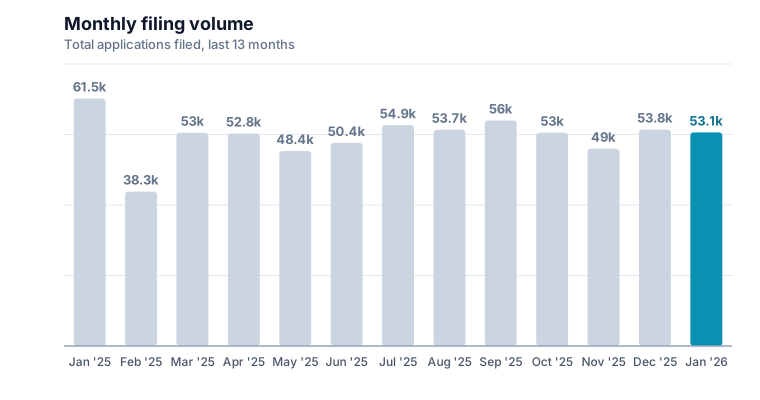
| Month | Total Filings | MoM Change |
|---|---|---|
| Jan. 2026 | 53,063 | -1.3% |
| Dec. 2025 | 53,761 | 9.7% |
| Nov. 2025 | 49,015 | -7.5% |
| Oct. 2025 | 52,991 | -5.4% |
| Sep. 2025 | 56,026 | 4.3% |
| Aug. 2025 | 53,722 | -2.1% |
| Jul. 2025 | 54,850 | 8.7% |
| Jun. 2025 | 50,447 | 4.1% |
| May 2025 | 48,440 | -8.2% |
| Apr. 2025 | 52,785 | -0.3% |
| Mar. 2025 | 52,969 | 38.1% |
| Feb. 2025 | 38,348 | -37.6% |
| Jan. 2025 | 61,451 | — |
Start with the same-month history, not the month-over-month line. January 2026 ranks third among every January in this 11-year window. The only higher Januarys were 2025's 61,451 filings and 2021's 56,525. A weak month does not finish third.
Because January is also the year-to-date total, the YTD frame says the same thing: 2026 opened 13.6% below 2025 but above every January from 2016–2020 and 2022–2024. The 1.3% dip from December is noise by comparison.
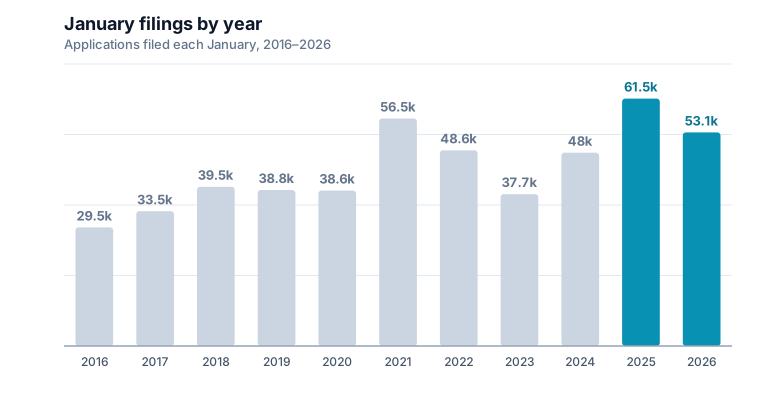
Every January, 2016–2026
| Year | January Filings |
|---|---|
| 2016 | 29,469 |
| 2017 | 33,487 |
| 2018 | 39,549 |
| 2019 | 38,756 |
| 2020 | 38,601 |
| 2021 | 56,525 |
| 2022 | 48,604 |
| 2023 | 37,744 |
| 2024 | 48,014 |
| 2025 | 61,451 |
| 2026 | 53,063 |
January 2026 trails only January 2025 and January 2021 in the same-month comparison.
The year-over-year decline is real but should not be read as weakness. January 2025 was the anomaly, not January 2026, which sits comfortably above both the pre-2021 baseline and the 2022–2024 band.
NICE Class Leaderboard
| Rank | NICE Class | Description | Filings | MoM | YoY |
|---|---|---|---|---|---|
| 1 | 41 | Education, training, entertainment, sporting and cultural activities | 6,908 | -6.3% | 12.7% |
| 2 | 9 | Software, electronics, scientific and audiovisual apparatus | 6,434 | -13.8% | -14.5% |
| 3 | 25 | Clothing, footwear and headwear | 5,783 | 5.4% | -8% |
| 4 | 35 | Advertising, business management and retail services | 5,417 | -11.9% | -9.5% |
| 5 | 42 | Scientific and technological services; software design and development | 5,271 | -8.3% | 24.6% |
| 6 | 3 | Cosmetics and cleaning preparations | 2,907 | -1.4% | -7.4% |
| 7 | 5 | Pharmaceuticals, supplements and medical preparations | 2,662 | -7.1% | -16.5% |
| 8 | 28 | Games, toys, sporting goods and playthings | 2,417 | -9.4% | -29.8% |
| 9 | 21 | Household and kitchen utensils, containers and related goods | 2,378 | -4.7% | -33.5% |
| 10 | 16 | Paper goods, printed matter and office supplies | 2,162 | -6.7% | -11.5% |
| 11 | 36 | Insurance, financial, monetary and real estate services | 1,984 | -7.3% | -9.3% |
| 12 | 20 | Furniture, mirrors, frames and non-metal containers | 1,739 | 3.3% | -35.6% |
| 13 | 44 | Medical, beauty, veterinary and agricultural services | 1,607 | -12% | 0.6% |
| 14 | 30 | Coffee, tea, bakery, confectionery and staple foods | 1,473 | -0.2% | -13.6% |
| 15 | 11 | Lighting, heating, cooking, cooling and sanitary apparatus | 1,432 | -7% | -39.5% |
Class 41 topped the leaderboard and, more notably, grew 12.7% year over year — the media, entertainment, and creator-services tier is still expanding while most of the table contracts.
Class 42 is the better growth story. It is the only top-five class up double digits year over year, and a 24.6% rise in a class that large is not a rounding artifact. Our read: AI and software companies are forming, rebranding, and extending product lines into services that need early clearance, and that pipeline has not slowed with the broader market.
The contrast with physical goods is stark. Classes 28, 21, 20, and 11 each fell more than 29% year over year — the marketplace and consumer-hardware brand rush that powered many 2024–2025 months has clearly thinned.
Top Filing Owners
| Owner | Filings | Prior Month | MoM |
|---|---|---|---|
| CVS PHARMACY, INC. | 45 | 2 | 2,150% |
| WALMART APOLLO, LLC | 31 | 9 | 244.4% |
| LIGHT & WONDER, INC. | 29 | 26 | 11.5% |
| Yousheng Cen | 29 | 0 | — |
| Nianlian Cen | 27 | 0 | — |
| Jixiu Luo | 27 | 0 | — |
| Sun,Guojun | 26 | 0 | — |
| Qi Zhongfeng | 26 | 0 | — |
| BLUESCOPE STEEL LIMITED | 25 | 0 | — |
| Hyper Foundation | 24 | 0 | — |
| Round One Entertainment, Inc. | 24 | 0 | — |
| YANG, GUANGNING | 24 | 0 | — |
CVS is the eye-catcher: 45 filings after just 2 in December. A jump like that almost never reflects a single product and usually means a private-label or store-brand refresh moving through in one batch — worth a look for anyone tracking retail house brands.
Below the recognizable names — CVS, Walmart, Light & Wonder, BlueScope Steel — the leaderboard is dense with individual filers who appeared from a zero base. That pattern reads like coordinated batch filing rather than brand strategy, which is exactly the distinction practitioners should make before treating raw owner volume as a signal.
Top Correspondent Firms
| Firm | Filings | Prior Month | MoM |
|---|---|---|---|
| Swyft Legal LLC | 884 | 1,037 | -14.8% |
| Overseas Operation Services, Inc. DBA Flatfee Corp. | 599 | 616 | -2.8% |
| LZ Legal Services, LLC | 595 | 691 | -13.9% |
| Grogan, Tuccillo & Vanderleedeen, LLP | 478 | 400 | 19.5% |
| Alioth Law P.C. | 458 | 617 | -25.8% |
| Sparring Legal LLP | 297 | 258 | 15.1% |
| SOLORIO LEGAL PC | 278 | 286 | -2.8% |
| Usa | 256 | 250 | 2.4% |
| Naveen Thakur | 216 | 0 | — |
| Kearston Grace Everitt | 215 | 3 | 7,066.7% |
| MEDIA LAW GROUP | 207 | 160 | 29.4% |
| LegalForce RAPC Worldwide, P.C. | 197 | 250 | -21.2% |
The productized filing shops still own the top of this table. Swyft Legal, Flatfee Corp., and LZ Legal Services hold the top three slots — a reminder that a large slice of USPTO volume is now fixed-fee, high-throughput work rather than traditional prosecution.
The outlier worth flagging is Kearston Grace Everitt: 215 filings after 3 in December. A jump from a near-zero base to mid-table in one month is the correspondent-side equivalent of the individual-owner spikes above, and it usually points to a single high-volume filer routing work through a new name.1
Notable Filings
Netflix: V/RTUALS, plus EYELINE and TOP9
Netflix's filing week was the busiest of the month. TOP9 (99607123) landed Jan. 21, EYELINE (99612406) Jan. 23, NETFLIX V/RTUALS (99615322) Jan. 26, and the standalone V/RTUALS (99622147) Jan. 29.
V/RTUALS is the one to watch. We found no public Netflix product, feature, or announcement using the name; filing it both house-branded and standalone within four days is the behavior of a company protecting something specific it has not yet revealed.
EYELINE is the opposite case — it is already a known brand. Netflix merged its Scanline VFX and Eyeline Studios operations under the single "Eyeline" name in October 2025, so this filing reads as portfolio maintenance for an existing virtual-production and VFX unit, not a tease.
Apple: N1
Apple filed N1 (99620324) on Jan. 28. This is not a mystery mark: N1 is Apple's in-house wireless networking chip, introduced in September 2025 with the iPhone 17 line and the iPhone Air, and since extended to the iPad Pro. The January filing is best read as Apple shoring up registration coverage on a chip brand that is already shipping in volume — the kind of follow-on filing that routinely trails a hardware launch.
Samsung: NEO MICRO RGB, VXT AI STUDIO, and VXT SHADOW GEN.
Samsung filed VXT SHADOW GEN. (99609497) on Jan. 22, VXT AI STUDIO (99610952) on Jan. 23, and NEO MICRO RGB (79444979) on Jan. 27.
NEO MICRO RGB is tied to an existing product line: Samsung's Micro RGB TV technology debuted in 2025 and the company expanded the lineup at CES in early January 2026, so this filing lands right alongside that rollout rather than ahead of it. The two VXT marks are the more open questions — they read like software or creative-tool branding around Samsung's display and enterprise stack, and we found no specific announced product matching either.
Google: ARIA AIR
Google filed ARIA AIR (99611184) on Jan. 23, and it has already reached registered status. Worth a note of caution for anyone reaching for the obvious link: "Aria" is the name of Meta's research-glasses program, not a Google product, so this is not Google entering that space under a borrowed name. We did not find a clearly matching announced Google product for ARIA AIR; the speed to registration suggests a relatively unobstructed mark.
Amazon Technologies: ROCKIN' GRANDMA'S
Amazon Technologies filed ROCKIN' GRANDMA'S (99620856) on Jan. 28. The phrasing doesn't read like cloud, devices, or logistics; it sounds consumer-facing — a content property, character, or shopping program. We found no public counterpart, so the value here is simply that a platform owner reserved a very specific phrase, which tends to mean a specific use is coming.
Nike: SWOOSH and CA
Nike filed SWOOSH (99607517) and CA (99607538) on Jan. 21. SWOOSH is core house-mark maintenance; when a company refiles a signature mark, the interesting question is coverage — new classes, new goods, new channels. CA is too short to interpret on its own and we found no obvious public product behind it.
TTAB Activity
| Type | Filings | Prior Month | MoM |
|---|---|---|---|
| Oppositions | 647 | 769 | -15.9% |
| Cancellations | 225 | 244 | -7.8% |
The docket cooled — oppositions fell to 647 and cancellations to 225 — but the plaintiff list stayed concentrated among brands with broad merchandising footprints.
The top name is the telling one. 1661, Inc. is GOAT, the sneaker-and-apparel resale marketplace, and it has spent years defending and contesting the "GOAT" mark — most visibly in its long-running dispute with London's Goat Fashion over apparel rights. Nine proceedings in a single month from a marketplace operator is aggressive brand-control behavior, and it is consistent with a company that has learned the hard way how much its name is worth. Apple's 8 proceedings need no explanation: a company spanning hardware, software, services, retail, and developer tools has more brand edges to police than almost anyone. Pop Mart and Mattel show collectibles and toy brands using the TTAB as a brand-control venue.
Registration Rates
| Cohort Month | Total Filed | Registered | Registration Rate |
|---|---|---|---|
| Jan. 2025 | 61,451 | 31,448 | 51.2% |
| Dec. 2024 | 53,459 | 26,210 | 49% |
| Nov. 2024 | 47,795 | 22,895 | 47.9% |
| Oct. 2024 | 52,967 | 26,167 | 49.4% |
| Sep. 2024 | 51,308 | 23,184 | 45.2% |
| Aug. 2024 | 50,411 | 16,219 | 32.2% |
| Jul. 2024 | 50,715 | 18,534 | 36.5% |
| Jun. 2024 | 46,732 | 18,825 | 40.3% |
| May 2024 | 51,570 | 25,544 | 49.5% |
| Apr. 2024 | 51,609 | 25,430 | 49.3% |
| Mar. 2024 | 48,993 | 25,018 | 51.1% |
| Feb. 2024 | 43,788 | 21,610 | 49.4% |
Outcomes belong to older cohorts. Most mature months here cluster in the high 40s to low 50s, with July and August 2024 lagging the surrounding band. January 2026 is a filing-volume and class-mix month; its registration outcomes won't be legible for a year.
Practitioner Takeaways
- Don't mistake the year-over-year drop for a weak January. It was still the third-strongest January since 2016.
- Software clearance is getting more crowded. Class 42's 24.6% year-over-year rise means AI, SaaS, and platform-service naming conflicts will stay active while physical-goods classes thin.
- Watch coined names filed in clusters. Netflix's V/RTUALS pair is the model: a made-up word filed twice in a week, with no public product, is usually a launch in waiting.
- TTAB risk is concentrated around famous and fiercely protective brands. GOAT, Apple, Pop Mart, Mattel, McDonald's, Puma, and the Cubs are exactly the owners that turn a clearance search into more than a knockout exercise.
Explore more USPTO data analysis on the GleanMark Insights blog.
More in this series
Previous: December 2025 · Next: February 2026 · Browse all filing reports
Footnotes
-
Methodology: figures cover USPTO trademark applications by filing date, from GleanMark's mirror of the full USPTO dataset (~14M records). NICE-class figures count class claims, not applications, so class totals are not directly comparable to filing-volume totals. Recent-month filings are ~99% pending — prosecution timing, not outcomes; registration rates use cohorts old enough to have matured. Firm totals cover filings mapped to a law firm (about 61% of the month); one entry resolves only to "Usa," a known data-source artifact rather than a firm name. Informational, not legal advice. ↩
Related Articles
Class 42 Filings Up 32% Year Over Year as September 2026 Tops September 2025
October 5, 2026
Amazon Filed a Trademark for DUCKLABS the Same Day It Announced Buying DuckLabs
September 5, 2026
July 2026 Trademark Filings Top Every July Since 2016
August 5, 2026