First-pass clearance.
$79. Instant.
Examiner-style search methods. Goods & services overlap scoring. A written §2(d) analysis on each top conflict. Domain and web presence signals. A 10+ page report with full audit trail — ready in minutes, not days.
7-day Professional trial, no credit card required. Includes sample reports so you can evaluate the work product before committing.
Tested against the USPTO’s own answer key. In an August 2026 test on 192 applications the USPTO refused under Section 2(d), the search behind every clearance report surfaced the examiner’s cited registration in 9 of 10 cases. Method available on request.
TMZAP
Classes 9, 42, 45, expanded to 48 coordinated classes
Searched in 7.8 seconds, with a written analysis of each top conflict.
8
Search methods per report
5
Conflicts given a written §2(d) analysis
14M+
USPTO records searched
~10 min
Average report delivery
A clear verdict —
not a data dump
Every search opens with a graded recommendation. Each reason cites the specific marks, web presence findings, and domain status behind it — so the analysis is already done when you sit down to write to your client.
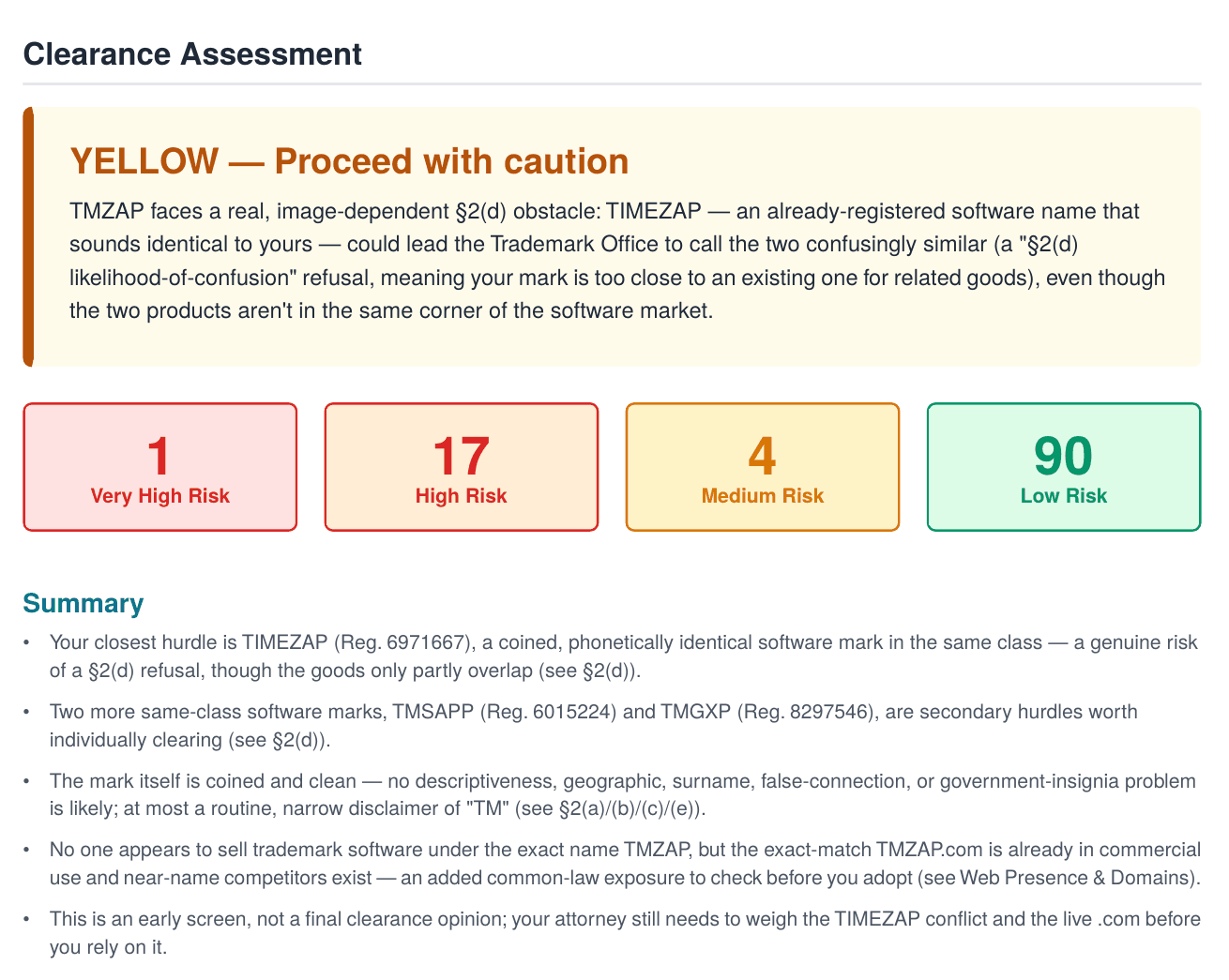
Domain and web presence —
built in
Five domain extensions checked instantly with parked-vs-active detection. Web presence research surfaces businesses already using the name online — common-law risk signals that traditional clearance searches miss entirely.
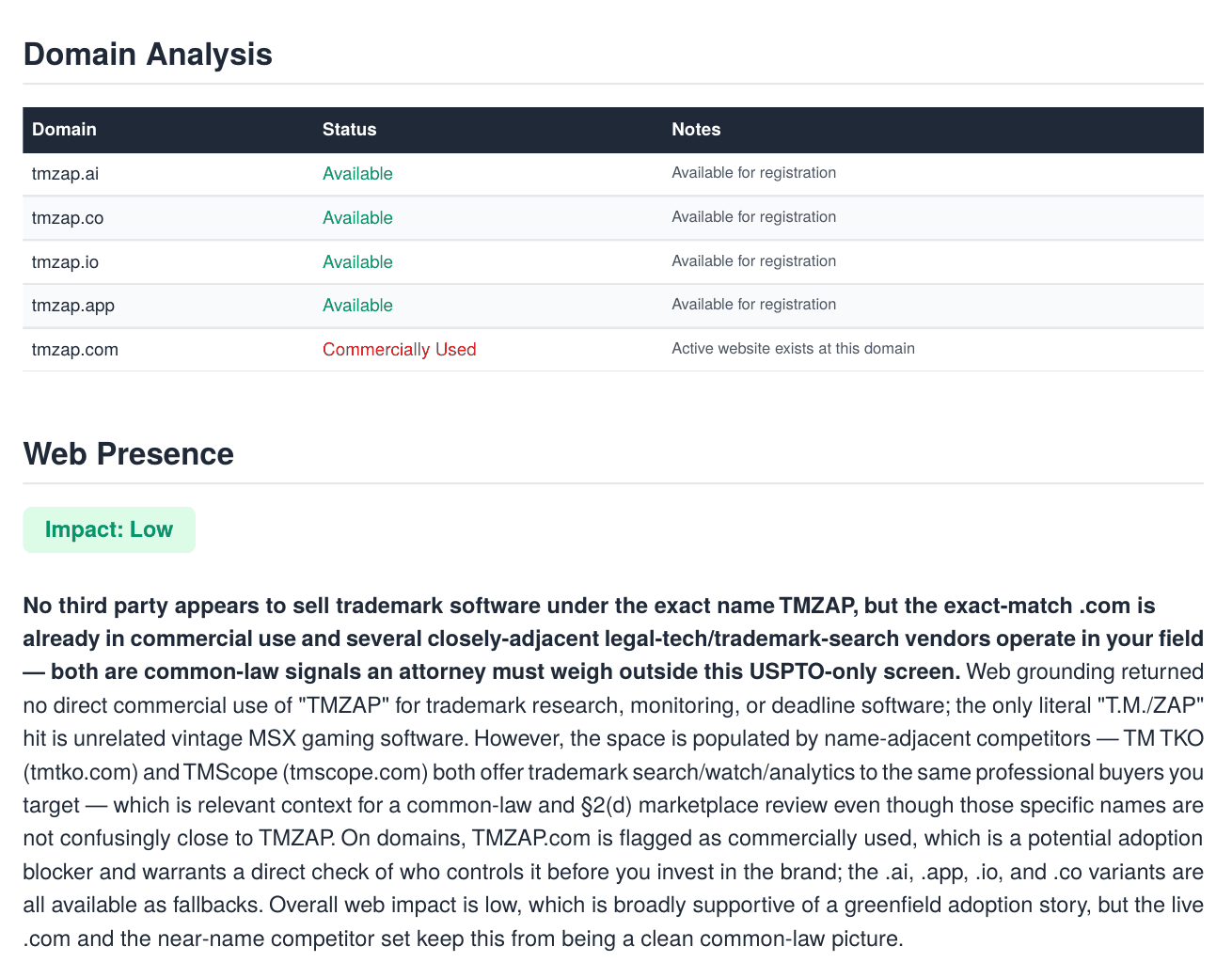
See exactly what the
examiner would find
Conflicts organized by the search method that found them. Select the marks that matter for §2(d) analysis with one click. Full transparency into why each mark was flagged.
See what you get before you buy
Download a real clearance report. Same format, same depth, same audit trail you'd get for your own marks.
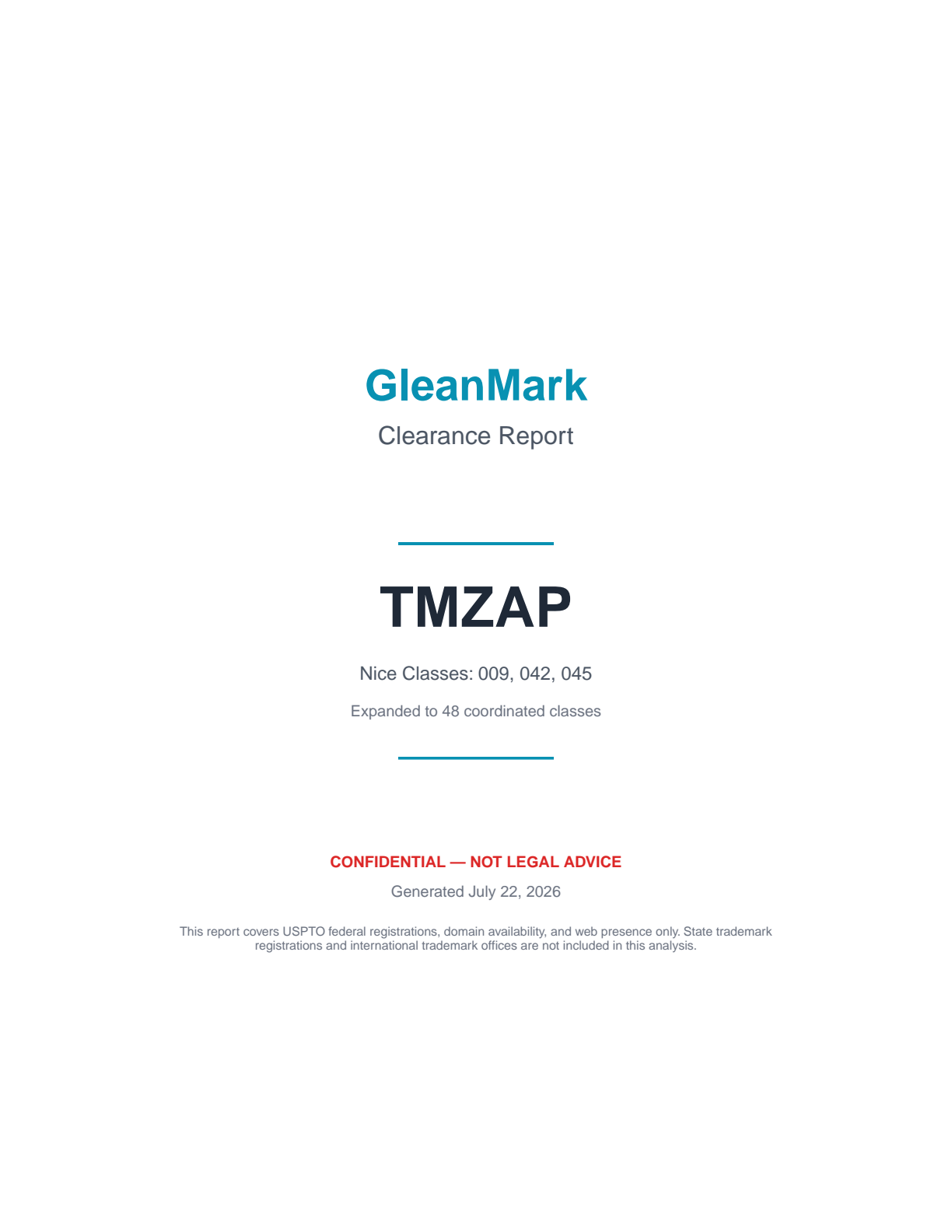
TMZAP
Proceed with CautionClass 9, 42 + 45 · pre-filing clearance
A short, coined software name that runs straight into a phonetically identical senior registration. The value is in what the analysis does next: a per-mark du Pont likelihood-of-confusion walk, goods-relatedness scoring that pushes an unrelated medical-software hit down rather than up, a famous-brand near-miss correctly ruled out of scope, plus domain and web-presence signals. The written verdict is proceed with caution — clear the one conflict that matters, monitor the rest. No cherry-picking — this is exactly what the tool produced.
Download the full TMZAP report (PDF)Another sample report
CASA VERDE
High RiskClass 43
Restaurant services — a Spanish-language mark run through the Doctrine of Foreign Equivalents, with a crowded-field counter-argument the register-only view would miss.
Download Sample PDFBoth samples use a proposed brand name run against the live USPTO database — the conflicts, scores, and analysis are real.
Four steps to a client-ready clearance report
From proposed mark to client-ready report in minutes.
Enter your proposed mark
Add the mark name, a goods & services description, and optionally select Nice classes. The system suggests classes from your description.
Review conflicts instantly
Results appear in seconds. See a clear recommendation, risk breakdown, domain availability, web presence, and every conflict organized by the search method that found it.
Choose the conflicts that matter
Select which marks the report should analyze. Each one gets a written §2(d) analysis in the finished report, factor by factor.
Generate the report
One click produces a 10+ page PDF, Word, or Excel document with executive summary, DuPont analyses, methodology audit trail, and appendices. Ready for your client file.
What every report includes
Deeper analysis than services costing 2-10x as much — with full transparency.
Examiner-style search methodology
Examiner-style search strategies that replicate how a USPTO examining attorney evaluates your mark: exact match, pseudo-mark resolution, phonetic similarity, visual patterns, shared word components, coordinated class expansion, word-level phonetic, similar meaning, and foreign translation under the Doctrine of Foreign Equivalents. Compound marks are automatically decomposed into components so each word is tested independently.
DuPont analysis on the conflicts that matter
Select the marks you want analyzed and get a written §2(d) likelihood-of-confusion analysis on each one. It walks the du Pont factors a pre-filing record can actually speak to — similarity of the marks in their entireties, goods and services relatedness on the du Pont sliding scale, trade channels inferred from the recitations as written, and the strength of the cited mark against any crowded field — giving each a directional conclusion with the authority it rests on. The factors that turn on use or litigation evidence are named as neutral rather than guessed at. No invented scores. We are not aware of another clearance product that runs this automatically.
How examiners actually treated similar marks
Not inference — real examiner action. We pull the actual Office Actions for the closest similar marks, reading even scanned paper-era documents, and show which drew a §2(d) citation and exactly which registration was cited, which drew a §2(e) refusal for descriptiveness, surname, or geographic significance, and how the applicant cured it — Supplemental Register, §2(f), disclaimer, argued, or abandoned. Registrations cited repeatedly across the neighborhood are surfaced as recurring blockers. Marks that registered without objection are called out too, because that is the counterpoint arguing in your favor. Included with every clearance report.
Coexistence evidence from the live register
For a contested conflict, we search the federal register for similar marks that already coexist across both goods universes — In re Thor Tech, 113 USPQ2d 1546 (TTAB 2015) evidence, assembled for you, with independent owners separated from affiliates of the same corporate family. Tag the pairs you want and download an exhibit bundle: a Word summary chart plus a live TSDR status PDF for every registration you tagged, zipped. The evidence appears in its own tab on the first run; re-analyze to fold it into the written §2(d) narrative.
Clearance for logos, not just words
Clear a design-only mark with no wording at all, or a logo-plus-words mark as a whole. We have fingerprinted over 1.2 million trademark design images, so conflicts come back as lookalike designs shown side by side against yours in the app — rather than you guessing at design codes. You still supply goods and services and at least one class, as with any clearance.
Choose what goes in before you generate
Twelve report sections you can include or leave out — refusal history, coexistence, domains, web presence, appendices, and more — chosen before the report is built, and applied to the PDF and Word versions. You can also filter conflicts by your own counsel rating, so your judgment decides what reaches the client, not the scoring. A clearance memo and an internal working file are different documents; you should not have to send the same one for both.
Goods & services commercial overlap
Your goods & services description is analyzed against each conflict's registered goods to score how commercially related they actually are — not just whether classes match. This is how an examiner evaluates whether consumers would expect the goods to come from the same source.
Clear recommendation with reasoning
Not a risk score — a written verdict. From High-Similarity Marks Found through Notable Similar Marks, Proceed with Caution, Manageable Risk, Generally Favorable, and Looks Clear — with specific reasons citing the marks, domains, and web presence that informed the assessment. Actionable enough to relay directly to your client.
Domain and web presence research
Five domain extensions checked with parked-vs-active detection. Web presence research surfaces businesses already using the name online — common-law risk signals that traditional clearance searches miss entirely.
Full audit trail for your client file
Every search step is documented: what was searched, which methods found each mark, and why it scored the way it did. Transparent enough to share with a client or include as supporting documentation in a work product file. This is not a black box.
10+ page professional report
Executive summary, per-mark §2(d) analysis, complete search methodology documentation, conflict tables sorted by risk level, domain analysis, web presence findings, and step-by-step appendices. PDF, Word, or Excel.
More analysis. Lower cost. Faster delivery.
Side-by-side comparison with traditional clearance vendors.
| Feature | GleanMark $79 | Corsearch | Trademark Engine | LegalZoom |
|---|---|---|---|---|
| Search methodology | Examiner-style, multi-strategy (phonetic, visual, component, coordinated class, foreign translation) | Proprietary AI matching | Keyword + phonetic + common law (varies by tier) | Keyword + phonetic + statistical ranking |
| Speed | Instant | Screening: instant. Full clearance: 3 days | ~3 business days | ~5 business days |
| G&S commercial overlap | Semantic analysis of your actual goods & services description | Not included | Not included | Not included |
| DuPont analysis | Written §2(d) analysis per conflict, factor by factor | Not included | Not included | Not included |
| Recommendation | Graded verdict with written reasoning | Risk score | Summary report | Ranked data — no opinion |
| Domain + web presence | Integrated (5 domains, parked detection, web research) | Included in full clearance | Included at $299+ tier | Included at $299 tier |
| Audit trail | Full methodology — every step documented | Proprietary scoring | Not documented | Not documented |
| Report | 10+ page PDF, Word, or Excel with executive summary | Clearance report (PDF) | Online report | Ranked data report |
| Price (per search) | $79 | $840 (full clearance) | $149–499 (depends on tier) | $199–299 (search only) |
Competitor pricing and features based on publicly available information as of May 2026. Pricing may vary.
What every report covers
Designed to cover the conflicts that drive most federal filing decisions — quickly and affordably.
Included
- Complete USPTO federal database (14M records)
- Examiner-style multi-step search methodology
- Goods & services commercial overlap scoring
- Per-mark DuPont likelihood of confusion analysis
- Written graded recommendation with reasoning
- Domain availability across 5 extensions
- Web presence research (common-law signals)
- Full audit trail for your client file
- 10+ page PDF, Word, or Excel report
Not included
- State trademark registrations (Secretary of State)
- International databases (Madrid, EUIPO, WIPO)
- Human attorney review
For most federal filing decisions, federal conflicts combined with domain and web presence are what drive the go/no-go decision. When the stakes require state or international coverage, this report serves as a strong first pass.
Traditional clearance: $1,500-2,500
$79 per report
- Per-mark DuPont analysis included
- Domain + web research included
- Full audit trail included
Starter includes 1 report a month, Professional 2, and Max 5 per seat per month — then $79 each. Free sample reports on every new paid account.
On Max, firms can put their own logo and firm name on the cover and header, so the report reads as your work product rather than ours. Requires a firm workspace; a “Powered by GleanMark” line remains in the footer.
Frequently asked questions
Related on GleanMark
Run your first clearance report in the next 10 minutes.
No credit card. No commitment. See how an examiner-style search handles your hardest mark.
Start Free Trial