Disney Filed Its IMAX Rival Two Weeks Before Announcing It — Inside a Record March on the Trademark Register
On March 30, Disney Enterprises filed a trademark application for INFINITY VISION.
 By Howard Katzenberg
Founder, GleanMark
Updated October 6, 2026
On March 30, Disney Enterprises filed a trademark application for INFINITY VISION. Seventeen days later, at CinemaCon, Walt Disney Studios unveiled Infinity Vision as a new certification for premium large-format theaters developed in collaboration with global theatrical exhibition partners, with cinemas that qualify signifying to audiences which auditoriums offer the biggest, brightest, and most immersive cinematic experiences. The trademark register saw it first — which is the whole point of reading the register.
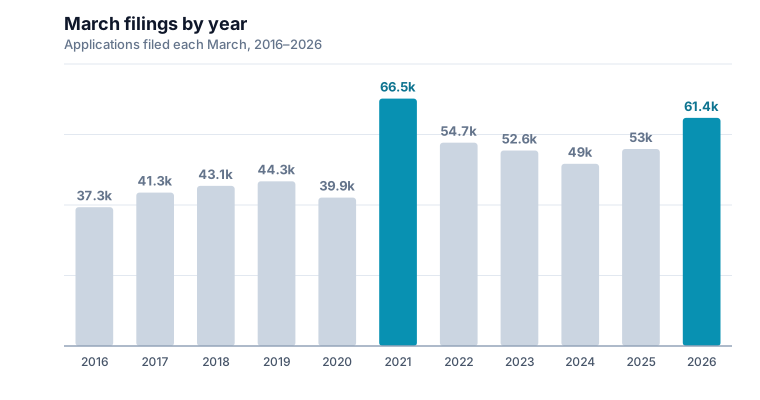
That filing landed inside the strongest March the USPTO trademark system has recorded since at least 2016, save one. March 2026 drew 61,352 applications, trailing only the 2021 pandemic boom. Through three months, 2026 is running 7.5% ahead of 2025 — and software-and-services Class 42 filings are up 82% year over year.
"The trademark register is the cleanest public preview of a company's product roadmap. Disney told the USPTO about its IMAX rival more than two weeks before it told the audience at CinemaCon."
— Howard Katzenberg, Founder, GleanMark
We think the broad March strength likely reflects three forces hitting the register at once: AI and software company formation, marketplace brand-registry behavior from online sellers, and a normal post-holiday filing catch-up. This was not a narrow rebound. Demand came back with breadth.
What We Found
- March was the second-strongest on record. 61,352 applications, behind only March 2021's 66,522 in the same-month history since 2016.
- The year is pulling ahead. 2026 reached 164,299 filings through March versus 152,768 in 2025 — a 7.5% lead, and itself second only to 2021.
- Software and services broke out. Class 42 logged 7,684 class claims, up 82% year over year — the steepest jump among the top classes, and not the profile of a pure consumer-goods rebound.
- Disney filed ahead of its own announcement. INFINITY VISION, serial 99732764, filed March 30; announced at CinemaCon April 16–17.
- GOAT outfiled Apple at the TTAB. Sneaker-and-apparel marketplace 1661, Inc. led all plaintiffs with 9 proceedings — more than Apple, Adidas, or Puma.
Filing Volume
| Month | Total Filings | MoM Change |
|---|---|---|
| March 2025 | 52,969 | — |
| April 2025 | 52,785 | -0.3% |
| May 2025 | 48,440 | -8.2% |
| June 2025 | 50,447 | 4.1% |
| July 2025 | 54,850 | 8.7% |
| August 2025 | 53,722 | -2.1% |
| September 2025 | 56,026 | 4.3% |
| October 2025 | 52,991 | -5.4% |
| November 2025 | 49,015 | -7.5% |
| December 2025 | 53,761 | 9.7% |
| January 2026 | 53,063 | -1.3% |
| February 2026 | 49,884 | -6% |
| March 2026 | 61,352 | 23% |
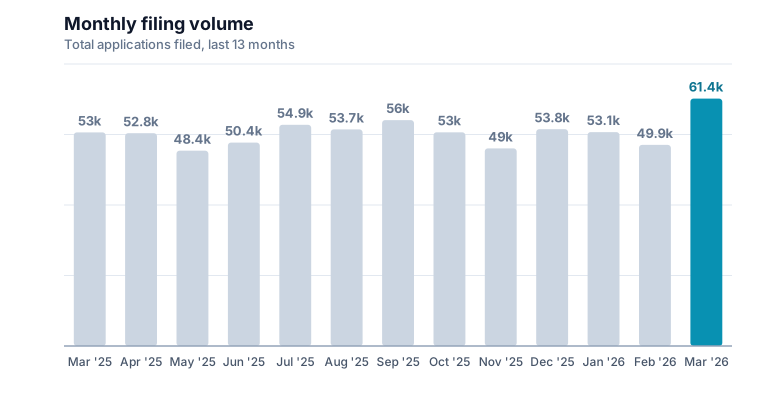
The 23% jump from February is the eye-catching number, but it is the least interesting one here. February was a soft month; bouncing off it proves little. The durable story is the level. At 61,352, March 2026 sits 5,170 applications below March 2021 and above every other March since 2016. A weak month does not finish second.
Every March, 2016–2026
| Year | March Filings |
|---|---|
| 2016 | 37,337 |
| 2017 | 41,256 |
| 2018 | 43,054 |
| 2019 | 44,278 |
| 2020 | 39,917 |
| 2021 | 66,522 |
| 2022 | 54,661 |
| 2023 | 52,566 |
| 2024 | 48,993 |
| 2025 | 52,969 |
| 2026 | 61,352 |
The 2021 peak was an anomaly — stimulus-era e-commerce formation flooding the register. Strip that out and March 2026 is the high-water mark of the normal era. Year over year, March rose 15.8% from 52,969.
| Year | Filings Through March |
|---|---|
| 2021 | 174,155 |
| 2022 | 145,606 |
| 2023 | 131,876 |
| 2024 | 140,795 |
| 2025 | 152,768 |
| 2026 | 164,299 |
The year-to-date line matters more than any single month. At 164,299 filings through March, 2026 leads 2025 by 7.5% and again trails only 2021. Three months in, this is shaping up as the busiest non-bubble year the register has seen.
NICE Class Leaderboard
| Rank | NICE Class | Description | Filings | MoM | YoY |
|---|---|---|---|---|---|
| 1 | 41 | Education; training; entertainment; sporting and cultural activities | 8,537 | 18.2% | 45.1% |
| 2 | 9 | Scientific, electronic, and digital goods, including downloadable software | 7,698 | 22.1% | 17.8% |
| 3 | 42 | Scientific and technological services; software design and development | 7,684 | 27.4% | 82% |
| 4 | 35 | Advertising, business management, retail, and online marketplace services | 6,998 | 19.1% | 21.7% |
| 5 | 25 | Clothing, footwear, and headwear | 6,479 | 22.4% | 17.5% |
| 6 | 3 | Cosmetics, toiletries, cleaning preparations, and perfumery | 3,255 | 27.9% | 24% |
| 7 | 5 | Pharmaceuticals, supplements, and medical preparations | 3,120 | 20.1% | 17.5% |
| 8 | 28 | Toys, games, sporting goods, and playthings | 2,729 | 21.1% | 1.3% |
| 9 | 16 | Paper goods, printed matter, stationery, and office supplies | 2,529 | 33.2% | 16.5% |
| 10 | 36 | Insurance, financial affairs, monetary affairs, and real estate services | 2,492 | 17.9% | 20.2% |
| 11 | 21 | Household, kitchen, glassware, and cleaning articles | 2,407 | 32% | -11.6% |
| 12 | 44 | Medical, beauty, veterinary, agricultural, and hygienic services | 2,149 | 19.5% | 32.1% |
| 13 | 30 | Staple foods, coffee, tea, bakery goods, and confectionery | 1,828 | 8.9% | 16.7% |
| 14 | 20 | Furniture, mirrors, picture frames, and non-metal containers | 1,758 | 28.9% | -10.7% |
| 15 | 43 | Restaurant, bar, catering, and temporary accommodation services | 1,712 | 19.3% | 20.4% |
Class 41 led by volume, and its 45.1% year-over-year surge tracks the steady migration of creator, media, live-event, and education brands onto the register. But Class 42 is the tell. A top-three class does not grow 82% on noise. That is AI, SaaS, and technical-services formation showing up as brand demand — and it means clearance work for software names is about to get more crowded, not less.
Two classes shrank against an otherwise rising tide: household goods (Class 21) and furniture (Class 20), both down double digits year over year despite broad month-over-month gains. The physical-goods long tail is cooling even as software runs hot.
Top Filing Owners
| Owner | Filings | Prior Month | MoM |
|---|---|---|---|
| OPENEVIDENCE INC. | 40 | 20 | 100% |
| Shiming Jiang | 36 | 0 | — |
| JUN, JIANG | 35 | 0 | — |
| Sport Fishing Championship Ltd. | 34 | 9 | 277.8% |
| Rise River Asset Co., LTD. | 31 | 0 | — |
| Korea Zinc Co., Ltd. | 30 | 2 | 1400% |
| BRISTOL-MYERS SQUIBB COMPANY | 28 | 20 | 40% |
| IGT | 28 | 19 | 47.4% |
| GLAXO GROUP LIMITED | 27 | 0 | — |
| LIGHT & WONDER, INC. | 26 | 28 | -7.1% |
| Source Foundry Inc. | 24 | 0 | — |
| Knyt Inc. | 24 | 0 | — |
OpenEvidence doubled its filings to 40 and topped the board — fitting for a healthcare-AI company in a category where naming activity tends to run ahead of the market narrative. Below it, the table is the usual mix: recognizable pharma (Bristol-Myers Squibb, Glaxo) and gaming portfolios (IGT, Light & Wonder) interleaved with holding companies and repeat-filing programs that arrive in batches. The better question these tables answer is not who "won" March but which established industries are still paying to reserve names — and pharma and gaming clearly are.
Top Correspondent Firms
| Firm | Filings | Prior Month | MoM |
|---|---|---|---|
| LZ Legal Services, LLC | 1,001 | 837 | 19.6% |
| Swyft Legal LLC | 949 | 943 | 0.6% |
| Overseas Operation Services, Inc. DBA Flatfee Corp. | 603 | 636 | -5.2% |
| Grogan, Tuccillo & Vanderleedeen, LLP | 343 | 251 | 36.7% |
| Sparring Legal LLP | 271 | 236 | 14.8% |
| MEDIA LAW GROUP | 256 | 259 | -1.2% |
| One Juris PC | 249 | 173 | 43.9% |
| Usa | 248 | 130 | 90.8% |
| Kearston Grace Everitt | 247 | 179 | 38% |
| Alioth Law P.C. | 246 | 231 | 6.5% |
| SOLORIO LEGAL PC | 233 | 116 | 100.9% |
| YK law(New Jersey) | 231 | 132 | 75% |
LZ Legal Services crossed 1,000 filings, with Swyft Legal close behind at 949 and essentially flat. The top of this board is a high-throughput filing business, not a traditional counseling practice — and several names jumped sharply month over month (SOLORIO LEGAL doubled; YK law up 75%), the signature of scaled operations onboarding seller cohorts. The register increasingly runs on this dual track: bespoke counsel at one end, volume filing shops at the other.1
Notable Filings
Disney: INFINITY VISION — filed before the reveal
Disney Enterprises filed INFINITY VISION, serial 99732764, on March 30. Disney then announced the brand publicly at CinemaCon on April 16–17, where it positioned the label as a competitor to IMAX and the spiritual successor to Lucasfilm's THX certification. The filing beat the announcement by more than two weeks — exactly the kind of timing gap that makes the register worth watching. To carry the Infinity Vision label, auditoriums must meet technical standards including the largest screens, laser projection, and premium audio formats. Whatever exhibitors ultimately make of it, March 30 is the date it first surfaced.
Apple: SNEAKY SASQUATCH
Apple filed SNEAKY SASQUATCH, serial 99724738, on March 25. This is portfolio reinforcement, not a mystery: Sneaky Sasquatch is a marquee Apple Arcade title, and Apple acquired its developer, RAC7, in May 2025 in its first acquisition of a video game developer. Owning the studio, Apple is now papering the IP — the kind of housekeeping that follows an acquisition rather than precedes a launch.
Coca-Cola: FRNX, CATRINA, HAYSTACKS, HOWLIE, and DRAYK
Coca-Cola filed five marks on March 26: FRNX (99725949), CATRINA (99725962), HAYSTACKS (99725969), HOWLIE (99725964), and DRAYK (99725945). We found no public product tied to any of them — FRNX and DRAYK read as coined names, the others as evocative placeholders. A beverage company filing five names in one day is buying creative optionality before the marketing calendar hardens. Watch the goods descriptions as they publish; that is where the intent leaks.
Amazon Technologies: PETRA
Amazon Technologies filed PETRA, serial 99729283, on March 27. PETRA is a common given name and the name of an existing music act, so a public-records search does not cleanly map it to an Amazon product. The brevity is the interesting part: one-word marks like this travel easily across hardware, software, and services, which is why Amazon files them. We have no evidence of a specific launch behind it.
Samsung: SILICONE RING MAGNET and 360 STAND MAGNET
Samsung Electronics filed SILICONE RING MAGNET, serial 99729844, and 360 STAND MAGNET, serial 99729835, on March 27. These are descriptive accessory names — "ring," "stand," "magnet" are function words, not house marks. The parallel naming and same-day filing point to a device-accessory line, likely in the magnetic-attachment category that has grown around modern phones.
Nike: AIR RIFT
Nike filed AIR RIFT, serial 99722241, on March 24. AIR RIFT is a heritage Nike footwear name; this reads as protection maintenance around an existing silhouette rather than a new launch.
TTAB Activity
| Type | Filings | Prior Month | MoM |
|---|---|---|---|
| Oppositions | 697 | 705 | -1.1% |
| Cancellations | 253 | 238 | 6.3% |
| Plaintiff | Proceedings Filed |
|---|---|
| 1661, INC. | 9 |
| APPLE, INC. | 6 |
| ALO, LLC | 6 |
| PUMA SE | 5 |
| DUKE UNIVERSITY | 5 |
| CATERPILLAR, INC. | 5 |
| ADIDAS AG | 5 |
| ADIDAS INTERNATIONAL MARKETING B.V. | 5 |
| POP MART (SINGAPORE) HOLDING PTE. LTD. | 5 |
| TAO, JIN | 5 |
Oppositions held flat while cancellations ticked up. The plaintiff table is where the story is. Leading it is 1661, Inc. — better known as GOAT, the online retailer of apparel and footwear products. That is no accident: GOAT has a long history of aggressive trademark enforcement, including a trademark and breach-of-contract battle it fought against the similarly named Goat Fashion, which began in December 2019 , and more recent litigation against a "Green Goat" apparel brand. A marketplace built on protecting a three-letter word polices that word relentlessly.
The rest is familiar perimeter defense: Apple's wide brand surface, the two Adidas entities plus Puma keeping sportswear enforcement hot, Duke's collegiate licensing, Caterpillar's brand reaching well past heavy equipment, and Pop Mart's collectibles portfolio — increasingly a target for, and source of, enforcement.
Registration Rates
| Cohort Month | Total Filed | Registered | Registration Rate |
|---|---|---|---|
| March 2025 | 52,969 | 23,067 | 43.5% |
| February 2025 | 38,348 | 14,651 | 38.2% |
| January 2025 | 61,451 | 31,448 | 51.2% |
| December 2024 | 53,459 | 26,210 | 49% |
| November 2024 | 47,795 | 22,895 | 47.9% |
| October 2024 | 52,967 | 26,167 | 49.4% |
| September 2024 | 51,308 | 23,184 | 45.2% |
| August 2024 | 50,411 | 16,219 | 32.2% |
| July 2024 | 50,715 | 18,534 | 36.5% |
| June 2024 | 46,732 | 18,825 | 40.3% |
| May 2024 | 51,570 | 25,544 | 49.5% |
| April 2024 | 51,609 | 25,430 | 49.3% |
Mature cohorts cluster in a broad 38–51% band. The March 2025 cohort sits at 43.5%; January 2025 leads at 51.2%; August 2024 remains the outlier floor at 32.2%. Nothing here breaks pattern — these are prosecution outcomes catching up with old filing classes, not a signal about March 2026's fresh, still-pending wave.
Practitioner Takeaways
- Treat March as confirmation, not a blip. Second-strongest March on record plus a 7.5% year-to-date lead is real demand, not a calendar artifact.
- Start software clearance earlier. Class 42's 82% year-over-year jump means crowded searches for AI, SaaS, and technical-services names.
- Mine same-day filing clusters. Coca-Cola's five-name March 26 batch and Disney's pre-announcement INFINITY VISION filing both show the register previewing strategy weeks ahead of the press release.
- Know your repeat TTAB players. GOAT, Apple, Adidas, and Pop Mart are filing oppositions at a clip; if you're naming into footwear, apparel, or collectibles, assume someone is watching.
Methodology: figures cover USPTO trademark applications by filing date, from GleanMark's mirror of the full USPTO dataset (~14M records). NICE class figures are class claims, not applications — one application can claim multiple classes, so the leaderboard describes the month's mix and does not re-sum to 61,352. Recent-month filings are ~99% pending — prosecution timing, not outcomes; registration rates use cohorts old enough to have matured. Firm totals cover filings mapped to a law firm (about 60% of the month). Informational, not legal advice.
Explore more USPTO data analysis on the GleanMark Insights blog.
More in this series
Previous: February 2026 · Next: April 2026 · Browse all filing reports
Footnotes
-
The "Usa" entry in the correspondent table is a malformed firm name in the source data, not a verified law-firm identity; we have left it as-is pending correction. ↩
Related Articles
Class 42 Filings Up 32% Year Over Year as September 2026 Tops September 2025
October 5, 2026
Amazon Filed a Trademark for DUCKLABS the Same Day It Announced Buying DuckLabs
September 5, 2026
July 2026 Trademark Filings Top Every July Since 2016
August 5, 2026