Trademark Examiners Cleared a Backlog in March: Non-Final Actions Jumped 57% to End Q1 2026
The most interesting number in the first quarter is not the 92,404 non-final office actions the USPTO issued — it's how lumpily they arrived.
 By Howard Katzenberg
Founder, GleanMark
Quarterly USPTO Prosecution Report | USPTO data through March 31, 2026
The most interesting number in the first quarter is not the 92,404 non-final office actions the USPTO issued — it's how lumpily they arrived. Examiners issued fewer non-final actions in February than in January, then put out 39,032 in March, a 56.8% jump in a single month. A quarter that looked sleepy at its midpoint finished with the heaviest examination month of the three. If you manage a docket, March did not feel like an average month, and the quarterly total hides that.
A quarter that dips in February and then issues four out of every ten of its non-final actions in March isn't steady-state examination — it's a pipeline catching up.
— Howard Katzenberg, Founder, GleanMark
We think the February-to-March swing most likely reflects examination capacity and queue timing rather than a surge in new applications reaching examiners — office-action output tends to move in batches as examiners clear assigned dockets, not in smooth monthly increments. That's a hypothesis, not a finding; the volume data alone can't separate staffing effects from filing-cohort timing.
Executive Summary
- March carried the quarter. Non-final actions ran 28,478 in January, dipped to 24,894 in February, then jumped to 39,032 in March — 42.2% of the quarter's non-final volume in one month.
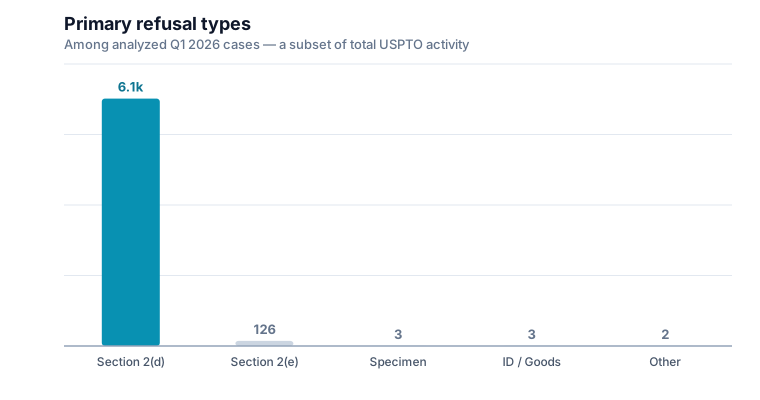
- Section 2(d) is essentially the whole refusal story. In our analyzed Q1 response subset, likelihood of confusion was the primary refusal in 6,143 of 6,277 responses — 97.9%. Everything else is a rounding error by comparison.
- Descriptiveness arguments punch above their weight. Section 2(e) refusal-type arguments posted the highest directional effectiveness score, 0.951, but on only 277 instances. Section 2(d) scored 0.814 across 4,421 instances — a lower score on a vastly larger base, which is the number that should actually shape your strategy.
- Specimen Support and Supplemental Register lead the argument-category table. Specimen Support scored 0.956 (55 instances); Supplemental Register scored 0.936 across 709 instances — the rare combination of a high score and a large sample.
- This is a subset, not the whole register. The refusal and argument analysis covers 6,659 analyzed office-action records and 6,277 analyzed responses against 92,404 total USPTO non-final actions. Read the percentages as describing the analyzed subset, not the entire USPTO docket.1
1. Prosecution Volume
| Period | Non-Final Actions | Final Actions | Non-Final and Final Actions | Non-Final MoM Change |
|---|---|---|---|---|
| January 2026 | 28,478 | 3,595 | 32,073 | — |
| February 2026 | 24,894 | 2,764 | 27,658 | -12.6% |
| March 2026 | 39,032 | 3,307 | 42,339 | +56.8% |
| Q1 2026 Total | 92,404 | 9,666 | 102,070 | — |
The headline is 92,404 non-final actions and 9,666 final actions — together 102,070 office-action documents. Across all recorded prosecution document types, the quarter generated 650,319 documents.
The shape matters more than the total. February's non-final output fell 12.6% from January; March then rose 56.8%. That isn't a gentle recovery — it's a batch. Final actions traced the same down-then-up path (3,595, then 2,764, then 3,307) but on a smaller scale, and March's final-action count never recovered to January's level. The non-final surge did all the work of lifting the quarter.
2. Office Action Document Types
| Document Code | Document Type | Documents in Q1 2026 |
|---|---|---|
| NFIN | Non-Final Action | 92,404 |
| XSS | XSearch Search Summary | 71,546 |
| NFO | Notice of Non-Final Office Action | 64,085 |
| AMC | Amendment and Mail Process Complete | 59,153 |
| ROA | Response to Office Action | 55,914 |
| ABN | Abandonment — Notice | 28,650 |
| PB3 | OG Publication Confirmation | 27,073 |
| PB1 | Notice of Publication | 26,399 |
| EB4 | Notification of Notice of Publication | 26,399 |
| PNR | Public Note | 24,792 |
| PST | TRAM Snapshot of App at Pub for Opposition | 24,773 |
| EDS | Notice of Design Search Code Emailed | 14,125 |
| ORC | Registration Certificate | 13,627 |
| ERO | Notice of Registration Email | 13,452 |
| SPE | Specimen | 11,269 |
| FREF | Final Action | 9,666 |
One trap in this table is worth flagging because people fall into it: NFIN (the action itself, 92,404) and NFO (the notice of that action, 64,085) are distinct document codes for related events. Adding them together double-counts. The headline office-action figure is 92,404, full stop. The long tail of XSearch summaries, publication confirmations, and registration emails is the administrative exhaust of examination, useful for reconciling counts but not a measure of legal activity.
3. Refusal Landscape
| Primary Refusal Type | Cases | Share of Analyzed Responses | Registered Cases |
|---|---|---|---|
| Section 2(d) — Likelihood of Confusion | 6,143 | 97.9% | 3,380 |
| Section 2(e) — Descriptiveness / Surname | 126 | 2.0% | 8 |
| Specimen Refusal | 3 | 0.05% | 2 |
| Identification of Goods/Services | 3 | 0.05% | 2 |
| Other | 2 | 0.03% | 0 |
| Refusal Type Appearing Anywhere in Analyzed Case | Cases with Tag | Registered Cases with Tag | Avg. Days to Registration |
|---|---|---|---|
| Section 2(d) — Likelihood of Confusion | 6,143 | 3,380 | 121 |
| Section 2(e) — Descriptiveness / Surname | 146 | 12 | 86 |
| Disclaimer Requirement | 46 | 7 | — |
| Identification of Goods/Services | 26 | 3 | — |
| Specimen Refusal | 15 | 3 | — |
| Other | 3 | 0 | — |
| Ornamental Refusal | 1 | 0 | — |
The primary-refusal view counts each response once, and on that basis there is exactly one story: Section 2(d) is the primary refusal 97.9% of the time. Descriptiveness and surname refusals are a distant second at 126 cases. Everything else is in the single digits.
The overlapping-tag view is where the nuance lives, and it's worth reading the two tables together rather than averaging them. Section 2(e) appears in 146 tagged cases versus 126 as a primary refusal — the gap is the set of cases where descriptiveness rode along as a secondary issue behind a 2(d) refusal. The tag table is your issue-spotting tool; the primary table is your share-of-response tool. They answer different questions, so don't merge them.
One number to sit with: Section 2(d) cases that registered did so in an average of 121 days, against 86 days for Section 2(e). Likelihood-of-confusion fights take longer to win, which tracks — they usually require argument and evidence rather than a curable amendment.
4. Argument Effectiveness
| Refusal Type | Directional Score (0–1) | Argument Instances | Verified-Win Instances |
|---|---|---|---|
| Section 2(e) — Descriptiveness / Surname | 0.951 | 277 | 16 |
| Identification of Goods/Services | 0.890 | 2 | 0 |
| Section 2(d) — Likelihood of Confusion | 0.814 | 4,421 | 1,443 |
| Specimen Refusal | 0.683 | 3 | 3 |
| Disclaimer Requirement | 0.950 | 1 | 1 |
| Other | 0.900 | 1 | 0 |
| Argument Category | Directional Score (0–1) | Outcome Multiplier | Argument Instances |
|---|---|---|---|
| Specimen Support | 0.956 | 1.189 | 55 |
| Design Distinctiveness | 0.940 | 1.200 | 4 |
| Supplemental Register | 0.936 | 1.161 | 709 |
| Disclaimer | 0.927 | 1.182 | 79 |
| Class Deletion | 0.903 | 1.102 | 313 |
| Consent Agreement | 0.903 | 1.48 | 113 |
| Suggestive Not Descriptive | 0.866 | 1.200 | 25 |
| Incongruity | 0.860 | 1.200 | 2 |
| Commercial Impression | 0.822 | 1.84 | 409 |
| Cited Mark Abandoned | 0.821 | 1.21 | 164 |
| Goods Amendment | 0.812 | 1.86 | 765 |
| Third Party Registrations | 0.785 | 1.32 | 244 |
| Weakness Of Cited Mark | 0.783 | 1.46 | 335 |
| Goods Coexistence | 0.766 | 1.32 | 450 |
| Market Channel Distinction | 0.763 | 1.21 | 219 |
The directional score is a 0–1 analytical measure, not a win rate and not a percentage. Treat it as a ranking signal, and always read it next to the instance count.
Here is the discipline the table demands. Section 2(e) tops the refusal-type list at 0.951 — but on 277 instances and 16 verified wins. Section 2(d) scores 0.814 on 4,421 instances and 1,443 verified wins. The higher score is the better headline; the lower score is the better evidence base, and it's the one that governs almost every refusal a practitioner will actually face this quarter.
In the argument-category table, the standout is Supplemental Register: a 0.936 score across 709 instances is the rare case where a high score and a deep sample coincide, which is exactly the combination you want before you bet a response on a tactic. Specimen Support edges it on score (0.956) but on 55 instances. Be skeptical of Design Distinctiveness (four instances) and Incongruity (two) no matter how good the number looks — a 0.94 on four cases tells you almost nothing.
Note the lane separation: Supplemental Register, Disclaimer, and Suggestive-Not-Descriptive arguments address descriptiveness and surname refusals. They do nothing for likelihood of confusion. For the 2(d) refusal that dominates this dataset, the relevant tools are consent agreements, cited-mark abandonment, goods amendments and coexistence, third-party registration evidence, weakness of the cited mark, and market-channel distinctions — most of which cluster in the 0.76–0.82 range. There is no high-scoring silver bullet for 2(d), which is itself the point.
Practitioner Takeaways
- Build for a back-loaded quarter. Output dipped in February and spiked in March. Quarterly totals smooth that over; your response deadlines won't.
- Assume Section 2(d) until proven otherwise. It's the primary refusal in 97.9% of analyzed responses. Front-load clearance and cited-registration review accordingly.
- Match the tool to the refusal, and don't cross lanes. Supplemental Register and disclaimer arguments cure descriptiveness, not confusion. Consent and coexistence belong to 2(d).
- Weigh the sample, not just the score. A 0.94 on four instances is noise; a 0.936 on 709 is a plan. Supplemental Register and Goods Amendment carry both score and depth.
- Budget time for 2(d). Confusion refusals that registered took 121 days on average versus 86 for descriptiveness — they are won with argument, not amendment.
Explore more USPTO data analysis on the GleanMark Insights blog.
Footnotes
-
Coverage and methodology, stated once: the refusal and argument analysis covers an analyzed subset of 6,659 office-action records and 6,277 responses, against 92,404 total USPTO non-final actions in the quarter. NICE class references describe classes within applications, not application counts. Share-of-response percentages describe the analyzed subset only and should not be read as total USPTO refusal rates. Data sourced from USPTO TSDR and public prosecution records, reflecting activity recorded through the report date. Informational only; not legal advice. ↩
Related Articles
Final Refusals Fell Every Month of Q2 Even as Examiners Issued More Non-Finals
July 5, 2026
The USPTO Issued More Trademark Office Actions in September 2025 Than in July and August Combined
June 4, 2026
The USPTO Kept Examining Through the Longest Shutdown in History — and Q4's Numbers Show It
June 4, 2026