Amazon Filed the 'Amazon Leo' Trademark the Day It Killed 'Project Kuiper'
When Amazon retired the Project Kuiper code name and rechristened its satellite-internet constellation Amazon Leo on November 12, it did something the press release didn't mention: the next day, it
 By Howard Katzenberg
Founder, GleanMark
Updated October 6, 2026
When Amazon retired the Project Kuiper code name and rechristened its satellite-internet constellation Amazon Leo on November 12, it did something the press release didn't mention: the next day, it went to the trademark office. AMAZON LEO (99494666) was filed November 13 — the rebrand and the filing are effectively the same event. Then, twelve days later, Amazon filed a bare LEO (99516140) on its own. The register caught the company building out a naming lane in real time.
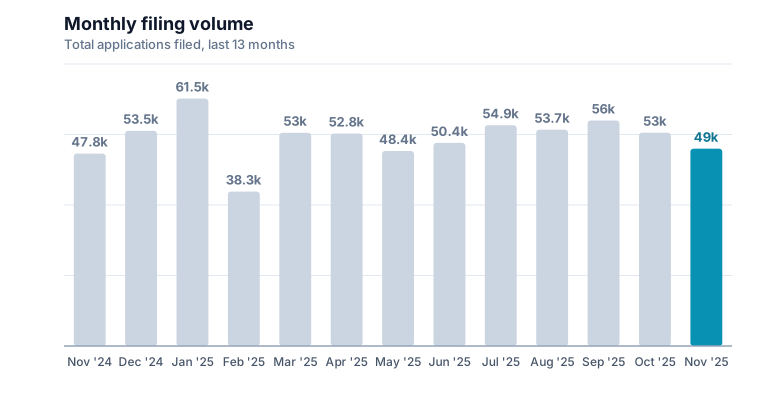
That is the kind of thing the trademark register is unusually good at showing, and November 2025 had more of it than most months. Total USPTO applications came in at 49,015 — down 7.5% from October, but the third-strongest November in a decade and up 2.6% from last November. The dip is noise. The composition is the story.
"The register is where corporate branding decisions become public before the marketing department is ready for you to notice. Amazon told the world its satellites had a new name and filed the paperwork the very next morning."
— Howard Katzenberg, Founder, GleanMark
What We Found
- Amazon's LEO filings track a live rebrand. AMAZON LEO was filed November 13, one day after the Project Kuiper → Amazon Leo announcement; a standalone LEO followed November 25.
- November punched above its weight. At 49,015 applications, it was the third-highest November in the 2016–2025 series, behind only 2020 and 2021.
- 2025 is outpacing 2024. Year-to-date filings reached 571,044 through November, up 5.0% and second only to 2021 among the years shown.
- Software-services led on growth. Class 42 filings rose 32.9% year over year — the steepest YoY move in the top five.
- McDonald's was the month's most active TTAB plaintiff, with 9 proceedings — consistent with its long-running, prefix-driven enforcement of the "Mc" family of marks.
Filing Volume
| Month | Total Filings | MoM Change |
|---|---|---|
| November 2025 | 49,015 | -7.5% |
| October 2025 | 52,991 | -5.4% |
| September 2025 | 56,026 | 4.3% |
| August 2025 | 53,722 | -2.1% |
| July 2025 | 54,850 | 8.7% |
| June 2025 | 50,447 | 4.1% |
| May 2025 | 48,440 | -8.2% |
| April 2025 | 52,785 | -0.3% |
| March 2025 | 52,969 | 38.1% |
| February 2025 | 38,348 | -37.6% |
| January 2025 | 61,451 | 14.9% |
| December 2024 | 53,459 | 11.9% |
| November 2024 | 47,795 | — |
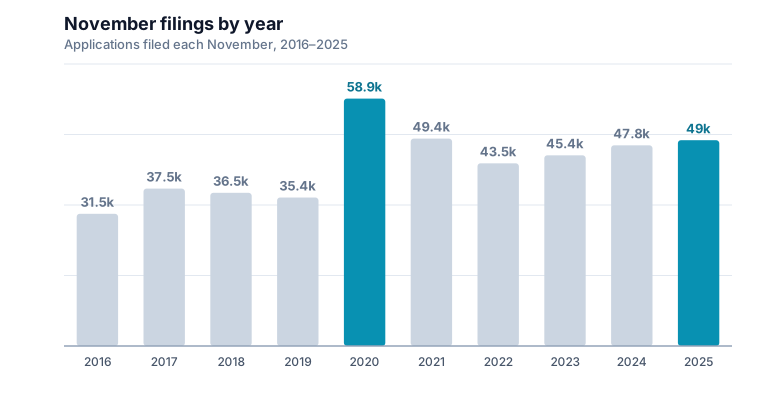
Yes, November fell 7.5% from October. A weak month does not finish third in a decade. Against its own history the month was strong: 49,015 applications trail only 2020's 58,910 and 2021's 49,398, and sit above every other November back to 2016.
The annual view is cleaner than the monthly one. Through November, 2025 reached 571,044 filings — up 5.0% from 543,902 in 2024, and the second-highest year-to-date total in the five years shown, behind 2021's post-pandemic spike. November itself rose 2.6% year over year.
Every November, 2016–2025
| Year | November Filings |
|---|---|
| 2016 | 31,480 |
| 2017 | 37,489 |
| 2018 | 36,491 |
| 2019 | 35,368 |
| 2020 | 58,910 |
| 2021 | 49,398 |
| 2022 | 43,519 |
| 2023 | 45,415 |
| 2024 | 47,795 |
| 2025 | 49,015 |
November 2025 ranks third among the Novembers shown, behind 2020 and 2021.
NICE Class Leaderboard
| Rank | NICE Class | Description | Filings | MoM | YoY |
|---|---|---|---|---|---|
| 1 | 9 | Electrical and scientific apparatus | 6,644 | -6.4% | 11.6% |
| 2 | 41 | Education and entertainment services | 6,466 | -9.6% | 27.3% |
| 3 | 35 | Advertising and business services | 5,642 | -14% | 7.8% |
| 4 | 42 | Scientific and technological services; software design | 5,059 | -12.9% | 32.9% |
| 5 | 25 | Clothing, footwear, and headwear | 5,033 | -10% | 0.7% |
| 6 | 3 | Cosmetics and cleaning preparations | 2,728 | -0.6% | 8.3% |
| 7 | 5 | Pharmaceuticals and medical preparations | 2,568 | -16.2% | 8.2% |
| 8 | 28 | Toys, games, and sporting goods | 2,235 | -9.3% | -10% |
| 9 | 16 | Paper goods and printed matter | 2,186 | -6.3% | 10.9% |
| 10 | 21 | Housewares and glassware | 2,160 | 1.8% | -11.8% |
| 11 | 36 | Insurance and financial services | 1,968 | -16.4% | 7.6% |
| 12 | 44 | Medical, beauty, and agricultural services | 1,679 | -11.5% | 8.7% |
| 13 | 20 | Furniture and related goods | 1,620 | 8% | -16.2% |
| 14 | 30 | Staple foods | 1,499 | -11.5% | 6.3% |
| 15 | 11 | Environmental control apparatus | 1,403 | 10.8% | -16.5% |
Class 9 and Class 41 still top the table by raw volume. But the number that should hold a practitioner's attention is Class 42, up 32.9% year over year — nearly triple Class 9's growth rate and the fastest mover in the top tier. Education and entertainment (Class 41, +27.3%) is the other standout.
We think the Class 42 surge most likely reflects the trademark mechanics of the AI build-out: companies naming models, developer tools, data products, and cloud platforms, often before those names surface through ordinary launch channels. That is a hypothesis, not a proven cause — but the concentration of growth in software-services rather than across the board is what you'd expect if it were true.
The soft spots are physical goods. Class 11, Class 20, Class 21, and Class 28 all fell year over year, even where they ticked up from October.
Top Filing Owners
| Owner | Filings | Prior Month | MoM |
|---|---|---|---|
| GANNETT VENTURES, LLC | 50 | 0 | — |
| WALMART APOLLO, LLC | 48 | 30 | 60% |
| Yuexiang Zeng | 45 | 0 | — |
| Zhiqu Li | 42 | 0 | — |
| FARM JOURNAL, INC. | 33 | 0 | — |
| VWWHP, LLC | 31 | 0 | — |
| Rise to Nutrition, LLC | 29 | 16 | 81.3% |
| JYP ENTERTAINMENT CORPORATION | 28 | 8 | 250% |
| L'OREAL (SOCIETE ANONYME) | 27 | 15 | 80% |
| Chelsea Corporate Events LLC | 25 | 0 | — |
| Abundantia Media LLC | 24 | 0 | — |
| DANA HERITAGE FINANZ ST. HONORE BEAUTY LLC | 23 | 0 | — |
The named corporates are the useful read. JYP Entertainment's jump from 8 to 28 filings is the one to watch — a 250% month-over-month spike that, for a K-pop label, usually signals a cluster of artist, tour, merchandise, or platform brands going onto the register at once. Walmart Apollo (+60%) and L'Oréal (+80%) also stepped up their pace.
Most of the rest is the batch-filing economy: single-month LLCs and individual applicants that appear from zero and will likely vanish again. It's real volume, but it reflects channel mechanics, not a strategic roadmap, so it tells you less.
Top Correspondent Firms
| Firm | Filings | Prior Month | MoM |
|---|---|---|---|
| Swyft Legal LLC | 1,105 | 1,250 | -11.6% |
| LZ Legal Services, LLC | 646 | 943 | -31.5% |
| Overseas Operation Services, Inc. DBA Flatfee Corp. | 626 | 488 | 28.3% |
| Alioth Law P.C. | 568 | 539 | 5.4% |
| All West Law Group, PLLC | 273 | 242 | 12.8% |
| Usa † | 237 | 245 | -3.3% |
| Sparring Legal LLP | 228 | 258 | -11.6% |
| Grogan, Tuccillo & Vanderleedeen, LLP | 210 | 203 | 3.4% |
| LegalForce RAPC Worldwide, P.C. | 193 | 232 | -16.8% |
| BAYRAMOGLU LAW OFFICES LLC | 184 | 151 | 21.9% |
| Law On Call, LLC | 175 | 213 | -17.8% |
| One Juris PC | 159 | 83 | 91.6% |
High-volume filing shops still own the top of this table. Swyft Legal led at 1,105 even after an 11.6% drop, and LZ Legal Services fell harder, down 31.5% to 646. The countertrend belongs to Flatfee Corp. (+28.3%), Bayramoglu (+21.9%), and One Juris, which nearly doubled from 83 to 159. Grogan, Tuccillo & Vanderleedeen is the rare traditional-firm name in a list otherwise built on volume intake.
Notable Filings
A theme runs through the month's corporate filings: companies registering the house mark and the short form of the same brand, days apart.
Amazon: AMAZON LEO, LEO, AMAZON CONNECT, AWS EDUCATE
| Mark | Serial Number | Filing Date | Status |
|---|---|---|---|
| AMAZON LEO | 99494666 | November 13, 2025 | Pending |
| AWS EDUCATE | 99510748 | November 21, 2025 | Pending |
| LEO | 99516140 | November 25, 2025 | Pending |
| AMAZON CONNECT | 99517611 | November 26, 2025 | Pending |
The LEO pair is the cleanest case of the month. Amazon announced the Project Kuiper rebrand to Amazon Leo on November 12; AMAZON LEO was filed November 13, and the unadorned LEO followed on November 25. The name is a nod to the low-Earth-orbit constellation, and the two-filing sequence — branded mark first, short form after — is exactly the protective pattern you'd expect around a freshly named flagship. AMAZON CONNECT and AWS EDUCATE are existing Amazon cloud and education brands; their filings read as routine portfolio maintenance, not new product signals.
Google: GOOGLE TPU and IRONWOOD
| Mark | Serial Number | Filing Date | Status |
|---|---|---|---|
| GOOGLE TPU | 99509904 | November 21, 2025 | Pending |
| IRONWOOD | 99509911 | November 21, 2025 | Pending |
This pair is a registration catch-up, not a leak. Ironwood is Google's seventh-generation Tensor Processing Unit, unveiled at Cloud Next in April 2025 and moved to general availability in November — so the November 21 filings landed alongside the chip's commercial launch, not ahead of it. Useful as confirmation that Google is locking down the Ironwood and TPU word marks now that the product is selling externally; not a preview of anything unannounced.
Samsung: BESPOKE AI LAUNDRY DUO, AI FOOD MANAGER, and more
| Mark | Serial Number | Filing Date | Status |
|---|---|---|---|
| MUSIC STUDIO | 99500743 | November 17, 2025 | Pending |
| SHEALTH RESEARCH | 99500585 | November 17, 2025 | Pending |
| MUSIC DISC | 99500747 | November 17, 2025 | Pending |
| AI FOOD MANAGER | 99514054 | November 24, 2025 | Pending |
| BESPOKE AI LAUNDRY DUO | 99517975 | November 26, 2025 | Pending |
Samsung's filings map its AI-appliance strategy almost literally — laundry, food, health, audio. BESPOKE AI LAUNDRY DUO sits squarely within the Bespoke AI appliance line Samsung has been expanding (a related 2026 Bespoke AI Laundry Combo was unveiled at CES); the "Duo" filing suggests a distinct SKU or variant within that family rather than a wholly new brand. AI FOOD MANAGER points at connected-kitchen software. SHEALTH RESEARCH, filed by Samsung Research America, sits closest to the Samsung Health data and research stack.
Apple: PREVIEW 10X
| Mark | Serial Number | Filing Date | Status |
|---|---|---|---|
| PREVIEW 10X | 99510270 | November 21, 2025 | Pending |
"Preview" is established Apple software vocabulary, and "10X" reads as a version or performance descriptor rather than a house mark. We could not match PREVIEW 10X to any publicly announced Apple product as of filing; on the name alone it looks like feature- or software-experience branding. Worth tracking as the goods-and-services description and any subsequent filings clarify intent.
Nike: NIKE MIND
| Mark | Serial Number | Filing Date | Status |
|---|---|---|---|
| NIKE MIND | 99505727 | November 19, 2025 | Pending |
NIKE MIND points at the non-footwear edge of sports branding — training, mental performance, coaching, and digital wellness. We did not find a publicly announced product under this name at filing; the phrase is broad enough to stretch across apps, content, and athlete-development programs.
TTAB Activity
| Type | Filings | Prior Month | MoM |
|---|---|---|---|
| Oppositions | 604 | 734 | -17.7% |
| Cancellations | 224 | 274 | -18.2% |
TTAB volume cooled across the board — oppositions down 17.7%, cancellations down 18.2%. The plaintiff list is the more interesting read. McDonald's topped it with 9 proceedings, which fits its well-documented habit of policing the "Mc" prefix aggressively across categories, including against marks with no food connection. Chanel and the two Hugo Boss entities reflect fashion's standing fight against look-alikes, and Jellycat's filings point to imitation pressure in the fast-scaling plush-and-collectibles market.
Registration Rates
| Cohort Month | Total Filed | Registered | Registration Rate |
|---|---|---|---|
| November 2024 | 47,795 | 22,895 | 47.9% |
| October 2024 | 52,967 | 26,167 | 49.4% |
| September 2024 | 51,308 | 23,184 | 45.2% |
| August 2024 | 50,411 | 16,219 | 32.2% |
| July 2024 | 50,715 | 18,534 | 36.5% |
| June 2024 | 46,732 | 18,825 | 40.3% |
| May 2024 | 51,570 | 25,544 | 49.5% |
| April 2024 | 51,609 | 25,430 | 49.3% |
| March 2024 | 48,993 | 25,018 | 51.1% |
| February 2024 | 43,788 | 21,610 | 49.4% |
| January 2024 | 48,014 | 25,921 | 54% |
| December 2023 | 44,949 | 24,743 | 55% |
Mature cohorts cluster in the high-40s to mid-50s, with July and August 2024 lagging at this snapshot as those filings continue to clear prosecution. Read this as cohort-maturity context, not a verdict on November 2025's filings, which are still almost entirely pending.
Practitioner Takeaways
- Class 42 is the month's real signal. Total volume was only modestly higher year over year; software-service filings rose 32.9%. That's where the energy is.
- Don't over-read the October-to-November dip. It was still the third-strongest November in a decade.
- Watch house-mark-plus-short-form pairs. Amazon's AMAZON LEO and LEO, filed twelve days apart around the Kuiper rebrand, show how large companies reserve both the branded and bare versions of a name.
- TTAB is quieter, but enforcement is still brand-driven. McDonald's, Amazon, Chanel, Apple, Hugo Boss, and Jellycat dominated the challenger list.
† "Usa" reflects a malformed correspondent-name record in the source data, not a law firm called Usa; figures are reported as recorded pending cleanup. ‡ Jellycat appears in the source data under two near-identical owner records ("Jellycat, Ltd." and "Jellycat Limited"), each credited with 5 proceedings; they map to the same entity, so the combined total may be as high as 10. Treat the count as approximate pending de-duplication.
Methodology: figures cover USPTO trademark applications by filing date, from GleanMark's mirror of the full USPTO dataset (~14M records). NICE class figures are class counts, not application counts — a single application can span multiple classes — so class growth and total-application growth are not directly comparable. Recent-month filings are ~99% pending, reflecting prosecution timing rather than outcomes; registration rates use cohorts old enough to have matured. Firm totals cover filings mapped to a law firm (about 61% of the month). Informational, not legal advice.
Explore more USPTO data analysis on the GleanMark Insights blog.
More in this series
Previous: October 2025 · Next: December 2025 · Browse all filing reports
Related Articles
Class 42 Filings Up 32% Year Over Year as September 2026 Tops September 2025
October 5, 2026
Amazon Filed a Trademark for DUCKLABS the Same Day It Announced Buying DuckLabs
September 5, 2026
July 2026 Trademark Filings Top Every July Since 2016
August 5, 2026