TTAB in Q3 2025: 87% of Sustained Oppositions Were Never Answered
TTAB filings rose 2.4% to 6,718 in Q3 2025, driven by extensions of time to oppose. Of the 1,231 oppositions the Board sustained during the quarter, 1,065 (87%) never had an answer filed.
 By Howard Katzenberg
Founder, GleanMark
Updated October 7, 2026
Quarterly TTAB Report | USPTO TTAB data through September 30, 2025
Most oppositions the Trademark Trial and Appeal Board sustained in Q3 2025 were never contested. The Board posted 1,244 sustained opposition decision entries during the quarter against 774 dismissals or denials, but 1,227 of the sustained entries were judgments entered without a trial decision, most often by default. Of the 1,231 oppositions with a sustained entry, 1,065 (87%) never had an answer filed. Cancellations followed the same pattern: 397 of the 445 cancellations granted (89%) never had an answer. Decisions after trial or on summary judgment were rare: 23 in oppositions (15 sustained, 7 dismissed, 1 split) and 18 in cancellations (7 granted, 11 denied).
Among the 15 major brands this report screens, Amazon Technologies, Inc. was the most active filer, with 16 oppositions, 1 cancellation petition and 13 extensions of time to oppose. Amazon, Apple, Nike and Google together filed 82 oppositions, cancellation petitions and extensions during the quarter; 16 of them came in the last eight days, September 23 to 30, including 6 oppositions on September 29 and 30.
Total filings rose 2.4% to 6,718. Extensions of time to oppose rose by 268, more than the entire increase of 155, while oppositions and ex parte appeals both fell.
1. Filing Volume
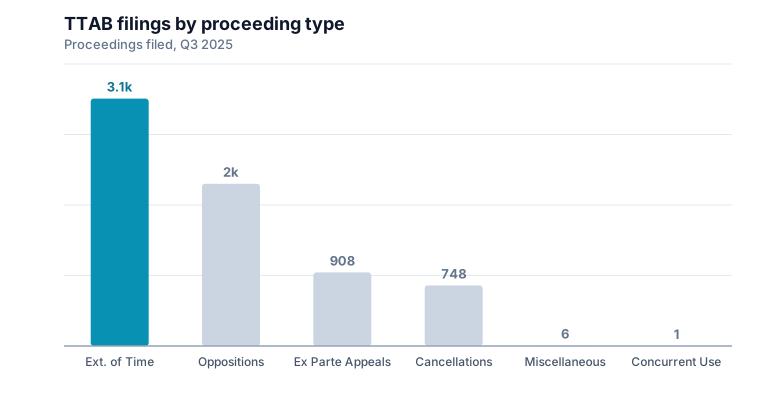
| Proceeding Type | Type Code | Current Quarter Filings | Prior Quarter Filings | QoQ Change |
|---|---|---|---|---|
| Extensions of Time to Oppose | EXT | 3,053 | 2,785 | +268 |
| Oppositions | OPP | 2,002 | 2,047 | -45 |
| Ex Parte Appeal | EXA | 908 | 998 | -90 |
| Cancellations | CAN | 748 | 727 | +21 |
| Miscellaneous | MIS | 6 | 2 | +4 |
| Concurrent Use | CNU | 1 | 4 | -3 |
| Quarter Total | All Types | 6,718 | 6,563 | +155 (+2.4%) |
The 2.4% rise is real but lopsided. Extensions of time to oppose added 268 filings and supplied more than the entire quarterly increase by themselves; without them, the docket would have shrunk. Oppositions slipped, ex parte appeals fell harder, and only cancellations nudged up among the contested categories.
An extension of time to oppose is not a dispute. It gives a potential opposer more time to decide whether to oppose a published application. About half lead to one: as of October 6, 2026, 1,492 of the 3,053 extensions filed in Q3 2025 (48.9%) had been followed by an opposition against the same application, compared with 1,284 of the 2,785 filed in Q2 2025 (46.1%).
2. Outcomes by Proceeding Type
| Proceeding Type | Type Code | Proceedings with Decisions | Decision Entries | Sustained | Granted | Dismissed or Denied | Affirmed | Reversed | Moot | Reconsideration | Other Procedural Rulings |
|---|---|---|---|---|---|---|---|---|---|---|---|
| Oppositions | OPP | 2,026 | 2,059 | 1,244 | 0 | 774 | 0 | 0 | 2 | 2 | 40 |
| Ex Parte Appeal | EXA | 769 | 836 | 0 | 0 | 254 | 67 | 3 | 26 | 355 | 157 |
| Cancellations | CAN | 759 | 767 | 0 | 447 | 289 | 0 | 0 | 5 | 1 | 30 |
| Concurrent Use | CNU | 6 | 6 | 0 | 0 | 0 | 0 | 0 | 1 | 0 | 5 |
| Extensions of Time to Oppose | EXT | 1 | 1 | 0 | 0 | 0 | 0 | 0 | 0 | 1 | 0 |
Moot dismissals are also counted under Dismissed or Denied, and one split opposition decision appears under both Sustained and Dismissed or Denied, so a row's categories can add up to more than its entry total. Ex parte Affirmed and Reversed count Board decisions only; court rulings on appeals from the Board are counted under Other.
Of 2,059 opposition decision entries, 1,244 were sustained and 774 were dismissed or denied, but few of either were rulings on the merits. Of the sustained entries, 1,227 were judgments the Board entered without a trial decision, most often by default. Of the dismissals, 694 were dismissals with or without prejudice, and only 7 were final decisions after trial or briefing. Cancellations followed the same pattern: 440 of the 447 grants were entered without a trial decision, and 260 of the 289 dismissals or denials were dismissals with or without prejudice.
Ex parte appeals are reported separately because the applicant is appealing an examining attorney's refusal, not facing another party. The Board affirmed the refusal in 67 decisions and reversed it in 3, and 4 more decisions are docketed as "FINAL DECISION: DISCLAIMER ACCEPTED." Another 193 appeals were dismissed because no appeal brief was filed. The 355 reconsideration entries, nearly all of them examining attorneys denying a request for reconsideration, and the 157 other entries are not Board rulings on the merits.1
3. Terminations
| Proceeding Type | Type Code | Proceedings Terminated | Terminated with Decision | Terminated with No Decision |
|---|---|---|---|---|
| Extensions of Time to Oppose | EXT | 2,966 | 0 | 2,966 |
| Oppositions | OPP | 1,960 | 1,927 | 33 |
| Ex Parte Appeal | EXA | 933 | 224 | 709 |
| Cancellations | CAN | 586 | 389 | 197 |
| Concurrent Use | CNU | 5 | 5 | 0 |
| Miscellaneous | MIS | 4 | 0 | 4 |
Of the 1,960 oppositions terminated in the quarter, 1,927 had a decision entry posted during the quarter, but few of the terminated oppositions were contested: as measured on October 7, 2026, 933 ended in a default judgment and 30 were contested through trial, briefing or summary judgment. The other 33 had their decision entered before July 1, and so did all 197 cancellations listed as terminated with no decision. Every extension of time to oppose terminated without a decision entry, 2,966 of 2,966. Of the 933 terminated ex parte appeals, 709 had no decision entry during the quarter: 237 of them had one before July 1, and the other 472 had none at all. For 439 of those 472, the docket goes from "Pending, Instituted" to "Terminated" without recording why.
So the sustained and dismissed counts mostly reflect defaults, withdrawals and abandoned applications, not trial outcomes. Few disputes reached a merits ruling: as measured on October 6, 2026, 30 of the oppositions and 15 of the cancellations that ended in the quarter were contested through trial, briefing or summary judgment.
4. High-Profile Proceedings
| Filing Date | Brand / Owner | Proceeding | Proceeding Type | Status |
|---|---|---|---|---|
| 2025-09-30 | Amazon Technologies, Inc. | 91302068 | Oppositions | Terminated |
| 2025-09-29 | Apple Inc. | 91302017 | Oppositions | Terminated |
| 2025-09-30 | Nike, Inc. | 91302053 | Oppositions | Terminated |
| 2025-09-30 | Google LLC | 99055823 | Extensions of Time to Oppose | Terminated |
The table shows one of the last filings of the quarter by each of four brands this report screens.
Amazon (Amazon Technologies, Inc.) filed 16 oppositions, 1 cancellation petition and 13 extensions of time to oppose in Q3 2025, with 8 of the oppositions in August and 8 in September. Its last five oppositions were 91301926 on September 24, 91301999 and 91302001 on September 26, and 91302068 and 91302069 on September 30, both against Shenzhen Nuling Electronic Technology Co., Ltd. It also filed extension 98811581 on September 26.
Apple filed three oppositions on September 29, 91302017, 91302037 and 91302035, each against a different individual applicant. Over the quarter, Apple Inc. filed 9 oppositions, 1 cancellation petition and 11 extensions of time to oppose.
Nike filed oppositions on September 30 (91302053) and September 25 (91301967), and an extension of time to oppose on September 24 (99022621). Over the quarter, Nike, Inc. filed 9 oppositions and 10 extensions.
Google filed extension of time to oppose 99055823 on September 30. Google LLC's 5 oppositions in the quarter were filed in July (3) and August (2), and it filed 7 extensions over the quarter. In extension 99081886, filed September 24, Google was the applicant: Auvik Networks Inc. requested more time to oppose a Google application.
None of the ten oppositions named in this section was answered, and all ten ended between January and February 2026 with the opposition sustained.
5. Notable Decisions
| Decision Date | Proceeding | Plaintiff v. Defendant | Decision | How It Ended |
|---|---|---|---|---|
| 2025-09-30 | 91271261 | OMS Investments, Inc. v. Urban-Gro, Inc. | Dismissed with prejudice | Opposer withdrew the opposition |
| 2025-09-30 | 91288187 | Gospel Music Workshop Of America, Inc. v. LaShone Cleveland | Sustained | Applicant did not respond to an order to show cause |
| 2025-09-30 | 91289395 | Marie Junie St. Clair Bernard v. Daphnee Lagredelle | Opposition dismissed | Final decision after briefing (not precedential) |
| 2025-09-30 | 91289620 | Kenneth JP Hartzer v. Willis Humphrey | Sustained on summary judgment | Summary judgment on nonuse (not precedential) |
| 2025-09-30 | 91291971 | Selective Marketplace Limited v. Irie Poetry Shop Ltd Co | Sustained | Opposer's motion for discovery sanctions granted as conceded |
| 2025-09-30 | 91294100 | Dreamwell, Ltd. v. Beauty Pie Limited | Dismissed with prejudice | Applicant narrowed its goods with the opposer's consent; opposer withdrew |
| 2025-09-30 | 91295625 | The Board of Regents of the University of Texas System v. Neptune Operations Ltd. | Sustained (Class 10 only) | Applicant deleted the opposed class without the opposer's consent |
| 2025-09-30 | 91295923 | Prive Properties LLC dba Prive Vineyard v. Campbell-Wright Investments, Inc. | Sustained | Default judgment |
| 2025-09-30 | 91297027 | Jeffrey M. Archipley v. Bear Cloud Coffee LLC | Sustained | Default judgment |
| 2025-09-30 | 91297557 | Taylor Fresh Foods, Inc. v. Oppenheimer Pty Ltd | Sustained | Applicant abandoned its application without the opposer's consent |
All ten decisions above were entered on September 30, the last day of the quarter. Two were rulings on the merits, and neither is precedential. In 91289395, the Board dismissed Marie Junie St. Clair Bernard's opposition to the FABTAH application because the opposer did not prove entitlement to bring her claims. In 91289620, Kenneth JP Hartzer won summary judgment against the SHAMELESS NAMELESS application on his nonuse claim. The other eight ended without a merits ruling: two by default, one after the applicant did not respond to an order to show cause, one as a discovery sanction, two after the applicant abandoned all or part of its application, one after the opposer withdrew, and one after a settlement in which the applicant narrowed its goods.
In 91295625, the Board of Regents of the University of Texas System opposed the Class 10 portion of two Neptune Operations Ltd. applications, citing its MD ANDERSON mark. On September 25, Neptune deleted Class 10 from both applications without the opposer's written consent, so under Trademark Rule 2.135 the Board entered judgment against it for that class. The applications continue in their other classes.
Several of these proceedings were filed years before they ended; OMS Investments filed its opposition in August 2021. Quarterly outcome counts track decision dates, not filing dates.
Key Numbers
-
Most sustained oppositions were never contested. Of the 1,231 oppositions with a sustained decision entry in Q3 2025, 1,065 (87%) never had an answer filed. Of the 445 cancellations granted, 397 (89%) never had an answer.
-
Few cases reached a merits decision. The Board issued 23 final decisions in oppositions after trial or on summary judgment (15 sustained, 7 dismissed, 1 split) and 18 in cancellations (7 granted, 11 denied).
-
The Board rarely reversed a refusal. Board decisions in ex parte appeals affirmed the refusal 67 times and reversed it 3 times; another 193 appeals were dismissed because no appeal brief was filed.
-
Extensions drove the filing increase. Extensions of time to oppose rose by 268 to 3,053, more than the total increase of 155, while oppositions fell by 45 and ex parte appeals by 90.
-
Decision dates are not filing dates. One September 30 decision, 91271261, closed an opposition filed in August 2021. Quarterly outcome counts measure when the Board ruled.
Data sourced from USPTO TTAB records and public filings. This report is informational and does not constitute legal advice.
Explore more USPTO data analysis on the GleanMark Insights blog.
Footnotes
-
Two measures appear throughout this report. "Proceedings with Decisions" counts distinct proceedings that received at least one decision entry during the quarter; "Decision Entries" counts the decision records themselves, and a single proceeding can generate more than one. All outcome-category figures (sustained, granted, dismissed/denied, affirmed, reversed, etc.) are decision-entry counts. Figures reflect proceedings as recorded through the report date and will change as cases progress. ↩
Related Articles
TTAB in Q3 2026: Contested Filings Rise 3.9% While Defaults End 55% of Oppositions
October 5, 2026
How a Name Becomes Unownable: OSHO and the Anatomy of a Generic Trademark
September 22, 2026
Board dismisses Inmode challenge to Empower Aesthetics design application
October 22, 2026