TTAB Q4 2025: About Half of Terminated Oppositions and Cancellations Were Defaults
Of the 2,399 oppositions and cancellations that ended at the TTAB in Q4 2025, 1,187 (49.5%) ended in default because the defendant never answered. Only 41 (1.7%) went through trial, briefing, or summary judgment.
 By Howard Katzenberg
Founder, GleanMark
Updated October 7, 2026
Of the 2,399 oppositions and cancellations that ended at the Trademark Trial and Appeal Board in Q4 2025, 1,187 (49.5%) ended in default judgment because the defendant never filed an answer. Another 873 (36.4%) ended in a withdrawal, a surrendered registration, or after a suspension for settlement talks. Only 41 (1.7%) went through testimony, briefing, a hearing, or summary judgment.
The quarter's decision counts reflect this. Of 1,587 opposition decision entries, 978 were "sustained", but 844 of those 978 entries came in cases where the applicant never filed an answer. Total TTAB filings rose 6.7% to 7,168; oppositions and cancellations together rose 3.6% to 2,849.
Executive Summary
- Most "sustained" oppositions were defaults. Sustained entries made up 978 of the 1,587 opposition decision entries, but 834 of the 969 oppositions sustained during the quarter (86.1%) never had an answer filed. The Board issued 16 final merits decisions in oppositions, after trial or on summary judgment.
- Extensions do not produce rulings, but about half lead to an opposition. Of the 3,085 extensions of time to oppose that ended in Q4, 3,084 closed without a decision entry. Of the 3,339 extensions filed in Q4, 1,658 (49.7%) had been followed by an opposition against the same application as of October 6, 2026.
- Filings rose 6.7%, led by the front of the pipeline. Q4 logged 7,168 filings versus 6,718 in Q3 (+450), with extensions and oppositions driving the increase.
- Cancellation grants were mostly defaults too. Of the 355 cancellations granted during the quarter, 306 (86.2%) never had an answer filed. The Board issued 18 final merits decisions in cancellations: 8 granted, 1 granted in part, and 9 denied.
- Many ex parte appeals ended without a brief. The Board dismissed 181 ex parte appeals in Q4 because the applicant did not file an appeal brief: 82 in October, 49 in November and 50 in December, including 13 on December 31.
A note on units: proceedings with a decision count cases, while decision entries count docket entries in the Board's Decisions category. A single proceeding can have more than one entry, and some entries are interim steps, such as an examining attorney denying a request for reconsideration.
1. Filing Volume
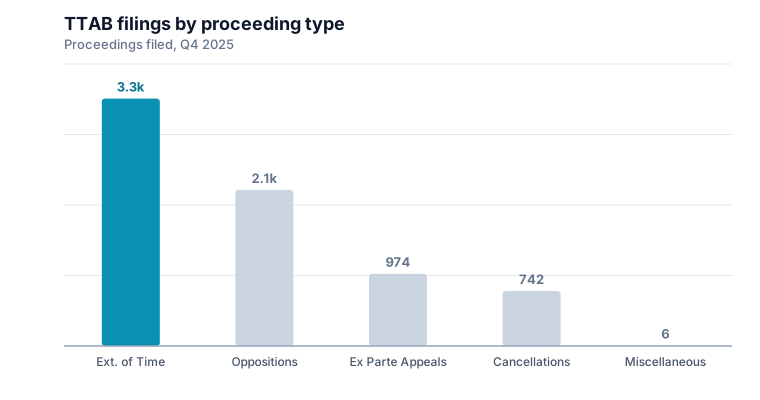
| Proceeding Type | Q4 2025 Filings | Q3 2025 Filings | QoQ Count Change |
|---|---|---|---|
| Extensions of Time to Oppose | 3,339 | 3,053 | +286 |
| Oppositions | 2,107 | 2,002 | +105 |
| Ex Parte Appeal | 974 | 908 | +66 |
| Cancellations | 742 | 748 | -6 |
| Miscellaneous | 6 | 6 | 0 |
| Concurrent Use | 0 | 1 | -1 |
| Total | 7,168 | 6,718 | +450 (6.7% increase) |
Most of the growth came from extensions and oppositions. Extensions added 286 filings, oppositions 105 and ex parte appeals 66, while cancellations fell by six and concurrent use by one, for a net gain of 450. Oppositions and cancellations together, the quarter's contested filings, rose from 2,750 to 2,849 (+99, +3.6%).
The shape of the docket did not change; it just got busier. Extensions still lead by a wide margin, oppositions still sit second, and ex parte appeals — applicants fighting USPTO refusals rather than private parties — held their roughly one-in-seven share of new filings.
2. Outcomes by Proceeding Type
| Proceeding Type | Proceedings With Any Decision | Decision Entries | Sustained | Granted | Affirmed | Reversed | Dismissed or Denied | Moot | Reconsideration | Other |
|---|---|---|---|---|---|---|---|---|---|---|
| Oppositions | 1,571 | 1,587 | 978 | 0 | 0 | 0 | 578 | 4 | 3 | 29 |
| Ex Parte Appeal | 700 | 734 | 0 | 0 | 55 | 6 | 242 | 32 | 291 | 140 |
| Cancellations | 638 | 646 | 0 | 355 | 0 | 0 | 269 | 4 | 2 | 20 |
| Extensions of Time to Oppose | 2 | 3 | 0 | 0 | 0 | 0 | 0 | 0 | 3 | 0 |
Moot dismissals (4, 32 and 4) are also counted under Dismissed or Denied, and one partial opposition decision appears under both Sustained and Dismissed, so a row's categories can add up to more than its entry total. The ex parte Affirmed count includes one court decision; the Board affirmed 54.
Oppositions had the most decision entries: 1,587 in 1,571 proceedings. Sustained entries outnumbered dismissals and denials 978 to 578, but most sustained entries did not follow a contest. 967 of the 978 read "BOARD'S DECISION: SUSTAINED", the entry the Board posts when it enters judgment without a final merits decision. In this quarter, 731 of the 958 cases with that entry were defaults and 131 followed the applicant abandoning the application. Overall, 844 of the 978 sustained entries came in cases where the applicant never filed an answer. Ten were final decisions after trial, including one sustained in part.
Cancellations logged 646 decision entries in 638 proceedings: 355 grants against 269 dismissals or denials. As with oppositions, most grants were defaults: 306 of the 355 cancellations granted during the quarter never had an answer filed. The Board issued 18 final merits decisions in cancellations, listed in Section 5.
Ex parte appeals logged 734 decision entries in 700 proceedings, although 395 of those proceedings saw only interim steps during the quarter. Affirmed means the examining attorney's refusal stood: the Board affirmed 54 refusals, and a court affirmed 1 more. Reversed means the refusal was overturned: the Board reversed 6, and 1 more was affirmed in part and reversed in part. The 242 dismissals include 181 appeals dismissed because no appeal brief was filed, 28 other appeal dismissals, 32 dismissals as moot and 1 court dismissal. The 291 reconsideration entries are examining attorneys denying requests for reconsideration, after which the appeal resumes. The 140 other entries are mostly "submitted on brief" notices (97) and subsequent final refusals (41).
3. Terminations
How the oppositions and cancellations that ended in Q4 2025 ended, counting each case once (measured October 6, 2026):
| Proceeding Type | Terminated | Default Judgment | Withdrawn, Surrendered, or Suspended for Settlement | Contested (trial, briefing, or SJ) | Other Procedural |
|---|---|---|---|---|---|
| Oppositions | 1,551 | 735 | 599 | 25 | 192 |
| Cancellations | 848 | 452 | 274 | 16 | 106 |
| Combined | 2,399 | 1,187 | 873 | 41 | 298 |
Default judgments ended 1,187 of the 2,399 cases (49.5%): the defendant never filed an answer. Withdrawals, surrendered registrations and suspensions for settlement talks ended another 873 (36.4%). Only 41 (1.7%) had an answer and went on to testimony, briefing, a hearing, or summary judgment: 25 oppositions (1.6%) and 16 cancellations (1.9%). A second method, using our case-outcome records, gives similar totals (1,217 defaults and 44 contested cases) but puts oppositions slightly ahead (1.9% against 1.8% for cancellations), so this quarter's data does not show either type being contested more often.
Extensions of time to oppose end without a ruling: 3,084 of the 3,085 extensions that ended in Q4 closed without a decision entry. An extension ends when its time runs out, whether or not the party then files an opposition.
4. High-Profile Proceedings
Full-quarter Q4 2025 TTAB filings by the major brands this report screens. The first three columns count only proceedings the brand filed as plaintiff. "Named as Defendant" counts oppositions and cancellations that others filed against the brand. Netflix, Samsung Electronics, Gucci and Hermès International had none of these filings in Q4 2025 (Netflix Studios, LLC filed two ex parte appeals).
| Owner | Oppositions Filed | Cancellations Filed | Extensions of Time Filed | Named as Defendant |
|---|---|---|---|---|
| Apple Inc. | 9 | 1 | 24 | 0 |
| Amazon Technologies, Inc. | 11 | 1 | 8 | 1 |
| Google LLC | 9 | 0 | 5 | 0 |
| Meta Platforms, Inc. | 3 | 0 | 7 | 0 |
| Nike, Inc. | 5 | 1 | 4 | 0 |
| Disney Enterprises, Inc. | 2 | 0 | 5 | 0 |
| Louis Vuitton Malletier | 2 | 0 | 3 | 0 |
| PepsiCo, Inc. | 0 | 0 | 3 | 0 |
| Starbucks Corporation | 1 | 0 | 2 | 0 |
| The Coca-Cola Company | 0 | 0 | 2 | 0 |
| Microsoft Corporation | 1 | 0 | 0 | 1 |
Amazon Technologies filed the most oppositions among these brands (11), and Apple filed the most extensions of time to oppose (24). Amazon was also a defendant once: in 91304113, filed December 27, EV SAFE CHARGE INC. opposed Amazon Technologies' application for ZIGGY. Amazon did not answer, and the Board sustained the opposition by default on April 29, 2026.
Among the brands' late-December oppositions, Amazon's against applications for ABLINK (91304149) and AMERAZON (91304139), Disney's against CLICK THE MOUSE (91304124), and Google's against BLAZENEST (91303948) were all sustained between January 21 and May 19, 2026, without an answer from the applicant: two by default and two after the applicant abandoned the application.
5. Final Decisions
The Board issued 34 final merits decisions in oppositions and cancellations during Q4 2025, after trial or on summary judgment. Defaults, withdrawals and settlements are excluded. Oppositions accounted for 16: 9 sustained, 1 sustained in part, and 6 dismissed (1 on summary judgment). Cancellations accounted for 18: 8 granted (2 on summary judgment), 1 granted in part, and 9 denied (1 on summary judgment).
| Decision Date | Plaintiff v. Defendant | Type | Outcome | Proceeding |
|---|---|---|---|---|
| Dec 19, 2025 | New York University v. National Yang Ming Chiao Tung University | Opposition | Sustained | 91284793 |
| Dec 16, 2025 | Shanghai Duohui Network Technology Co., Ltd. v. Travel Tao Ltd. | Cancellation | Granted on summary judgment | 92080891 |
| Dec 3, 2025 | Naterra International, Inc. v. Samah Bensalem | Cancellation | Denied | 92074494 |
| Dec 3, 2025 | Allora Health Inc. DBA Evvy v. Movano Inc. | Opposition | Sustained in part, dismissed in part | 91287786 |
| Dec 1, 2025 | Smartling, Inc. v. Skawa Innovation Kft. | Cancellation | Denied | 92063654 |
| Nov 26, 2025 | TESSCO Communications Incorporated v. Hefei Gejin Information Technology Co., Ltd. | Opposition | Dismissed | 91286208 |
| Nov 24, 2025 | CandyVerse, LLC v. Zeeth Ltd. | Opposition | Dismissed on summary judgment | 91289595 |
| Nov 21, 2025 | Lorraine Massey v. MJ Imago, LLC | Cancellation | Denied | 92076077 |
| Nov 21, 2025 | MJ Imago, LLC v. Lorraine Massey | Opposition | Sustained; counterclaim denied | 91284168 |
| Nov 20, 2025 | Redbeet Interactive AB v. Alexander Novikov | Cancellation | Granted | 92075698 |
| Nov 18, 2025 | Guangzhou Teyu Electromechanical Co., Ltd v. Shanghai Top Nine Industrial Co., Ltd. | Cancellation | Granted | 92082566 |
| Nov 17, 2025 | Zigong Lantern Culture Industry Group Co., Ltd v. China Lantern International, LLC DBA Zigong Lantern Group | Cancellation | Granted | 92078432 |
| Nov 14, 2025 | Mint Construction, LLC v. Travis Hengst | Cancellation | Granted on summary judgment | 92085302 |
| Nov 14, 2025 | August Storck KG v. Florend Indústria e Comércio de Chocolates LTDA | Opposition | Dismissed | 91277224 |
| Nov 6, 2025 | Fox Factory, Inc. v. Dong Yongqiang | Cancellation | Granted | 92081730 |
| Nov 4, 2025 | The Coffee Rush LLC v. The Rush Coffee, LLC | Cancellation | Denied on summary judgment | 92087117 |
| Nov 4, 2025 | Banana Republic (Apparel), LLC v. Robert Thomas Wells | Opposition | Sustained | 91284287 |
| Oct 31, 2025 | Rapigen Inc. v. Ingenes, LLC | Opposition | Sustained | 91283697 |
| Oct 30, 2025 | Mobigame v. Edge Games, Inc. | Cancellation | Granted | 92075393 |
| Oct 29, 2025 | Michael R. Postar v. Gargoyle Management, Inc. | Cancellation | Denied | 92082894 |
| Oct 28, 2025 | Roots Corporation v. Crwn Rootz L.L.C. | Opposition | Dismissed | 91289659 |
| Oct 27, 2025 | 1645 Restaurant Group, Inc. v. Gregg Alan Buell | Cancellation | Denied | 92080536 |
| Oct 27, 2025 | 1645 Restaurant Group, Inc. v. Gregg Alan Buell | Cancellation | Denied | 92080535 |
| Oct 24, 2025 | Inhale, Inc. v. Mark Goodwin | Cancellation | Denied | 92078974 |
| Oct 24, 2025 | Inhale, Inc. v. Mark Goodwin | Cancellation | Granted in part, denied in part | 92078954 |
| Oct 23, 2025 | Paramus Publishing, Inc. v. Noaha | Cancellation | Granted | 92079706 |
| Oct 22, 2025 | Troop Nutrition, Inc. v. BW Essentials LLC | Opposition | Dismissed | 91287431 |
| Oct 21, 2025 | Suyen Corporation v. Deichmann SE | Opposition | Sustained | 91256682 |
| Oct 21, 2025 | Suyen Corporation v. Deichmann SE | Opposition | Sustained | 91251931 |
| Oct 17, 2025 | LabWorks, LLC v. Gerstel Inc. | Opposition | Sustained | 91285631 |
| Oct 15, 2025 | Chateau Lynch-Bages v. Chateau Angelus S.A. | Opposition | Sustained | 91268431 |
| Oct 14, 2025 | Robert W. Beissel v. Ron Rice Quality Suncare Products LLC and HB Suncare LLC | Opposition | Dismissed | 91276355 |
| Oct 6, 2025 | Zhejiang Import & Export Pet Food and Product Industry Association v. Jinchun Ma | Cancellation | Denied | 92076309 |
| Oct 3, 2025 | Karma Nuts, Inc. v. Karma Crackers | Opposition | Sustained | 91281846 |
The oldest case decided was Smartling, Inc.'s petition to cancel a registration owned by Skawa Innovation Kft. (92063654), filed April 27, 2016 and denied December 1, 2025. Five of the 34 decisions showed a status of Pending Court Appeal as of October 6, 2026.
None of the Board's December 31 decision entries was a final merits decision. That day it entered judgment for Mattel, Inc. in its opposition to Patricia W Brannon's application for BARB'S TOGS (91296927) after the applicant withdrew the application on December 18; the case did not go to trial. It also dismissed 13 ex parte appeals because the applicant did not file an appeal brief, including 79353716 (FLORI, filed by Trim Gjota) and 79383875 (SPRŸNG, filed by YNSECT), both of which came through the Madrid Protocol. Madrid-route appeals made up 11 of the quarter's 181 no-brief dismissals.
Key Numbers
- Defaults ended about half of terminated disputes. Of the 2,399 oppositions and cancellations that ended in Q4 2025, 1,187 (49.5%) ended in default judgment because the defendant never answered.
- Sustained and granted counts are mostly defaults. 834 of the 969 oppositions sustained during the quarter (86.1%), and 306 of the 355 cancellations granted (86.2%), never had an answer filed.
- Few cases were litigated. 41 of the 2,399 terminated cases (1.7%) went through testimony, briefing, a hearing, or summary judgment. The Board issued 34 final merits decisions during the quarter.
- Ex parte appeals: 54 refusals affirmed, 6 reversed. The Board also dismissed 181 appeals because no appeal brief was filed.
- About half of extensions led to an opposition. Of the 3,339 extensions of time to oppose filed in Q4 2025, 1,658 (49.7%) had been followed by an opposition against the same application as of October 6, 2026.
Data sourced from USPTO TTAB records for October 1 to December 31, 2025. Filing and decision-entry counts were measured on June 4, 2026; the outcome split, brand totals, extension follow-through and case statuses were measured on October 6, 2026. Figures will change as cases progress. This report is informational and is not legal advice.
Explore more USPTO data analysis on the GleanMark Insights blog.
Related Articles
TTAB in Q3 2026: Contested Filings Rise 3.9% While Defaults End 55% of Oppositions
October 5, 2026
How a Name Becomes Unownable: OSHO and the Anatomy of a Generic Trademark
September 22, 2026
Board dismisses Inmode challenge to Empower Aesthetics design application
October 22, 2026