The USPTO Issued More Trademark Office Actions in September 2025 Than in July and August Combined
September did the work of a quarter. The USPTO issued 20,499 non-final office actions in September 2025 alone — more than the 9,941 it issued across July and August put together, and more than four
 By Howard Katzenberg
Founder, GleanMark
Quarterly USPTO Prosecution Report | Data through September 30, 2025
September did the work of a quarter. The USPTO issued 20,499 non-final office actions in September 2025 alone — more than the 9,941 it issued across July and August put together, and more than four times the August figure. Final actions followed the same curve, jumping from 222 in August to 1,359 in September. A quarter that opened at a flat, ordinary pace ended in a wall of refusals.
That is not how examination volume normally behaves month to month, and the timing is the tell. September closes the federal fiscal year, and fiscal Q4 is exactly when the Trademark Operation has every incentive to clear inventory against its annual pendency targets. The agency spent FY2025 publicly framing its unexamined backlog as a priority and reported first-action pendency of 5.6 months, ahead of its own goal. We think the September spike most likely reflects a year-end push to move applications off the unexamined pile rather than a sudden surge in new conflicts — a calendar artifact, not a shift in what examiners are finding.
If your docket felt quiet in August and then detonated in September, that wasn't your imagination — the USPTO cleared its throat at fiscal year-end and roughly four months of refusals landed in one.
— Howard Katzenberg, Founder, GleanMark
For the full quarter, the Office issued 30,440 non-final and 1,867 final office actions, for 32,307 combined final/non-final office-action documents and 248,234 prosecution documents of all types. Non-final actions made up 94.2% of the final/non-final office-action universe — the practical workload was first refusals and requirements, not final-action follow-through.
A note on scope, stated once and not repeated: the refusal and argument tables below cover GleanMark's analyzed subset — 3,095 office actions and 1,877 responses for the quarter — not the USPTO's total refusal activity. Read them as practitioner signal, not as agency-wide rates.
1. Prosecution Volume
| Period | Non-Final Actions | Final Actions | Total Final/Non-Final OAs | All Prosecution Documents | Non-Final MoM Change |
|---|---|---|---|---|---|
| July 2025 | 4,964 | 286 | 5,250 | Not itemized | — (first month) |
| August 2025 | 4,977 | 222 | 5,199 | Not itemized | +0.3% |
| September 2025 | 20,499 | 1,359 | 21,858 | Not itemized | +311.9% |
| Q3 2025 Total | 30,440 | 1,867 | 32,307 | 248,234 | — |
July and August were effectively the same month twice: 4,964 then 4,977 non-final actions, a rounding error apart. Then September quadrupled the count. A docket-forecasting model trained on the first two months of this quarter would have missed the quarter entirely, which is the real lesson here — trademark issuance volume clusters around the fiscal calendar, and the back of September is where it clusters hardest.
2. Document Types
| Code | Document Type | Q3 2025 |
|---|---|---|
| APP | Application | 75,186 |
| XSS | XSearch Search Summary | 33,414 |
| NFIN | Non-Final Action | 30,440 |
| AMC | Amendment and Mail Process Complete | 18,196 |
| ROA | Response to Office Action | 12,632 |
| EDS | Notice of Design Search Code Emailed | 8,978 |
| PNR | Public Note | 8,191 |
| SPE | Specimen | 6,936 |
| CAR | Change Address or Representation Form | 4,528 |
| FRC | Filing Receipt Trademark Application | 3,760 |
| SOU | Statement of Use | 3,429 |
| ELR | Application Extension to Response | 3,118 |
| PB | Notice of Publication | 3,069 |
| IUA | ITU Unit Action | 2,958 |
| EER | Notice of ITU Extension Approval | 2,701 |
| ESU | Extension of Time to File Statement of Use | 2,411 |
This is the wider prosecution record — applications, search summaries, responses, specimens, extensions, publications. One number is worth pulling out of the table: 12,632 responses to office actions. Issuance is only one side of the ledger; applicants and their counsel were filing replies in bulk during the same window, so the September issuance wave will echo into Q4 response volume as those three-month clocks run out.
3. Refusal Landscape
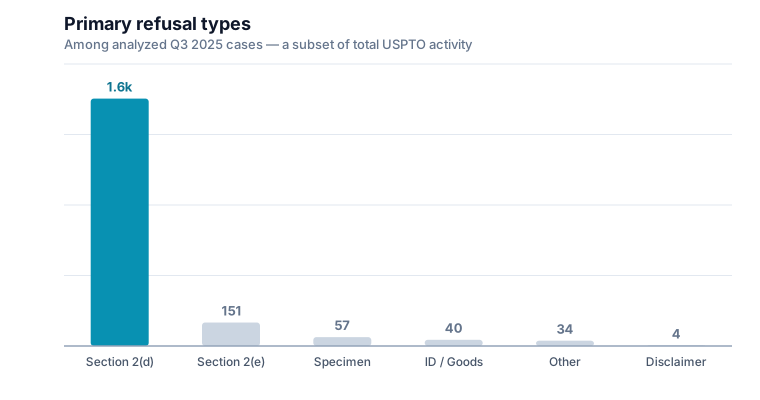
| Primary Refusal Type | Analyzed Responses | Share | Registered (Subset) |
|---|---|---|---|
| Section 2(d) — Likelihood of Confusion | 1,591 | 84.8% | 1,482 |
| Section 2(e) — Descriptiveness / Surname | 151 | 8.0% | 57 |
| Specimen Refusal | 57 | 3.0% | 56 |
| Identification of Goods/Services | 40 | 2.1% | 37 |
| Other | 34 | 1.8% | 30 |
| Disclaimer Requirement | 4 | 0.2% | 4 |
| Tag View (Overlapping) | Tagged Cases | Registered | Avg. Days to Reg. |
|---|---|---|---|
| Section 2(d) — Likelihood of Confusion | 1,591 | 1,482 | 120 |
| Section 2(e) — Descriptiveness / Surname | 162 | 64 | 129 |
| Identification of Goods/Services | 121 | 78 | 135 |
| Disclaimer Requirement | 101 | 50 | 132 |
| Specimen Refusal | 88 | 69 | 117 |
| Other | 34 | 30 | 116 |
Section 2(d) is not just the leading refusal — it is nearly the whole story, primary in 1,591 of 1,877 analyzed responses. Everything else is a rounding footnote by comparison.
The gap between the two tables is where the planning value sits. Disclaimer requirements were the primary issue in only 4 responses but rode along as a tag in 101 — meaning disclaimers almost never arrive alone; they show up bolted to a bigger refusal. Identification issues tell the same story (40 primary, 121 tagged). For counsel, that means a "minor" disclaimer or ID requirement in your office action is usually a signal that a substantive refusal is sitting next to it.
On timing, the registered cases in the subset cleared in a tight band — 116 to 135 days, with Section 2(d) at 120. Identification-tagged matters were the slowest to register at 135 days, which fits: amending goods and services invites a second look at classification and scope.
4. Argument Effectiveness
| Refusal Type | Instances | Verified Wins | Directional Score (0–1) |
|---|---|---|---|
| Section 2(d) — Likelihood of Confusion | 1,614 | 1,395 | 0.945 |
| Section 2(e) — Descriptiveness / Surname | 276 | 98 | 0.809 |
| Disclaimer Requirement | 7 | 7 | 0.791 |
| Identification of Goods/Services | 30 | 28 | 0.723 |
| Specimen Refusal | 26 | 25 | 0.714 |
| Other | 15 | 11 | 0.596 |
| Argument Category | Instances | Directional Score (0–1) | Outcome Multiplier |
|---|---|---|---|
| Consent Agreement | 42 | 0.987 | 1.20 |
| Cited Mark Abandoned | 16 | 0.973 | 1.19 |
| Third Party Registrations | 61 | 0.962 | 1.20 |
| Goods Amendment | 590 | 0.953 | 1.18 |
| Weakness Of Cited Mark | 104 | 0.937 | 1.20 |
| Class Deletion | 75 | 0.934 | 1.14 |
| Commercial Impression | 314 | 0.933 | 1.20 |
| Mark Distinction | 229 | 0.908 | 1.20 |
| Supplemental Register | 105 | 0.904 | 1.12 |
| Double Entendre | 5 | 0.904 | 1.16 |
| Consumer Sophistication | 40 | 0.891 | 1.18 |
| Goods Coexistence | 104 | 0.883 | 1.19 |
| Market Channel Distinction | 37 | 0.879 | 1.18 |
| Suggestive Not Descriptive | 45 | 0.878 | 1.15 |
| Incongruity | 13 | 0.845 | 1.09 |
These are directional 0–1 scores, not win rates: 0.987 is a relative strength signal, not "98.7% of consent agreements won." Read alongside instance counts, the table rewards skepticism of the top of the list. Consent agreements lead at 0.987 — but on 42 instances. Cited-mark abandonment (0.973) rests on 16. The most useful line isn't the highest one; it's Goods Amendment, which scored 0.953 across 590 instances. When the single most common argument in the dataset is also one of the most effective, that is the play you build the response around.
The Section 2(e) toolkit is genuinely different and shouldn't be confused with the 2(d) one. Supplemental Register (0.904, 105 instances), suggestive-not-descriptive (0.878, 45), and incongruity (0.845, 13) all target descriptiveness or surname problems. Supplemental Register registration is available only to use-in-commerce applications and does nothing for a likelihood-of-confusion refusal. Disclaimers narrow what you claim within a mark; they don't cure source confusion. Using a 2(e) tool against a 2(d) refusal is not a weak argument — it's a non-argument.
Practitioner Takeaways
-
Plan for lumpy issuance, not smooth issuance. July and August were nearly identical; September quadrupled them. Fiscal year-end is the danger zone for surprise office actions, and the responses to September's wave will crowd Q4.
-
Section 2(d) is the response battleground. With likelihood-of-confusion primary in 1,591 of 1,877 analyzed responses, build the record around mark differences, commercial impression, cited-mark weakness, third-party use and registration evidence, goods narrowing, and consent agreements where commercially realistic.
-
Lead with goods amendments. They are both the most-used argument (590 instances) and among the most effective (0.953). High-scoring but rare tactics like consent agreements are situational; goods amendments are the workhorse.
-
Keep Section 2(e) arguments in their lane. Supplemental Register, suggestive-not-descriptive, incongruity, and disclaimers address descriptiveness and surname issues. They do not resolve a 2(d) refusal.
-
Treat a "minor" requirement as a tripwire. Disclaimer and identification issues rarely travel alone — they were tagged far more often than they were primary, usually alongside a substantive refusal that deserves your real attention.
Refusal and argument figures reflect GleanMark's analyzed subset (3,095 office actions; 1,877 responses for the quarter), not total USPTO refusal activity. Directional scores are relative effectiveness signals, not win percentages. Volume figures are sourced from USPTO prosecution records through September 30, 2025. Informational only; not legal advice.
Explore more USPTO data analysis on the GleanMark Insights blog.
Related Articles
Final Refusals Fell Every Month of Q2 Even as Examiners Issued More Non-Finals
July 5, 2026
The USPTO Kept Examining Through the Longest Shutdown in History — and Q4's Numbers Show It
June 4, 2026
Trademark Examiners Cleared a Backlog in March: Non-Final Actions Jumped 57% to End Q1 2026
June 4, 2026