The USPTO Kept Examining Through the Longest Shutdown in History — and Q4's Numbers Show It
The federal government was shut down for 43 of the 92 days in this quarter — the longest shutdown in U.S.
 By Howard Katzenberg
Founder, GleanMark
Quarterly USPTO Prosecution Report | USPTO data through December 31, 2025
The federal government was shut down for 43 of the 92 days in this quarter — the longest shutdown in U.S. history, from October 1 through November 12 — and the trademark examination corps barely blinked. The USPTO issued 93,419 non-final office actions and 12,977 final actions in Q4 2025, kept publishing marks, and kept clearing responses, all while most of the government went dark. The one visible dent is exactly where you'd expect it: a 12.9% drop in non-final actions in November, the month that absorbed six weeks of furlough risk, a reduction in force, and a satellite-office closure. By December, output had snapped back.
The trademark office is the rare federal agency that runs on its own money, and Q4 is the cleanest demonstration we have of what that buys you: a shutdown that closed the Copyright Office outright barely registered on the trademark register.
— Howard Katzenberg, Founder, GleanMark
That independence is structural. The USPTO is funded by filing fees rather than annual appropriations, which is why it stayed open on operating reserves while the rest of Washington closed. The point of this report is to show what "stayed open" actually looked like in the data — and then to get into the refusal and argument metrics that practitioners came for.
Executive Summary
- The quarter survived a 43-day shutdown. Examination continued on fee reserves; the only clear footprint is November's dip in non-final actions, which rebounded in December.
- The November dip has a cause, not a mystery. Non-final actions fell from 32,918 in October to 28,665 in November, then recovered to 31,836 in December — the trough lines up with the shutdown weeks and a ~1% USPTO reduction in force.
- Section 2(d) owns the analyzed docket. In the analyzed subset of 9,962 Q4 responses, likelihood-of-confusion was the primary refusal in 8,067 of them — 81.0%.
- Class deletion and consent agreements are the sharpest tools in the box. They post the highest directional effectiveness scores (0.968 and 0.966), but on small bases; goods amendments do the heavy lifting at scale (2,270 instances, 0.960).
- Read the refusal numbers as a sample, not a census. They cover 15,236 analyzed office actions and 9,962 responses, against 93,419 total USPTO non-final actions for the quarter.1
1. Prosecution Volume
| Period | Non-Final Actions | Final Actions | Non-Final + Final | All Prosecution Documents | Non-Final MoM |
|---|---|---|---|---|---|
| October 2025 | 32,918 | 5,182 | 38,100 | Not available | — |
| November 2025 | 28,665 | 4,260 | 32,925 | Not available | -12.9% |
| December 2025 | 31,836 | 3,535 | 35,371 | Not available | +11.1% |
| Q4 2025 Total | 93,419 | 12,977 | 106,396 | 523,290 | — |
The shape of the quarter is the story the table can't tell on its own. October ran hot. November fell off. December clawed most of it back without fully closing the gap. That is precisely the profile you'd predict from a quarter in which the government shut down on day one and stayed shut for six weeks.
We think the November trough mostly reflects the shutdown drag rather than any change in examination policy. The USPTO stayed open, but it did not stay untouched: the agency executed a reduction in force affecting roughly 1% of its workforce in early October and announced the permanent closure of its Denver outreach office, both during this quarter. None of that stops an examining attorney from issuing an office action, but a workforce operating under furlough threat and missed-paycheck headlines is not a workforce running at full throttle. December's rebound is consistent with a corps catching up once funding was restored on November 12 — though the recovery stopped short of October's level, and the late-December federal-holiday closures on the 24th and 26th cost the office working days right at quarter's end.
Final actions tell a quieter, different story: a steady monthly decline from 5,182 to 4,260 to 3,535, with no rebound. A final action is downstream of a prior non-final and a response, so it carries more inertia and reacts more slowly to a single disrupted month. For docketing, the practical read is that Q4 ran two clocks at once — a heavy, shutdown-jostled non-final load up front and a final-action stream that simply tapered.
2. Office Action Document Types
| USPTO Code | Document Type | Documents in Quarter |
|---|---|---|
| NFIN | Non-Final Action | 93,419 |
| XSS | XSearch Search Summary | 91,031 |
| AMC | Amendment and Mail Process Complete | 55,349 |
| ROA | Response to Office Action | 45,612 |
| APP | Application | 30,147 |
| PNR | Public Note | 27,005 |
| EDS | Notice of Design Search Code Emailed | 15,995 |
| PST | TRAM Snapshot of App at Pub for Opposition | 15,335 |
| PB1 | Notice of Publication | 14,949 |
| EB4 | Notification of Notice of Publication | 14,949 |
| PB3 | OG Publication Confirmation | 13,346 |
| FREF | Final Action | 12,977 |
| SPE | Specimen | 11,820 |
| CAR | Change Address or Representation Form | 6,651 |
| EXAMA | Examiner's Amendment | 5,209 |
| ELR | Application Extension to Response | 5,082 |
One number here is worth sitting with: 45,612 responses to office actions were filed in the quarter. Filers kept responding straight through the shutdown, which makes sense — the people answering office actions are private-sector trademark counsel, not federal employees, and statutory deadlines kept running. The shutdown was an agency-side event, not a filer-side one, and the response volume shows it.
Do not add these rows together. Different codes capture related stages, parallel system artifacts, or distinct procedural events, and the publication-related codes in particular shadow one another (note PB1 and EB4 landing on the identical 14,949). The non-final and final totals in Section 1 are the office-action baseline; this table is the surrounding file-history mix.
3. Refusal Landscape
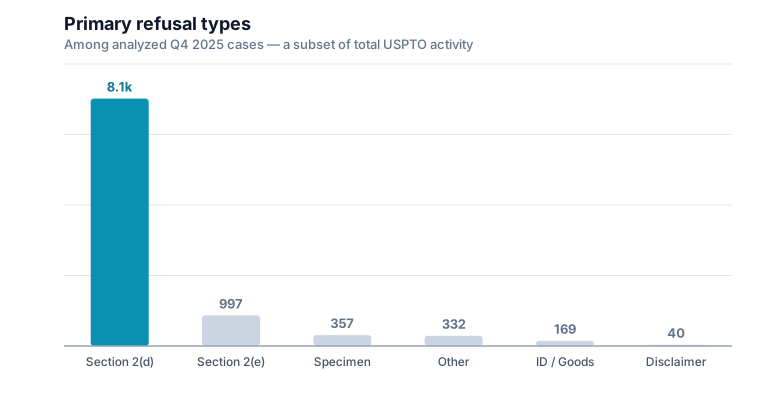
| Primary Refusal Type | Cases | Later Registered | Share of Analyzed Responses |
|---|---|---|---|
| Section 2(d) — Likelihood of Confusion | 8,067 | 7,552 | 81.0% |
| Section 2(e) — Descriptiveness / Surname | 997 | 480 | 10.0% |
| Specimen Refusal | 357 | 341 | 3.6% |
| Other | 332 | 318 | 3.3% |
| Identification of Goods/Services | 169 | 164 | 1.7% |
| Disclaimer Requirement | 40 | 34 | 0.4% |
Section 2(d) and Section 2(e) together account for 9,064 of 9,962 analyzed responses — 91.0% of the docket sits on confusion and descriptiveness. The rest is rounding error by comparison. If you want to know what trademark prosecution is actually about, it is talking the examiner out of a cited mark and, secondarily, arguing your term is more than merely descriptive.
The more interesting view is where issues hide rather than lead. Disclaimer requirements were the primary refusal in just 40 responses but show up as a tag in 742 cases — meaning disclaimer practice almost never drives a refusal on its own and instead rides along with something bigger. Identification issues follow the same logic at smaller scale: 169 primary versus 483 tagged. Among tagged matters that later registered, time to registration ran from 63 days for specimen-tagged cases up to 109 days for Section 2(d)-tagged cases, with Section 2(e) at 85 — confusion refusals take the longest to clear because they take the most argument. (Tag counts overlap; don't sum them or convert them to shares of the docket.)
4. Argument Effectiveness
| Refusal Type | Directional Score (0–1) | Argument Instances | Verified-Win Instances |
|---|---|---|---|
| Section 2(d) — Likelihood of Confusion | 0.947 | 5,729 | 4,831 |
| Section 2(e) — Descriptiveness / Surname | 0.901 | 1,714 | 746 |
| Specimen Refusal | 0.829 | 262 | 244 |
| Disclaimer Requirement | 0.911 | 40 | 33 |
| Identification of Goods/Services | 0.858 | 99 | 94 |
| Other | 0.771 | 150 | 129 |
| Argument Category | Directional Score (0–1) | Outcome Multiplier | Instances |
|---|---|---|---|
| Class Deletion | 0.968 | 1.194 | 320 |
| Consent Agreement | 0.966 | 1.191 | 119 |
| Goods Amendment | 0.960 | 1.197 | 2,270 |
| Commercial Impression | 0.945 | 1.200 | 932 |
| Cited Mark Abandoned | 0.939 | 1.200 | 87 |
| Supplemental Register | 0.939 | 1.184 | 849 |
| Third Party Registrations | 0.934 | 1.199 | 167 |
| Weakness of Cited Mark | 0.930 | 1.200 | 296 |
| Disclaimer | 0.917 | 1.183 | 696 |
| Goods Coexistence | 0.910 | 1.198 | 391 |
| Mark Distinction | 0.910 | 1.199 | 719 |
| Market Channel Distinction | 0.904 | 1.199 | 159 |
| Secondary Meaning | 0.878 | 1.157 | 154 |
| Consumer Sophistication | 0.876 | 1.199 | 130 |
| Suggestive Not Descriptive | 0.861 | 1.144 | 147 |
The scores are directional indicators on a 0–1 scale and the multipliers are relative weights — neither is a win rate. With that caveat, the standouts split into two kinds.
The high scorers at the top — class deletion (0.968) and consent agreement (0.966) — are powerful precisely because they change the facts rather than argue them, but they run on thin bases (320 and 119 instances) and only fit specific situations. A consent agreement is a Section 2(d) instrument; it does nothing for a descriptiveness refusal. The workhorse is the goods amendment: 2,270 instances at a 0.960 score, far more common than any other top-tier category. Narrowing an identification is the move practitioners reach for most because it bends both the confusion analysis (by shifting trade channels and purchaser context) and, in some cases, the descriptiveness inquiry.
Practitioner Takeaways
-
Plan around Section 2(d) first. It was the primary refusal in 81.0% of analyzed responses. Cited-mark strategy, goods and channel distinctions, and consent/coexistence pathways are the core of the job, not a sidebar.
-
Reach for the goods amendment when it changes the facts. It has both the volume and the score. Narrowing the identification can move a Section 2(d) analysis by altering trade-channel or purchaser context — and occasionally a descriptiveness refusal when the narrower wording shifts the inquiry.
-
Match the tool to the refusal. Consent agreements are Section 2(d)-only. Supplemental Register amendments address Section 2(e) descriptiveness or genericness for use-based applications. Specimen substitution fixes specimen defects. None of these cures a likelihood-of-confusion refusal by itself.
-
Don't read a slow middle month as a slow quarter. November's dip was a shutdown artifact, not a trend. December rebounded. If your docket logic assumes examiner output falls off into year-end, this quarter says otherwise.
Explore more USPTO data analysis on the GleanMark Insights blog.
Footnotes
-
Refusal and argument metrics throughout describe GleanMark's analyzed subset — 15,236 office actions and 9,962 responses tagged for the quarter, against 93,419 total USPTO non-final actions — and are directional, not USPTO-wide refusal counts. NICE class designations are not applications and are not counted as such anywhere in this report. Data sourced from USPTO TSDR and public prosecution records, as recorded through the report date. Informational only; not legal advice. ↩
Related Articles
Final Refusals Fell Every Month of Q2 Even as Examiners Issued More Non-Finals
July 5, 2026
The USPTO Issued More Trademark Office Actions in September 2025 Than in July and August Combined
June 4, 2026
Trademark Examiners Cleared a Backlog in March: Non-Final Actions Jumped 57% to End Q1 2026
June 4, 2026