Anthropic v. Abnormal: The Trademark Story Both Sides Left Out
What the public USPTO and TTAB record actually shows about the "A\" fight — and why every brand owner should be reading their own docket, not a reporter's.
 By Howard Katzenberg
Founder, GleanMark
On July 1, 2026, Anthropic sued Abnormal AI (formerly Abnormal Security) in the Northern District of California for trademark infringement, unfair competition, and false designation of origin. The claim: Abnormal's 2025 rebrand adopted a stylized "A" with a slanted stroke — plus an animated logo sequence — that lands too close to Anthropic's own "A\" identity in a market where the two increasingly compete.
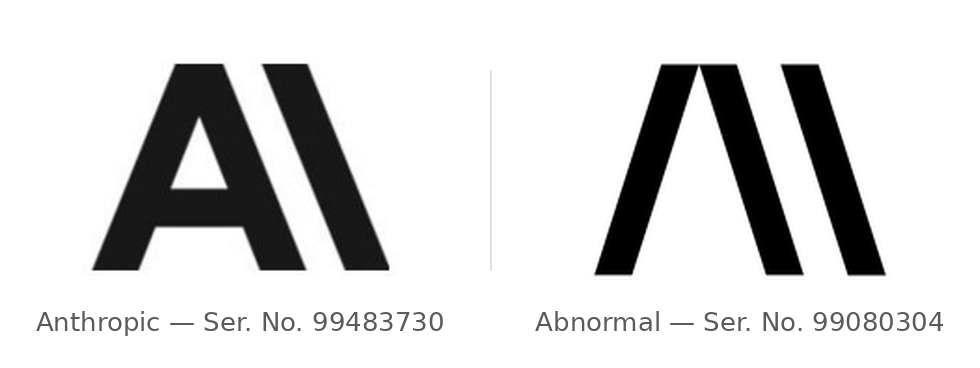
Abnormal's CEO, Evan Reiser, responded publicly and forcefully. The gist: we're older than Anthropic, we designed our look years ago, no customer was ever confused, and — most pointedly — "they never told us." He learned about the lawsuit, he wrote, from a reporter — "not our 'partner.'"
Both sides have now told their stories. Here's the thing about trademark disputes: there's a third account that doesn't do interviews and doesn't issue statements. It's the public record at the USPTO and the Trademark Trial and Appeal Board. And on several of the points both companies are arguing about, the register is more informative than either side's telling.
We pulled it. Here's what it shows.
"They never told us" is doing a lot of work
Read literally, the CEO's statement is narrow and probably accurate: companies rarely give a defendant a courtesy heads-up before filing a federal complaint, and learning about a filing from a reporter is an ordinary, if unpleasant, experience.
But the framing invites a broader inference — that this dispute materialized out of nowhere. The docket complicates that. According to the complaint and the TTAB record, the trademark conflict between these two companies was roughly eleven months old by the time the lawsuit landed:
- August 2025 — Anthropic's account manager flags the logos as "quite similar" and asks Abnormal to adjust its stylization. Abnormal's legal director responds that the marks are distinct and the companies are in "different markets." (Per the complaint.)
- August 2025 — Anthropic's IP counsel sends a letter asserting priority and offering a 60-day transition window. Abnormal declines. (Per the complaint.)
- November 2025 — Anthropic's outside counsel sends a formal demand letter. (Per the complaint.)
- November 21, 2025 — Anthropic files a Notice of Opposition at the TTAB (Opposition No. 91303262).
- March 23, 2026 — Abnormal answers the opposition — the most recent activity in Anthropic's opposition — denying the allegations and raising affirmative defenses.
- April 2026 — the parties hold a TTAB discovery conference. (Per the complaint.)
- July 1, 2026 — Anthropic files its infringement suit in the U.S. District Court for the Northern District of California.
You don't answer an opposition and sit for a discovery conference about a dispute you didn't know existed. The lawsuit may have been a surprise. The disagreement was not. That distinction matters — and it's exactly the kind of thing that lives in the public file rather than in the news cycle.
The part the headlines missed: Anthropic isn't the only opposer
Here's where the coverage undersold the story. Most write-ups frame this as Anthropic v. Abnormal, one-on-one. The TTAB docket for Abnormal's design application (Serial No. 99080304) shows two oppositions stacked against the same mark, from two different directions:
- Opposition No. 91303262 — Anthropic, PBC v. Abnormal. Priority and likelihood of confusion under Section 2(d).
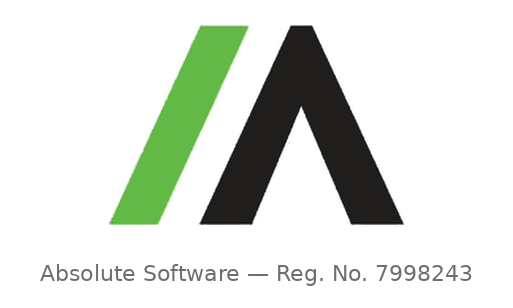
- Opposition No. 91305948 — Absolute Software Corporation v. Abnormal. A separate opposer, relying on its own long-used ABSOLUTE marks, also challenging the '304 application under Section 2(d). Filed March 2026.
Absolute Software is not a footnote. It's a well-known endpoint-security company with registered marks it says it has used since at least 2015. Whatever the merits, the takeaway for brand strategists is structural: a single new logo drew fire from two unrelated senior brand owners within a matter of months. When your mark sits in a contested visual neighborhood, you're not defending against one competitor — you're exposed to everyone with prior rights who happens to be watching. And the ones who are watching move first.
(A note on precision, because it's the kind of thing this post is about: because the '304 is a pending intent-to-use application, these are oppositions*, not cancellations — you can only cancel a mark that has actually registered.)*
The crowded field: the lookalikes are already on the register
Run Abnormal's and Anthropic's marks through a visual-similarity search and the "two companies fighting over one letter" narrative gives way to something more interesting: the minimalist, crossbar-less "A" with a slanted accent is a genuinely crowded design space.
A design search on Anthropic's application surfaces two dozen visually comparable marks.
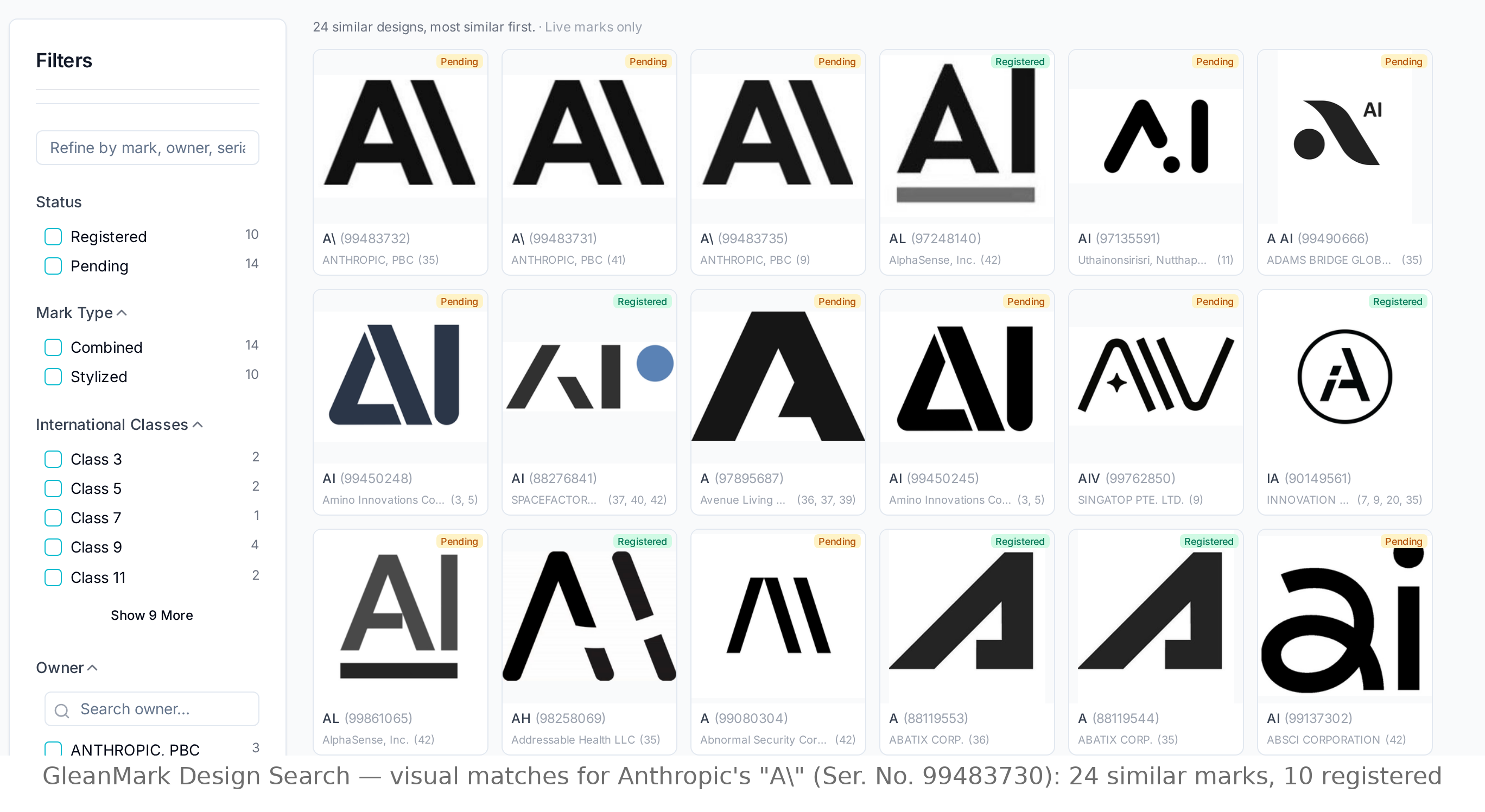
A representative sample of live filings, by unrelated owners, includes:
- AlphaSense, Inc. — a registered stylized A-form mark (its literal element is "AL") in Class 42, the same class at the center of the Anthropic–Abnormal fight. AlphaSense is itself an AI/market-intelligence company. Same letterform, same slant sensibility, same class.
- Addressable Health LLC — an "AH" design, registered, Class 35.
- Amino Innovations Corp. — "AI" design marks pending in Classes 3 and 5.
- Orthoselect — an "AI" mark, registered, reaching Classes 9 and 42.
- SpaceFactory (registered), Midea Group, Singatop, Absci, Acuity Insights, and more — each a live, stylized A/AI letterform of varying closeness, several of them in Class 42.
Visual similarity is not the same as legal likelihood of confusion — class, goods, channels, and buyer sophistication all matter, and most of these owners will never cross paths. But the density of the field carries a real legal signal that cuts in both directions:
- It complicates Anthropic's distinctiveness story. A crowded field of similar marks tends to make any one of them conceptually weaker and its protection narrower. Abnormal's answer goes even further: it argues Anthropic's asserted mark is descriptive or outright generic and lacks distinctiveness — and pleads unclean hands over Anthropic calling the mark a "stylized A" at all — while arguing its own logo reads as "AI," not "A."
- It also means no one in this neighborhood is safe by default. If the crossbar-less "A" is this common, every company using one — Anthropic included — is a potential target for, and a potential threat to, everyone else with prior rights.
That's not a prediction about who wins. It's the reason the register, not blog posts, is where this story is actually being written.
The registration gridlock (and the quiet "tell")
Two more facts from the file wrappers frame the whole dispute:
Abnormal filed first. Its '304 application went in on March 12, 2025. Anthropic filed its four "A\" applications (Classes 9, 35, 41, 42) on November 6, 2025 — roughly eight months later. Filing dates matter enormously at the USPTO, and the consequence is visible on Anthropic's own records: the examiner suspended all four Anthropic applications (status: "Suspension Letter – Mailed," June 2026), citing Abnormal's earlier-filed mark as a potential Section 2(d) bar. Anthropic, for its part, had already opposed Abnormal's application back in November 2025. Net result: nobody's "A" is registering until this resolves. Abnormal froze Anthropic's filings; Anthropic froze Abnormal's registration.
The intent-to-use basis is a tell. Abnormal filed the '304 on an intent-to-use (Section 1(b)) basis — a representation that, as of March 2025, it had a bona fide intent to use the mark but was not yet using it in commerce. That sits awkwardly next to the public claim that "the logo we use today was designed in April 2021." If a company had continuously used a mark since 2021, the natural filing basis is Section 1(a), use-in-commerce, with a 2021 first-use date — not intent-to-use in 2025. Anthropic's own filings show what that looks like: all four of its applications were filed on a use-in-commerce basis, with claimed first-use dates reaching back to May 2021. It's a small detail. It's also the kind of small detail that decides priority fights, and it's sitting in the public file for anyone who bothers to look.
There's a wrinkle on Anthropic's side of the ledger, too. Internet Archive captures of anthropic.com show the current "A\" header treatment appearing around March 2023 — a March 8, 2023 snapshot still shows the earlier branding. That timing actually lines up with parts of Anthropic's own portfolio: its Class 41 application claims first use in February 2023. But its two oldest applications claim use back to May 2021 — and website headers aren't how you prove service-mark use, so the archive doesn't contradict those dates by itself. It's simply the terrain where they'll be tested if discovery goes there.
None of this tells you who should win — that turns on facts still in discovery, and Abnormal has real arguments about sophisticated buyers, distinct markets, and a weak, crowded field. What it tells you is that the most decision-relevant facts in a brand dispute are usually public, and usually early.
So who actually has priority? (It's messier than you'd think)
Here's the part that makes this dispute genuinely interesting to trademark lawyers: on the letterform itself, nobody in this fight owns a U.S. registration — except the party the headlines ignore.
- Anthropic has four suspended applications. They're use-based, claiming first-use dates that reach back to May 2021 — but claimed dates are just that until proven.
- Abnormal has one pending, twice-opposed application, filed intent-to-use in March 2025. If it ever registers, its priority date is its filing date — the Lanham Act's "constructive use" rule — which would still leave it years behind Anthropic's claimed 2021 use.
- Absolute is the only one holding a registered letterform (Reg. No. 7998243). But that registration came through a Madrid Protocol filing made in September 2023, with no U.S. first-use date claimed — so its design-mark priority likely sits behind Anthropic's claimed 2021 use, too. Absolute's real seniority lives in a different asset: its ABSOLUTE word mark, registered with a first-use date of April 2015 — and its opposition pleads both.
Which raises the question people keep asking: if nobody (or almost nobody) has a registration, what decides priority? Common-law use. U.S. trademark rights come from actually using a mark in commerce, not from the register — an opposer doesn't need a registration at all if it can prove it used its mark first. So the TTAB fight would likely come down to evidence of real-world use: when each "A" actually appeared on products, sites, and sales materials. That's where Abnormal's intent-to-use filing becomes more than a technicality — proving pre-2025 common-law use means explaining why, in March 2025, it told the USPTO it wasn't using the mark yet.
Two more practical wrinkles:
Don't expect the TTAB to decide any of this soon. When the same parties are fighting in federal court over the same marks, the Board's standard practice is to suspend its own proceeding and wait — the court's judgment on infringement will usually control the registration question, not the other way around. With the N.D. Cal. case now filed, the Anthropic opposition is a strong candidate for suspension, and the registration gridlock above gets longer.
And even a clean priority win might not decide the war. Priority answers who was first — it doesn't answer whether anyone is confused. The companies' names — ANTHROPIC, ABNORMAL — share almost nothing, though that helps less than it sounds: a logo lives standalone on app icons, favicons, and booth signage, where no name travels with it. The confusion question really rides on a single stylized letter in a design space the register shows is already crowded — which narrows everyone's protection and makes real-world confusion genuinely hard to prove, especially among the sophisticated enterprise buyers both companies sell to. It's entirely possible to win the history fight and still lose on confusion. That's not a flaw in trademark law; that's the system working as designed — rights exist to prevent confusion, not to award letters of the alphabet.
The real lesson for brand owners
Strip away the two companies and the story is universal:
- A rebrand that looked clean internally drew two oppositions from unrelated senior owners.
- A first-filed application froze a much larger company's entire trademark portfolio in four classes.
- A single filing-basis choice from 2025 may undercut a public 2021-priority narrative.
- And the visual space everyone reached for was already crowded with prior rights.
Every one of those facts was knowable from the public record — most of them months before they made news. The companies with a monitoring discipline saw them as they happened. The ones relying on a reporter's call found out last.
You cannot enforce, defend, or even negotiate around what you aren't tracking. Trademark rights are a use-it-and-watch-it asset. The register moves every day — new applications, office actions, publications, oppositions, suspensions — and none of it emails you unless you've set it up to.
What this looks like on GleanMark
This is exactly what we built GleanMark for — and monitoring your own marks is free on the platform:
- Prosecution tracking — follow up to three of your own marks, plus one owner you care about (a competitor counts), through examination, publication, and registration, with alerts the moment status changes.
- TTAB alerts — get notified when an opposition is filed, answered, or moves phase on a mark or owner you follow — the way Abnormal's counsel presumably learned of each proceeding, except automatically and on day one.
- Register-wide Watch alerts — persistent, proactive surveillance of the whole register for new applications that conflict with yours, while there's still time to file an extension of time to oppose rather than after a mark registers. Every plan — including Free — includes one watch; Professional includes unlimited.
- Design Search — search the register by visual similarity, not just wording. It's how you find the crowded-field lookalikes above — the AlphaSense A-form in Class 42, the crossbar-less A's and slanted-i "AI" marks — before you commit to a logo, and how you spot new entrants crowding your space after you've launched.
- Clearance search (for paying customers) — run comprehensive mark and design searches against the USPTO register before you commit, so you can make smart branding decisions in advance.
Anthropic and Abnormal both have sophisticated counsel and were watching their marks. Most companies aren't, and don't. If you own a brand and operate in the U.S., set up monitoring on your marks today — it takes a few minutes, it's free, and it means you'll never learn that your brand is under challenge from a reporter's phone call.
Start free at gleanmark.com.
GleanMark is a trademark intelligence platform built on the full USPTO database. This post is commentary on public records for informational purposes and is not legal advice. Case and proceeding details are drawn from the public complaint (N.D. Cal.), USPTO records, and TTAB filings as of July 2026; parties' positions are allegations and defenses, not findings.
Related Articles
The Supreme Court will decide who measures trademark strength. Here is what measuring it looks like.
August 30, 2026
Buc-ee's Isn't Suing Over Its Name. It's Claiming the Cartoon Animal.
August 5, 2026
The USPTO Just Refused MARLBORO MAN Again — 180 People Have Tried This and 13 Made It
July 23, 2026