7-Eleven v. Nike: The Trademark Case That Isn't Really About Colors
What the USPTO and TTAB record shows about the Air Max 95 fight — and why the real question is striped trade dress, marketplace context, and Nike's own enforcement history.
 By Howard Katzenberg
Founder, GleanMark
What the USPTO and TTAB record shows about the Air Max 95 fight — and why the real question is striped trade dress, marketplace context, and Nike's own enforcement history.
On July 1, 2026, 7-Eleven sued Nike in the Northern District of Texas over an Air Max 95 colorway that sneaker media had already been calling "7-Eleven-inspired." The shoe uses orange, green, and red, and — according to the complaint — Nike scheduled it to drop on July 11: 7/11, the day everyone associates with 7-Eleven and free Slurpees.
The public reaction was instant and predictable:
Can a convenience store really own orange, green, and red?
That's the wrong question.
7-Eleven is not suing because those three colors exist. It's suing over a total commercial impression — a specific striped color sequence, on a sneaker, timed to its own holiday, in a market where consumers are trained to expect brand collaborations. This isn't a logo case. It's a trade dress case dressed up as a sneaker drop.
And the public record makes it a lot more interesting than the headlines do. So we pulled it.
First — what is trade dress?
Trademark law doesn't only protect brand names and logos. It can also protect the overall look and feel of a product, its packaging, or its presentation — when consumers have come to recognize that look as pointing to a single source.
That's trade dress. The famous examples are ones you'd recognize without ever using the legal term: the contour shape of a Coca-Cola bottle, the Tiffany blue box, the shape and foil plume of a Hershey's Kiss, the red sole of a Louboutin shoe.
The point is never that a company "owns a color" or "owns a shape" in the abstract. The point is whether a particular combination has become source-identifying in the real world.
That's why this case is more interesting than the online reaction suggests. 7-Eleven isn't really saying "we own orange, green, and red." It's saying that Nike used a particular striped presentation, at a particular moment, in a way consumers would read as a 7-Eleven collaboration.
The colors are common. The striped presentation is not.
Start with the broadest view, and Nike has a fair point.
We searched the register for every live, registered mark that claims only the colors orange, green, and red — with or without white, and nothing else. There are 113 of them, owned by 95 different companies. So if the argument were simply "7-Eleven owns this palette," it would be a weak argument. The palette is not rare.
But that isn't the argument. So we narrowed the search to registrations that also describe the mark using stripes, bars, rectangles, or lines — the striped trade dress at the center of the complaint. The field collapsed to about a dozen registrations across the entire register.
Here's where it gets striking:
- 7-Eleven owns four of them — more than any other single owner.
- In Class 35 — retail and convenience-store services — every single matching registration belongs to 7-Eleven.
- In Class 25 — apparel and footwear — there are none. No other company has registered orange/green/red striped trade dress for clothing or shoes.
And one detail that validates the whole exercise: the three Class 35 striped registrations our search surfaces for 7-Eleven (3,644,842, 3,679,337, and 4,917,149) are the exact same registrations 7-Eleven cites in its complaint as its Tri-Color Mark. Run the register the way trademark law actually looks at it — colors plus presentation, not colors alone — and it independently points you to the precise marks this lawsuit is built on.
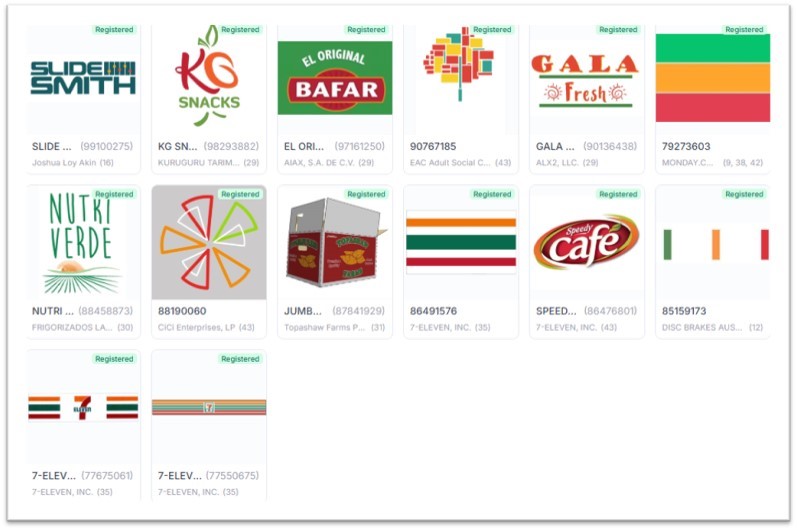
The register, filtered the way trademark law actually looks at it — live registrations claiming only orange, green, and red, described as a striped presentation. 7-Eleven's three Class 35 marks (bottom row) are the registrations it is suing on.
The register appears crowded for the colors in the abstract. It's nearly empty for the specific striped presentation. That distinction is the case.
The release date is not a footnote
If Nike had dropped a green, orange, and red sneaker on a random Tuesday in February, 7-Eleven's case would still exist — but it would be weaker.
The July 11 timing changes the context, and trademark law cares a great deal about context. It doesn't evaluate a mark in a vacuum; it asks how consumers actually encounter it in the marketplace. And the marketplace here is sneaker culture, where official collaborations — with food brands, beverage brands, artists, retailers — are common, hyped, and collectible.
There's a wrinkle that cuts against Nike here, straight from the complaint: 7-Eleven already does these collaborations. It has partnered on footwear and apparel with Crocs, Sunday Golf, Breezy Golf, and the skate brand DGK. When a company is known for licensed "collabs," consumers are primed to read a 7-Eleven-colored, 7/11-dated sneaker as another one.
Nobody thinks Nike is 7-Eleven. That's not the question. The question is whether a meaningful number of consumers would think 7-Eleven approved it. That's a much more serious one.
The media coverage may be evidence, not just noise
One of the most interesting features of this case is that 7-Eleven didn't have to manufacture the association. Sneaker media did it first.
Before the lawsuit, the shoe was widely written up as a 7-Eleven-inspired Air Max 95. 7-Eleven's complaint leans on exactly this — quoting outlets that called its color scheme "unmistakable," "signature," and "iconic," and that described the shoe as "specifically tied to" 7-Eleven.
Third-party descriptions don't prove confusion by themselves. But they're evidence of marketplace perception. When independent outlets and consumers immediately reach for the plaintiff's brand to describe the defendant's product — before it even launches — that supports the claim that the design created a real-world association.
Nike will say inspiration isn't infringement. That's true. But the line between "inspired by" and "reads as authorized by" is exactly where modern collaboration cases live.
The Nike wrinkle: its own TTAB pleadings
Here's the part that makes the case even more interesting.
Nike is one of the most aggressive trademark enforcers in the country. Since 2020, it has filed 157 oppositions and 16 cancellations at the Trademark Trial and Appeal Board. And its own filings show Nike taking broad positions built on famous visual marks, dilution, and relatedness that reaches well beyond identical products.
Two examples stand out.
In Opposition No. 91273889, Nike opposed a Class 35 advertising-and-marketing-services application for JUST BOOK IT — not shoes, not apparel. Nike pleaded both JUST DO IT and the Swoosh Design, asserted likelihood of confusion and dilution, and put a side-by-side visual comparison of the Swoosh against the applicant's composite logo in its notice.
In Opposition No. 91276430, Nike opposed a Class 44 physical-therapy and injury-prevention services mark, USPH. Nike tied the Swoosh to broader fitness, health, and wellness services, then argued the applicant's orange composite design was confusingly similar to the Swoosh.
Those are not tri-color-stripe cases — they're Swoosh cases, and it would be wrong to say Nike has ever made 7-Eleven's exact argument. But they show something that matters: Nike understands, and routinely argues, that trademark law protects far more than words. It has built one of the most valuable enforcement programs in the world on the principle that a famous visual identity can reach across classes and beyond identical goods. That's harder to square with "you can't trademark colors."
Nike has real defenses
None of this means 7-Eleven wins. Nike has serious arguments.
Sneaker colorways are expressive and part of the product itself — courts are careful before letting a trademark plaintiff control aesthetic features. Nike is one of the most recognizable house brands on earth, and will argue consumers plainly see a Nike shoe. 7-Eleven is a convenience-store company, not a footwear company, whatever its collabs. And "inspired by" genuinely does not equal "authorized by" — products reference culture, places, and colors all the time without implying sponsorship.
Those are real defenses. But none of them ends the case, because modern confusion is often about affiliation and sponsorship, not mistaken corporate identity. The question isn't whether consumers think 7-Eleven built an Air Max. It's whether they think 7-Eleven signed off on it.
The real lesson for brand owners
Strip away the two names and the lesson is universal.
Non-traditional trademarks — colors, stripes, layouts, packaging, retail environments, whole visual systems — are becoming some of the most valuable assets a brand has. And they create two blind spots.
The first is under-protection. Companies register their names and logos and ignore the visual system consumers actually recognize on the shelf.
The second is under-clearance. A team clears a word mark and never checks the trade dress. That's how you end up with a design that felt clever in the conference room and looks like someone else's brand in the market.
Clearing a brand today means asking questions a word search can't answer: What colors are claimed across the register? How crowded is the presentation, not just the palette? Who owns the closest configurations — and do they enforce? Have they filed at the TTAB before? And, above all: what will consumers think this is?
That's the question the record can answer before the lawsuit arrives.
What this looks like on GleanMark
This is exactly what we built GleanMark for.
- Register-level color and design analysis — to separate a common palette from the rare striped presentation that actually carries rights, the same way we isolated the dozen striped orange/green/red registrations above.
- TTAB research — to see how a party has enforced before, including the arguments it has made in its own pleadings.
- Design Search — to find visually similar marks before a launch or rebrand goes public.
- Watch alerts — to catch new filings moving into your visual neighborhood while there's still time to act.
- Portfolio monitoring — to track your marks, your competitors, and the proceedings that could affect your rights.
The 7-Eleven/Nike fight is a reminder that trademark risk is rarely just a wordmark problem. It's a marketplace-perception problem — and marketplace perception lives in the details: color, timing, layout, media reaction, prior licensing, enforcement history, and the public register.
That's why every serious brand owner should be reading the record before the internet writes the story for them.
Start free at gleanmark.com.
GleanMark is a trademark intelligence platform built on the full USPTO database. This post is commentary on public records for informational purposes and is not legal advice. Case and proceeding details are drawn from the public complaint (N.D. Tex.), USPTO records, TTAB filings, and public reporting as of July 2026; the parties' positions are allegations and defenses, not findings.
Related Articles
Buc-ee's Isn't Suing Over Its Name. It's Claiming the Cartoon Animal.
August 5, 2026
Jack Daniel's Loses Another 'Bad Spaniels' Round — And the TTAB Register Explains Why the Whiskey Giant Keeps Fighting
October 7, 2026
The 'Twitter' Land Grab: What a Startup's USPTO Filings Reveal About Reclaiming a Dead Name
September 6, 2026