Zara's Owner Wins on Summary Judgment as TTAB Contested Filings Rise 5.5% in Q2 2026
Oppositions and cancellations filed at the TTAB rose 5.5% to 2,918 in Q2 2026. Of the 2,537 that ended during the quarter, 1,284 (50.6%) ended in default because the respondent never answered.
 By Howard Katzenberg
Founder, GleanMark
Updated October 7, 2026
Industria de Diseño Textil, S.A. (Inditex), the owner of the ZARA marks, won an opposition on summary judgment at the Trademark Trial and Appeal Board on June 22, 2026. It was one of 29 final merits decisions the Board issued in oppositions and cancellations during Q2 2026, a quarter in which contested filings rose 5.5% to 2,918. Of the 2,537 oppositions and cancellations that ended during the quarter, 1,284 (50.6%) ended in default judgment because the respondent never answered.
Executive Summary
- Contested filings rose 5.5%. The Board took in 2,918 opposition and cancellation filings in Q2 2026, up 152 from 2,766 the prior quarter. Oppositions did the heavy lifting at 2,164; cancellations added 754.
- Defaults dominated. Across oppositions and cancellations, 1,284 of 2,537 terminated disputes — 50.6% — ended in default judgment. The respondent simply never answered.
- The contested core is small. Only 30 of the 2,537 terminated disputes (1.2%) had an answer plus trial, briefing, or summary judgment. The Board issued 29 final merits decisions in oppositions and cancellations during the quarter.
- Inditex won on summary judgment. On June 22, the Board granted Industria de Diseño Textil, S.A. (Inditex) summary judgment on likelihood of confusion, sustained its opposition to an application for VIZZARA, in stylized form, for plates, glasses and other Class 21 goods, and refused registration.
- Large brand owners filed throughout the quarter. Meta Platforms filed 7 oppositions and 15 extensions of time to oppose in Q2 2026, Amazon Technologies 7 and 13, Apple 5 and 14, and Google 3 and 7, spread across April, May and June.
1. Filing Volume
Contested activity — oppositions plus cancellations — reached 2,918 filings, a 5.5% increase over the prior quarter's 2,766.
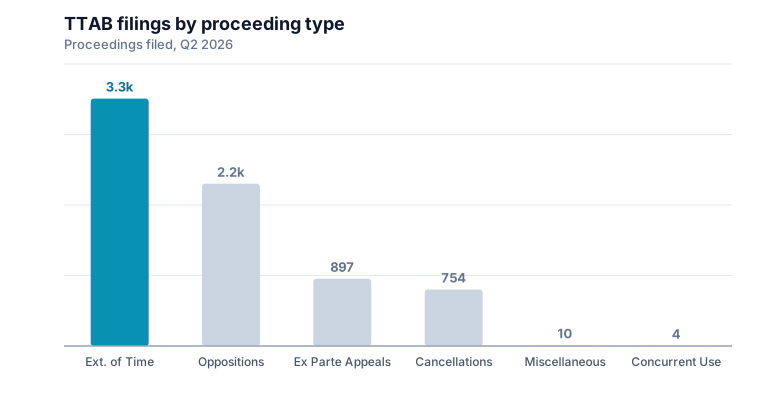
| Proceeding Type | Current Quarter | Prior Quarter | Change | Percent Change |
|---|---|---|---|---|
| Extensions of Time to Oppose | 3,299 | 2,932 | +367 | +12.5% |
| Oppositions | 2,164 | 2,050 | +114 | +5.6% |
| Ex Parte Appeal | 897 | 925 | -28 | -3.0% |
| Cancellations | 754 | 716 | +38 | +5.3% |
| Miscellaneous | 10 | 11 | -1 | -9.1% |
| Concurrent Use | 4 | 0 | +4 | — |
The litigation pulse is the contested total, not the administrative one. Extensions of time to oppose were the single largest category at 3,299 and grew fastest, up 12.5%. An extension is a request for more time to decide whether to oppose; it is not yet a dispute. Many do become one: by October 5, 2026, about 44% of the quarter's extensions (1,429 of 3,276) had been followed by an opposition against the same application.
Ex parte appeals — applicants fighting examiner refusals, not each other — slipped 3.0% to 897. They belong in the activity picture but not in the contested headline.
2. Outcomes by Proceeding Type
| Proceeding Type | Proceedings With Decisions | Decision Entries | Sustained | Granted | Dismissed or Denied | Affirmed | Reversed | Moot | Reconsideration | Other |
|---|---|---|---|---|---|---|---|---|---|---|
| Oppositions | 1,941 | 1,960 | 1,264 | 0 | 636 | 0 | 0 | 7 | 0 | 63 |
| Ex Parte Appeal | 799 | 838 | 0 | 0 | 241 | 83 | 9 | 20 | 337 | 168 |
| Cancellations | 701 | 710 | 0 | 442 | 243 | 1 | 0 | 6 | 1 | 23 |
| Concurrent Use | 2 | 2 | 0 | 0 | 0 | 0 | 0 | 0 | 0 | 2 |
| Extensions of Time to Oppose | 1 | 1 | 0 | 0 | 0 | 0 | 0 | 0 | 1 | 0 |
Other counts only entries that match no column. Moot dismissals (7, 20 and 6) also appear under Dismissed or Denied, and 3 partial opposition decisions appear under both Sustained and Dismissed or Denied, so a row's columns can add up to more than its entry total. The two oppositions sustained on summary judgment, including Inditex's, are counted under Other, and the cancellation row's one affirmance is a court decision, not a Board decision.
Count proceedings, not entries: one proceeding can have several decision entries. During the quarter, 1,941 oppositions, 701 cancellations and 799 ex parte appeals had at least one decision entry. Not every entry ends a case. For about 460 of the ex parte appeals, the quarter's only entries were interim steps, such as an examining attorney denying a request for reconsideration, after which the appeal resumes.
The vocabulary differs by type. In oppositions, "sustained" means the opposer won, and "dismissed or denied" means the opposition ended without being sustained, which includes dismissals after the opposer withdrew. In cancellations, "granted" means the petitioner won. In ex parte appeals, "affirmed" means the refusal stood and "reversed" means it was overturned. In the quarter's ex parte appeal decisions, the Board affirmed 83 refusals and reversed 9. Three more were affirmed in part and reversed in part, and 6 were recorded as "disclaimer accepted."
3. How Disputes End: Defaulted, Withdrawn, or Contested
| Proceeding Type | Terminated Proceedings | Default Judgment | Withdrawn or Suspended for Settlement | Contested (trial, briefing, or SJ) | Other Procedural |
|---|---|---|---|---|---|
| Oppositions | 1,895 | 960 (50.7%) | 668 (35.3%) | 22 (1.2%) | 245 (12.9%) |
| Cancellations | 642 | 324 (50.5%) | 224 (34.9%) | 8 (1.2%) | 86 (13.4%) |
Here is the disposition story, and it is procedural. Across both categories, 1,284 of 2,537 terminated disputes — 50.6% — ended in default judgment. A default is not a ruling on the merits. It means the applicant or registrant never filed an answer, and the Board entered judgment against it.
Withdrawals and settlement suspensions took another 892 disputes, or 35.2%. Only 30, or 1.2%, had an answer plus trial, briefing, or summary judgment. The remaining 331 (13.0%) ended in other procedural ways.
4. High-Profile Proceedings
This report screens 15 major brands. The table lists the oppositions those brands filed from June 15 to June 30, 2026, with each defendant and the mark opposed.
| Brand | Proceeding | Defendant (Mark) | Filing Date | Status as of Oct. 5, 2026 |
|---|---|---|---|---|
| Nike, Inc. | 91308453 | DKDH Enterprises, LLC (GO DO IT) | 2026-06-29 | Pending |
| Disney Enterprises, Inc. | 91308194 | Shanghai Xixi Hehe E-commerce Co., Ltd. (POOH PA POP) | 2026-06-18 | Suspended |
| Meta Platforms, Inc. | 91308156 | Huizhi Tianxia (Hangzhou) Technology Co., Ltd. (MEETAVISTA) | 2026-06-17 | Suspended |
| Apple Inc. | 91308128 | MACTRON GROUP CO., LTD. (M MACTRON GROUP) | 2026-06-16 | Pending |
| Apple Inc. | 91308097 | Calen McCann (CMAC TECH) | 2026-06-15 | Pending |
| Amazon Technologies, Inc. | 91308092 | Echosell Corporation PTE. Ltd. (ECHOTIK) | 2026-06-15 | Suspended |
| Amazon Technologies, Inc. | 91308119 | Echosell Corporation PTE. Ltd. (ECHOTIK) | 2026-06-15 | Suspended |
Across the full quarter, as plaintiffs, Meta Platforms filed 7 oppositions and 15 extensions of time to oppose, Amazon Technologies 7 and 13, Apple 5 and 14, and Nike 5 and 9. Google filed 3 oppositions, 1 cancellation petition and 7 extensions, and Disney Enterprises 1 opposition and 4 extensions. Most of these filings were spread across the quarter: Apple and Meta each filed 7 of their extensions in April. Google was the exception, with 4 of its 7 extensions filed from June 15 to June 30.
Several of the June extensions were later followed by oppositions against the same applications: Louis Vuitton Malletier against Zachery Segura's RV application (91308821, July 14), Apple against Applewood Creative Co., Ltd's APPLEWOOD application (91309273, July 27) and Advantic Building Group, LLC's FASTMAC application (91310168, September 4), Amazon Technologies against Hangzhou Qiaoyi Technology Co., Ltd.'s AMZSHOP application (91310367, September 15), and Google LLC against VirtualFrontier Tech Limited's NESTVIBEKA application (91310610, September 23).
5. Contested Decisions
The Board issued 29 final merits decisions in oppositions and cancellations during Q2 2026, after trial or on summary judgment. Defaults and settlements are excluded. Oppositions accounted for 21 and cancellations for 8. Of the 21 oppositions, 10 were sustained (2 on summary judgment), 4 were sustained in part (1 on summary judgment), and 7 were dismissed. Of the 8 cancellations, 2 were granted, 1 was granted in part, and 5 were denied.
| Decision Date | Plaintiff v. Defendant | Type | Outcome | Proceeding |
|---|---|---|---|---|
| Jun 30, 2026 | Upgrade, Inc. v. MQCC Bungay International LLC | Opposition | Sustained on summary judgment | 91297708 |
| Jun 29, 2026 | Tru Earth Environmental Products Inc. v. Macroidea Inc. | Opposition | Dismissed | 91285926 |
| Jun 29, 2026 | Tru Earth Environmental Products Inc. v. Macroidea Inc. | Opposition | Dismissed | 91285927 |
| Jun 22, 2026 | Industria de Diseño Textil, S.A. (Inditex) v. Musevych Kateryna | Opposition | Sustained on summary judgment | 91296286 |
| Jun 22, 2026 | Venchi S.p.A. v. Plant-Smart, LLC | Opposition | Sustained | 91291490 |
| Jun 17, 2026 | Wenbo Zhou v. Hangzhou Ai Xun Trade Co., Ltd. | Cancellation | Denied | 92082150 |
| Jun 16, 2026 | Revo Holdings, LLC v. RE Virtual Office Inc | Cancellation | Denied | 92085621 |
| Jun 9, 2026 | Sony Pictures Television Inc. v. Tim Lynch | Opposition | Sustained | 91289684 |
| Jun 5, 2026 | Nelwood Corp. v. Kevin Morgan | Opposition | Sustained in part on summary judgment | 91296358 |
| Jun 5, 2026 | Super Kings International, Inc. v. Shenzhen BMX Network Technology Ltd. | Cancellation | Granted | 92085356 |
| Jun 5, 2026 | Super Kings International, Inc. v. Shenzhen BMX Network Technology Ltd. | Cancellation | Granted | 92085358 |
| Jun 2, 2026 | Alcanza Clinical Research, LLC v. Diversa Clinical Research LLC | Opposition | Sustained | 91292960 |
| May 29, 2026 | Nike, Inc. v. Blue Ribbon Team | Opposition | Sustained | 91269520 |
| May 28, 2026 | Ayoub, Inc v. Danco Incorporated | Cancellation | Granted in part | 92080469 |
| May 22, 2026 | ABT, Inc. v. Landscape Structures Inc. | Opposition | Sustained | 91287603 |
| May 21, 2026 | Neaux Coffee LLC v. NEAU Brands, Inc. | Opposition | Dismissed | 91284466 |
| May 21, 2026 | Chen Jinxing v. Putian Licheng District Pure Gold Trading Co. Ltd. | Cancellation | Denied | 92085852 |
| May 11, 2026 | Mineplex LLC and 10 other opposers v. Mineverse LLC | Opposition | Sustained in part | 91266862 |
| May 11, 2026 | Microsoft Corporation v. Mineverse LLC | Opposition | Sustained in part | 91268696 |
| May 7, 2026 | Candy Dynamics, Inc. v. Aurox Distributors LLC | Opposition | Dismissed | 91292159 |
| May 1, 2026 | Rolex Watch U.S.A., Inc. v. DR GNP Holdings LLC and Jennoa R. Graham | Opposition | Sustained in part | 91290853 |
| Apr 24, 2026 | Hub Group, Inc. v. SPL Group Inc. | Opposition | Dismissed | 91263984 |
| Apr 21, 2026 | Lena West v. CEO Rise | Cancellation | Denied | 92083680 |
| Apr 17, 2026 | Sun Garden Packing Co. v. Da Napoli Foods LLC | Opposition | Sustained | 91284802 |
| Apr 13, 2026 | Allied Lomar, Inc v. Talnua, LLC. | Opposition | Dismissed; counterclaim denied | 91284670 |
| Apr 10, 2026 | Nuqul Brothers Company Limited v. FB International Inc | Opposition | Sustained | 91288958 |
| Apr 10, 2026 | Nuqul Brothers Company Limited v. FB International Inc | Opposition | Sustained | 91290934 |
| Apr 8, 2026 | Detail Medic v. Exotic Car Care, LLC | Cancellation | Denied | 92081874 |
| Apr 7, 2026 | AWGI, LLC v. Équipement Max-Atlas International Inc. | Opposition | Dismissed | 91291227 |
As of October 5, 2026, two of these decisions are on appeal to a court: 91266862 and 91287603. One more decision, in Newton, Udinson, & Hill PLLC v. Sigal Law Firm, PLLC (91289155), was mailed June 29, withdrawn by the Board on July 9, and reissued on July 13, so it counts in Q3.
Industria de Diseño Textil, S.A. (Inditex) v. Musevych Kateryna. Inditex opposed an application to register VIZZARA, in stylized form, for plates, cake servers, drinking glasses and other Class 21 goods, relying on its ZARA and ZARA HOME registrations. The Board granted Inditex summary judgment on likelihood of confusion, sustained the opposition, and refused registration. It did not reach Inditex's dilution claim.
Upgrade, Inc. v. MQCC Bungay International LLC. On June 30, the Board granted Upgrade, Inc. summary judgment on its claim that MQCC Bungay International LLC was not using UPGRADE ALGORITHM for the listed services when it filed its application. The Board held the application void, sustained the opposition, and did not reach likelihood of confusion.
Key Numbers
- Contested filings rose. Oppositions and cancellations filed rose 5.5%, from 2,766 in Q1 2026 to 2,918 in Q2. Extensions of time to oppose (3,299) and ex parte appeals (897) are counted separately.
- Defaults ended just over half of disputes. Of the 2,537 oppositions and cancellations that ended in Q2, 1,284 (50.6%) ended in default judgment.
- Most sustained oppositions were defaults. Of the 1,257 oppositions with a sustained decision in Q2, 1,113 (88.5%) never had an answer filed.
- Few cases were litigated to a decision. Only 30 of the 2,537 terminated disputes (1.2%) had an answer plus trial, briefing, or summary judgment. The Board issued 29 final merits decisions during the quarter.
- Extensions often lead to oppositions. By October 5, 2026, about 44% of the quarter's extensions of time to oppose had been followed by an opposition against the same application.
Methodology: Filing figures reflect USPTO TTAB records as recorded through June 30, 2026. Dispute outcomes were recomputed from records as of October 5, 2026. Figures will change as cases progress. "Contested filings" means oppositions plus cancellations; extensions of time and ex parte appeals are reported separately and are not counted as contests. NICE-class references, where they appear, describe classes claimed, not application counts. This report is informational and does not constitute legal advice.
Explore more USPTO data analysis on the GleanMark Insights blog.
Related Articles
TTAB in Q3 2026: Contested Filings Rise 3.9% While Defaults End 55% of Oppositions
October 5, 2026
How a Name Becomes Unownable: OSHO and the Anatomy of a Generic Trademark
September 22, 2026
Board dismisses Inmode challenge to Empower Aesthetics design application
October 22, 2026