Four Ways to Lose a Trademark Fight You Thought You'd Cleared
xAI, a champagne widow, an Italian wine label, and a matcha bar — what the four prongs of du Pont Factor 1 (appearance, sound, meaning, commercial impression) look like in real refusals and TTAB cases.
 By Howard Katzenberg
Founder of GleanMark. Eleven years as a CFO, then founder of the fintech company Glean.
Updated October 12, 2026
xAI, a champagne widow, an Italian wine label, and a matcha bar — what the four prongs of du Pont Factor 1 look like in real refusals and TTAB cases.
xAI has filed fourteen GROK-family trademark applications in the U.S. register. Thirteen are suspended. The oldest has been stuck since October 2023. The one that got through cleared only after xAI went to the Trademark Trial and Appeal Board and knocked out the registration blocking it.
Not all of that happened because someone else spelled Grok the same way. Much of it happened because of a chip company called Groq — with a Q.
Last Wednesday I wrote that the first du Pont factor — "similarity of the marks" — is really four tests in one: appearance, sound, meaning, and overall commercial impression. Examiners compare marks on all four, and the standard line in their refusals is blunt: "Similarity in any one of these elements may be sufficient to find the marks confusingly similar."
One prong is enough. That's the whole trap. Founders clear a name with their eyes — the spelling is different, the logo is different, we're fine. The register doesn't work that way, and this month's crop of refusals proves it. Here are all four prongs, each through a real case sitting in the public record right now.
Where the four prongs come from: a widow's champagne
First, the case behind the framework.
In 1998, an importer named Palm Bay filed to register VEUVE ROYALE for sparkling wine. The Clicquot house — whose VEUVE CLICQUOT PONSARDIN registration dates to 1982 — opposed in 1999. The fight went from the TTAB to the Federal Circuit, and the resulting decision, Palm Bay v. Veuve Clicquot (2005), is the case modern examiners still cite for how to compare two marks.
Both filings carry translation statements, because "veuve" is French: Clicquot's registration translates it as "widow" — Veuve Clicquot is the widow Clicquot, who ran the house in the 1800s — and Palm Bay's application translates VEUVE ROYALE as "Royal Widow." Two marks, one shared word, and a doctrine for almost every prong: how the marks look, how "veuve" sounds leading each mark, and whether American champagne buyers would stop and translate a French word at all.
The ending is in the file: VEUVE ROYALE's status today reads "Abandoned — after inter-partes decision." The opposition killed it. Twenty years later, the framework from that fight is deciding the cases below.
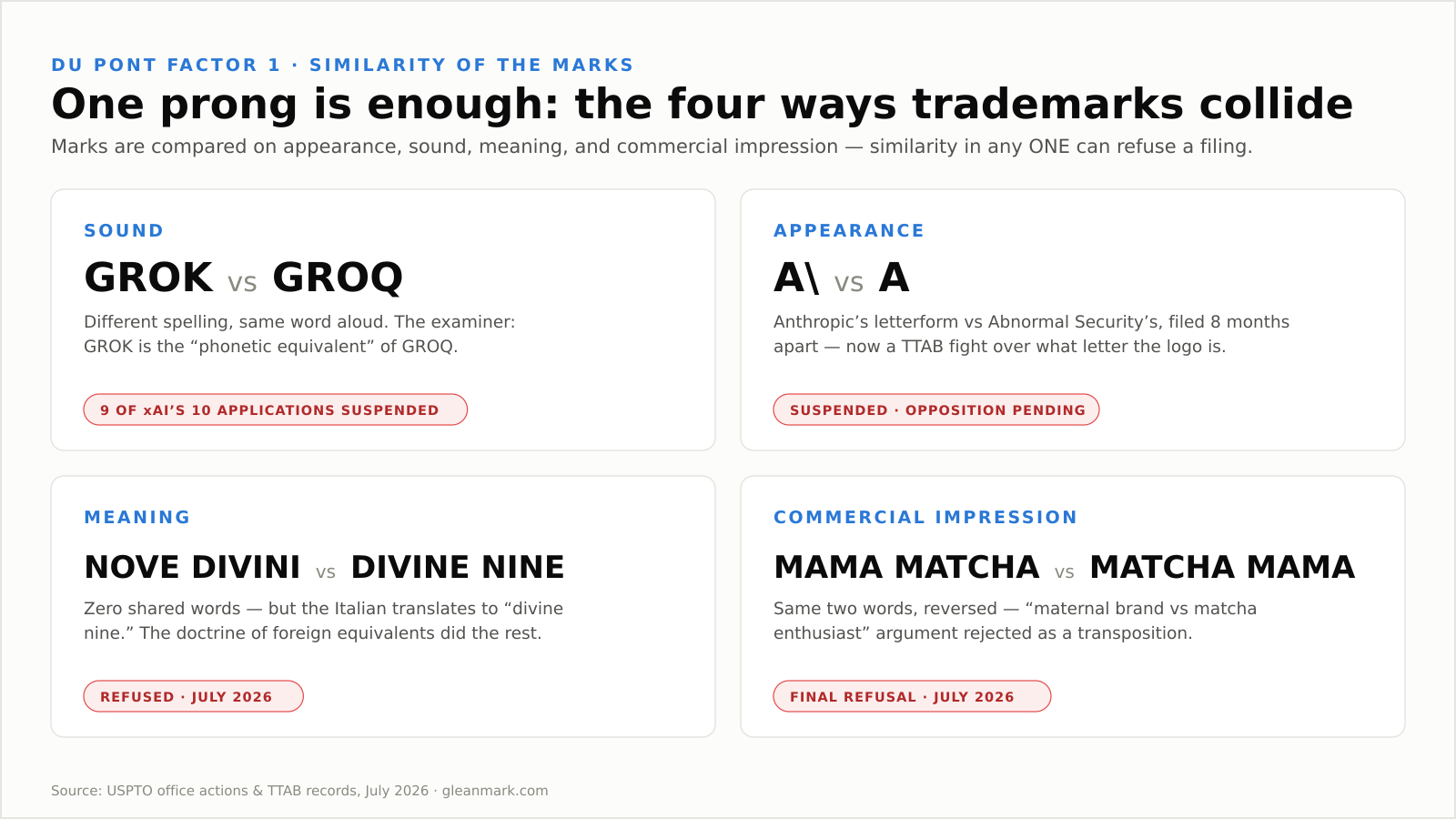
Four separate doors an examiner can walk through to refuse a name — one is enough.
Prong 1: Sound — GROK meets GROQ
The purest sound fight in the register right now belongs to xAI.
Groq, Inc. — the AI chip company — filed for GROQ in January 2017 and registered it in 2019, with a second Class 9 registration following in 2022. When xAI filed its first GROK application in October 2023, Groq's rights were already six years old. (Groq also made its feelings public with an open letter titled "Hey Elon: It's Time To Cease & DeGrok.")
The USPTO didn't need the letter. In May 2024 an examiner refused xAI's applications, citing Groq's registrations — plus a 2012 GROK registration owned by a software company called Grokstream. By the June 2025 round, the refusal ran six registrations deep, including DATAGROK. The examiner's reasoning is worth quoting, because it's exactly the trap founders fall into:
"All of the marks contain the wording GROK or its phonetic equivalent GROQ, which conveys the same overall commercial impression."
Phonetic equivalent. K versus Q never mattered. The examiner treated GROK and GROQ as the same word said aloud — which they are.
What's happened around it is a small war. In 2023, Groq itself opposed a grocery-checkout company's GROC application — abandoned after the inter-partes decision, same sound, third spelling. xAI petitioned to cancel GROXWEAR, the apparel registration blocking its merch application; that registration died in January 2026, and xAI's Class 14/25 GROK application was published for opposition in May. xAI also petitioned to cancel Grokstream's 2012 registration, then withdrew the petition in February 2026; by April, USPTO records listed xAI as that registration's owner. Grokstream, meanwhile, had petitioned to cancel a third company's GROK registration, a case now suspended while the Board decides pending motions, including a motion to substitute the plaintiff. Nearly every player in the GROK/GROQ neighborhood has been in a TTAB fight with another one.
The same prong reached into open source this year. Anthropic holds four live CLAUDE registrations covering AI software and services, and when a viral open-source project called Clawdbot took off, a trademark demand followed and the project renamed itself, per its maintainer's public account. CLAWD and CLAUDE share a phonetic fingerprint; the rename came from a demand, not a USPTO refusal. Sound-alike risk doesn't wait for you to file — it can arrive as a demand letter while you're still picking a logo.
The lesson: say your name out loud, then say the obvious respellings out loud. If they sound like something already registered in your space, the spelling will not save you.
Prong 2: Appearance — two logos walk into the same alphabet
Sound assumes words. Logos collide silently.
Last November, Anthropic filed four applications for its "A\" design mark — the stylized letterform it uses as its logo. In March, the examiner's search results flagged a problem Anthropic already knew about: Abnormal Security's stylized "A", filed eight months earlier, covering the same Class 42 territory. By June, all four Anthropic applications were suspended, frozen behind Abnormal's prior-filed application. Anthropic, meanwhile, had already opposed Abnormal's application at the TTAB — a proceeding that's still pending, now suspended while a federal lawsuit between the two companies plays out.
Two things make this the definitive appearance case of the moment.
First, the crowd. When we ran Anthropic's mark through GleanMark's design search in July, it surfaced other stylized-A marks orbiting the same letterform. Single letters are crowded real estate in the visual register.
Second, the fight inside the fight: Abnormal's TTAB answer denies its logo is a stylized "A" at all — it insists the mark reads as "AI." The parties are litigating what letter the logo is. That's what appearance similarity looks like at full intensity, and we covered the whole story in our Anthropic v. Abnormal deep dive.
The lesson: clearing the word is not clearing the mark. If your visual identity leans on a single letter or a simple geometric form, someone is already near you, and a design-level search is the only way to know how near.
It cuts the other way too. A word mark filed in standard characters is not tied to any font, style, size or color, which is why In re Viterra (Fed. Cir. 2012) let the examiner compare the plain word XCEED against a stylized X-Seed logo in any form XCEED might take.
Prong 3: Meaning — the refusal that crossed a language barrier
This July, a Healdsburg, California company called Popcorn Design received an office action on its wine brand NOVE DIVINI — Italian, elegant, and refused.
The cited registration shares not a single word with it: DIVINE NINE WINES AND SPIRITS, on file since 2023 and registered this April. The collision is entirely in the meaning. Under the doctrine of foreign equivalents, examiners translate non-English marks into English before comparing them — and here the examiner found the ordinary American purchaser "will stop and translate the mark because the English translation is literal and direct."
The painful detail sits in the applicant's own paperwork. Every application for a foreign-language mark includes a translation statement, and NOVE DIVINI's reads:
"The English translation of 'NOVE DIVINI' in the mark is 'DIVINE NINE.'"
The application announced its own conflict, verbatim, in the filing.
The doctrine has limits — courts apply it only where American buyers would actually stop and translate, a standard that comes straight out of the Veuve Clicquot fight above. But betting your brand on consumers not translating "nove divini" over a glass of wine is not a clearance strategy.
The lesson: search the translation, not just the spelling. Your Italian, Spanish, or French brand name is, to an examiner, its English equivalent wearing a costume.
Prong 4: Commercial impression — the matcha standoff
The fourth prong is the one founders find genuinely unfair, so here is this month's cleanest example.
On New Year's Day 2026, an applicant filed MAMA MATCHA for matcha and coffee products. The register already held MATCHA MAMA — the examiner cited two of its registrations, for a coffee-and-juice-bar brand whose owner's address of record is Tulum, Mexico. Same two words, opposite order, different classes: the applicant sells goods (Class 30), the registrant runs cafés (Class 43).
The applicant made a real argument: MAMA MATCHA "suggests a maternal or family-oriented brand identity," while MATCHA MAMA "suggests a person characterized by matcha or a colloquial 'matcha enthusiast.'" A matcha-loving mom versus a mom-run matcha brand. It's not a silly distinction.
The examiner rejected it anyway, citing decades of transposition decisions — RUST BUSTER blocked by BUST RUST, THE WINE SOCIETY OF AMERICA blocked by AMERICAN WINE SOCIETY — and wrote that the only difference between the marks "is the transposition or reversal of the terms," which "create substantially similar commercial impressions." In July, six months after filing, the refusal went final.
Note what didn't save the applicant: being in a different class. Goods versus services, matcha powder versus a juice bar — the refusal issued anyway, because the goods and services are related in the way consumers actually encounter them. That's the second du Pont factor doing its work, and it's where this series goes next Wednesday.
The lesson: commercial impression is the gestalt test — what sticks in a consumer's memory after one exposure. Word order, added descriptive words, and clever re-arrangements usually don't change it.
The uncomfortable arithmetic
Four prongs. One is enough.
- GROK ≠ GROQ on paper. Refused on sound.
- A\ ≠ A to a designer. Frozen on appearance.
- NOVE DIVINI shares zero words with DIVINE NINE. Refused on meaning.
- MAMA MATCHA reverses MATCHA MAMA. Final refusal on commercial impression.
And every one of these collisions was sitting in the public record before the junior filing was made: Groq had filed for GROQ more than six years before xAI filed; Abnormal's application was eight months old when Anthropic filed; DIVINE NINE's application predated NOVE DIVINI's refusal by three years; MATCHA MAMA was registered nearly two years before MAMA MATCHA was filed. Not one of these was unknowable. They were unlooked-for.
How to actually clear a name against all four prongs
This is exactly the gap GleanMark is built to close:
- Phonetic search — finds GROQ when you search GROK, CLAWD when you search CLAUDE. Sound-alike matching across 14M+ marks, because examiners compare with their ears.
- Design search — finds the stylized-A marks around yours before an examiner does.
- Full-record search with translations — the register's own translation statements are searchable data; NOVE DIVINI's conflict was one query away.
- Watch alerts — when someone files near your name (in sound, look, or meaning), you hear about it while opposition is still an option, the way Groq and the Clicquot house did.
The four prongs aren't law-school trivia. They're four separate doors an examiner can walk through to refuse your name — and this month, real examiners walked through every one of them.
Start free at gleanmark.com.
GleanMark is a trademark intelligence platform built on the full USPTO database. This post is commentary on public records for informational purposes and is not legal advice. Application statuses, office-action text, and TTAB proceeding details are drawn from USPTO records as of July 2026 and rechecked in October 2026; pending applications and proceedings may resolve either way, and nothing here predicts an outcome. This is part of a weekly series walking through all thirteen du Pont factors — factor two, relatedness of goods and services, is next.