Press release · For immediate release
Roughly 1 in 20 New U.S. Trademark Filings Now Claim AI, New GleanMark Report Finds
GleanMark makes its public launch announcement today — research, clearance, office action drafts, watching and deadlines in one place, with the USPTO record behind every answer — alongside its first “State of Trademark Filings” report. The platform has been open to customers since April 2026.
Key findings — State of Trademark Filings, January–July 2026
- “Artificial intelligence” appears in roughly one of every 20 new U.S. trademark applications (4.87% of 408,346 filings) — nearly triple its share two years ago.
- 65.4% of those AI applications are intent-to-use, against 48.2% for everything else — companies are naming AI products before they reach the market.
- “AI” is now the most-disclaimed word in new applications apart from corporate-form abbreviations like “Co.” and “LLC” — renounced nearly 700 times this year.
- The USPTO is digging out. The wait for a first Office Action has fallen from 251 days to 133 in two years.
PORT CHESTER, N.Y., August 10, 2026 — “Artificial intelligence” now appears in roughly one of every 20 new U.S. trademark applications — nearly triple its share two years ago — and 65.4% of those filings are intent-to-use, against 48.2% for everything else: companies are naming AI products they have not yet brought to market. Those are among the findings of the “State of Trademark Filings” report, released today by GleanMark and drawn from its structured corpus of the public USPTO record. The phrase is counted where it appears in the application’s goods-and-services description — the applicant’s own plain-English statement of what the mark will be used for — and the count requires it spelled out in full, so applications using only “AI” are not counted and the share is a floor rather than a ceiling. The report also finds that “AI” is now the most-disclaimed word in new applications apart from corporate-form abbreviations like “Co.” and “LLC,” renounced nearly 700 times this year by applicants formally giving up any exclusive right to it, even as crypto-era vocabulary fades. (Full report and methodology: gleanmark.com/reports/state-of-trademark-filings-jan-jul-2026.)
The report arrives alongside GleanMark’s own launch. Ask a U.S. trademark attorney about their tools and the same complaints come back: a clearance search that costs $1,000, takes three days, and arrives as a 500-page PDF someone still has to read; office action responses that eat a day of legwork; a watch service that buries real conflicts in noise; a separate docketing system; and uspto.gov open in a browser tab “constantly.” The new crop of AI tools adds a different problem — invented case law an attorney has to fact-check. GleanMark puts that work under one roof: trademark search, clearance analysis, office action response drafting, watching and deadline tracking in one place, with every answer drawn from the actual USPTO record and every decision left where it belongs — with the attorney. Research that took hours on uspto.gov takes seconds; a clearance analysis comes back in minutes, not days.
GleanMark’s two flagship products tackle the most expensive, highest-stakes moments in U.S. prosecution — clearing a mark before filing, and responding to an examiner’s office action — on one principle: an AI tool advising a trademark attorney should show its work. The data report is that same principle turned outward — every figure in it traceable to the register it came from.
The data study
Most published commentary on trademark filing trends relies on USPTO summary statistics or attorney surveys. GleanMark’s report instead queries the underlying record set directly, surfacing signals aggregate statistics do not: which examiner objections stop applications most often, how fast the USPTO is actually moving at every stage of prosecution, and which existing registrations block more new applications than any other. The company intends to publish it on a recurring basis and to make the methodology available to reporters, academics, and practitioners on request.
Clearance that shows the evidence behind the verdict
GleanMark Clearance is built for the part of the job that decides a filing: a Section 2(d) likelihood-of-confusion analysis that the attorney reviews, adjusts, and issues under their own firm’s name. A multi-stage search engine finds the conflicting marks, ranks them, and then does the deep evidence work on the ones that actually threaten the filing. The tool supplies the evidence; the attorney makes — and remains responsible for — the legal determination. It is deliberately U.S. and USPTO-focused, going deeper on the one register that decides a U.S. application rather than broad and shallow across many.
- Why each mark was flagged, not just a score. Where most clearance tools return a single confusion number and stop, GleanMark shows its reasoning for every conflict it surfaces: an exact match, a near-identical spelling, a mark that sounds alike, a shared dominant element, a pseudo-mark equivalent of a stylized mark, or a foreign-language equivalent under the Doctrine of Foreign Equivalents. Alongside it sits a goods-and-services overlap score computed from the actual wording of both filings, so an attorney can see which half of the analysis is driving the result.
- The prosecution history of the marks standing in your way. Clearance happens before you file, so the useful evidence is what the Office has already done to everyone else. For the conflicts closest to your mark, GleanMark pulls the prosecution record — what examiners refused on those marks, under §2(d) and on registrability grounds, and how those applicants fared. Where one conflict clearly dominates, it also pulls that owner’s TTAB record — how many proceedings they have been in and how often as the party bringing them — which is the difference between a mark that simply sits on the register and an owner who fights. It also searches closely similar dead marks, because a mark that died at examination tells you what the Office objected to before you spend anything finding out yourself.
- Whether the mark can register at all, not just who is in the way. A separate registrability screen covers the bars that have nothing to do with anyone else’s mark: whether it is merely descriptive, primarily a surname, or primarily geographic (§2(e)); whether it falsely suggests a connection or is deceptive (§2(a)); whether it uses a flag or government insignia (§2(b)); and whether it uses the name of a living person without their written consent (§2(c)). That section is written in plain English for the client to read, not only for the attorney.
- Goods-and-services overlap, calibrated on the real record. The overlap analysis (du Pont factor 2) is tuned against the goods relationships the USPTO has actually cited for confusion, rather than what a generic similarity model guesses.
- You own the deliverable. Attorneys edit the AI-drafted memo, choose which conflicts and which sections appear, and export a firm-branded report as PDF, plus Word and Excel for further customization, complete with a “How We Searched” methodology appendix.
Pricing is public and self-serve. A free USPTO search is the front door, no account required. Paid plans start at $99 a month, published at gleanmark.com/pricing, with no sales call required to see the cost and no minimum seat block. Clearance reports and office action drafts carry monthly allowances that scale with the plan — office action drafting is unlimited on the top tier — and are priced per matter beyond the allowance, so a firm can allocate the cost to the client file.
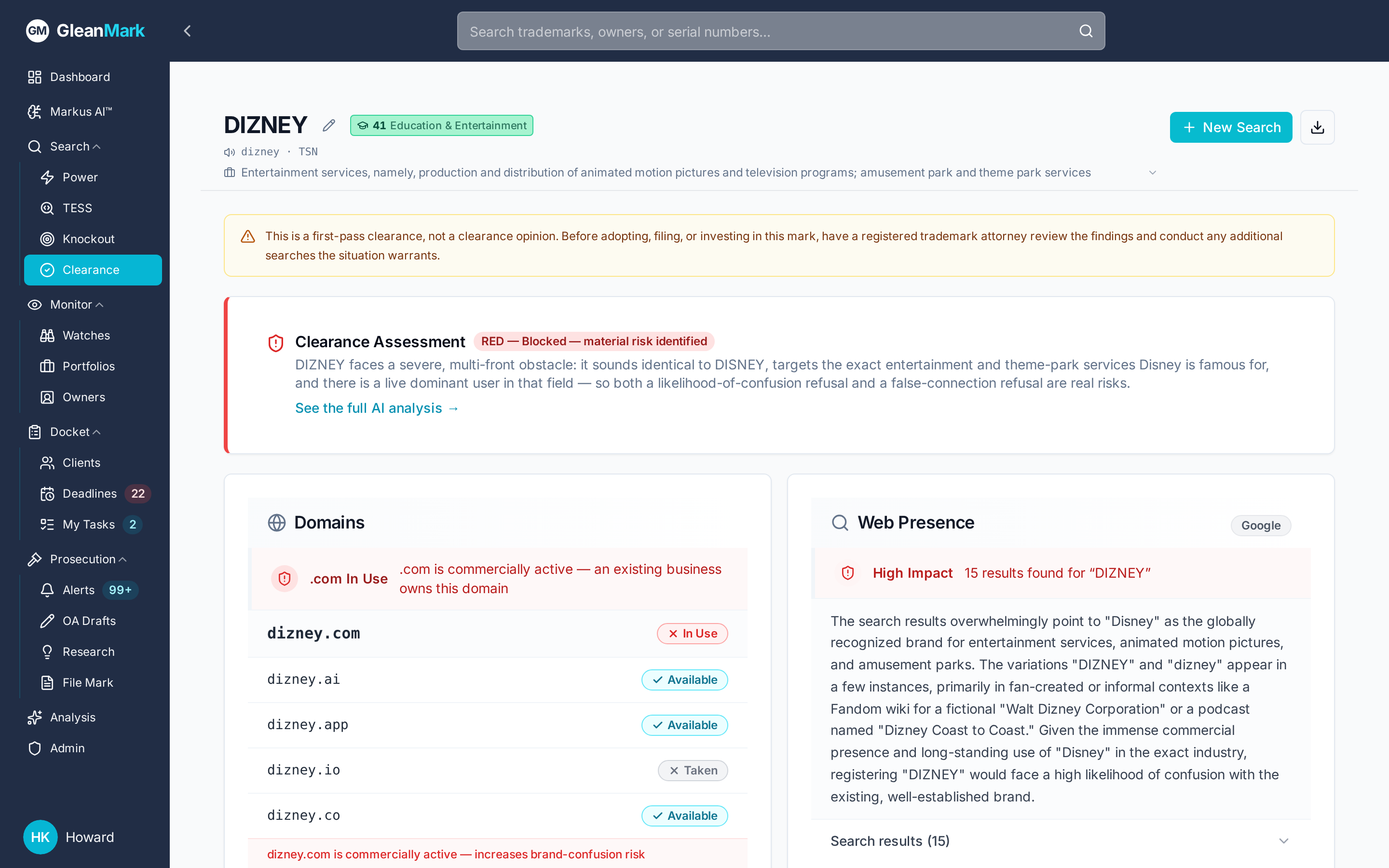
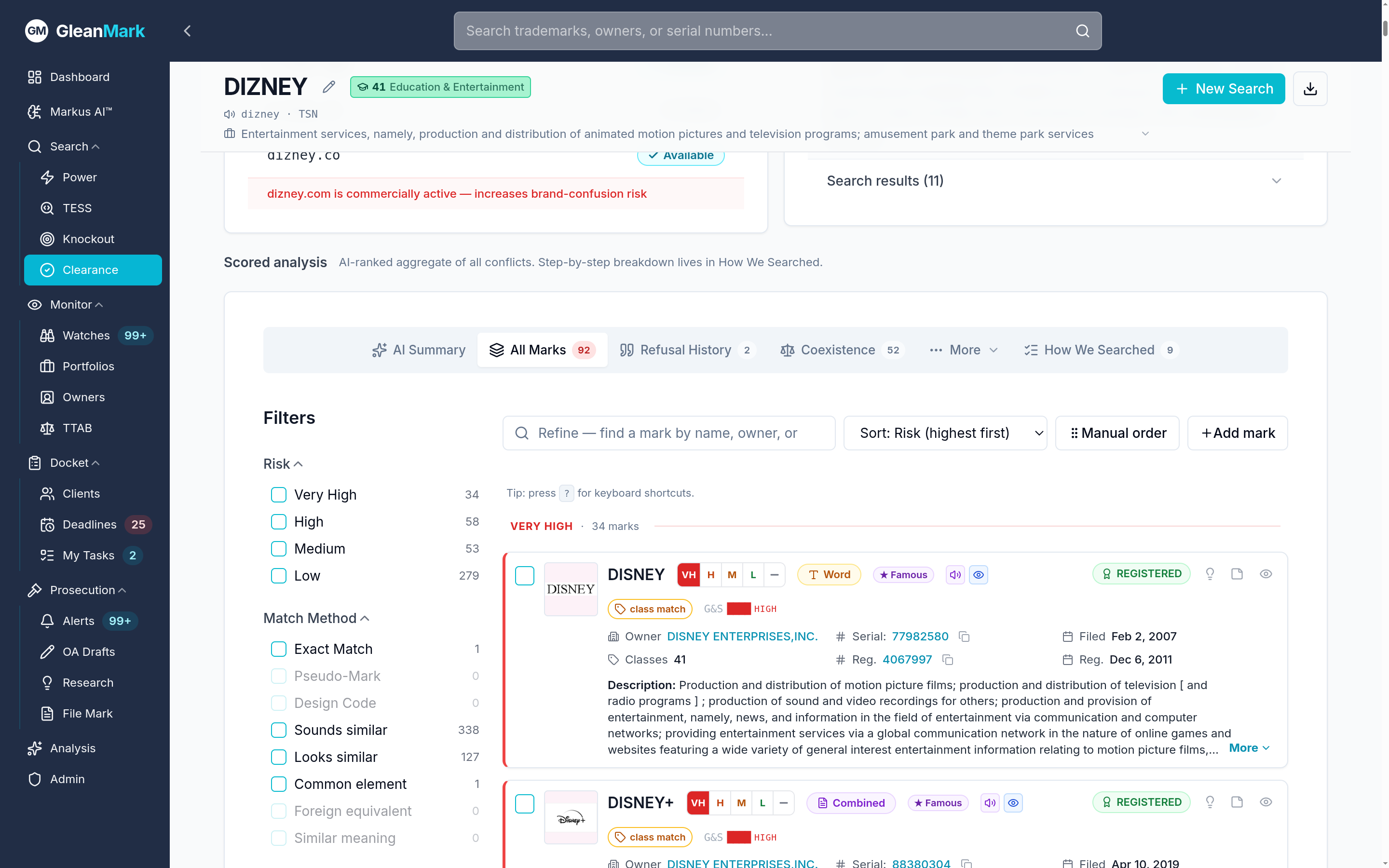
Download a full sample clearance report (PDF) — a complete 21-page analysis of the invented mark DIZNEY, delivered the way a firm delivers it: under the firm’s own logo and name, with GleanMark in the footer. White-label report branding is built in.
An office action response drafter that argues from the record
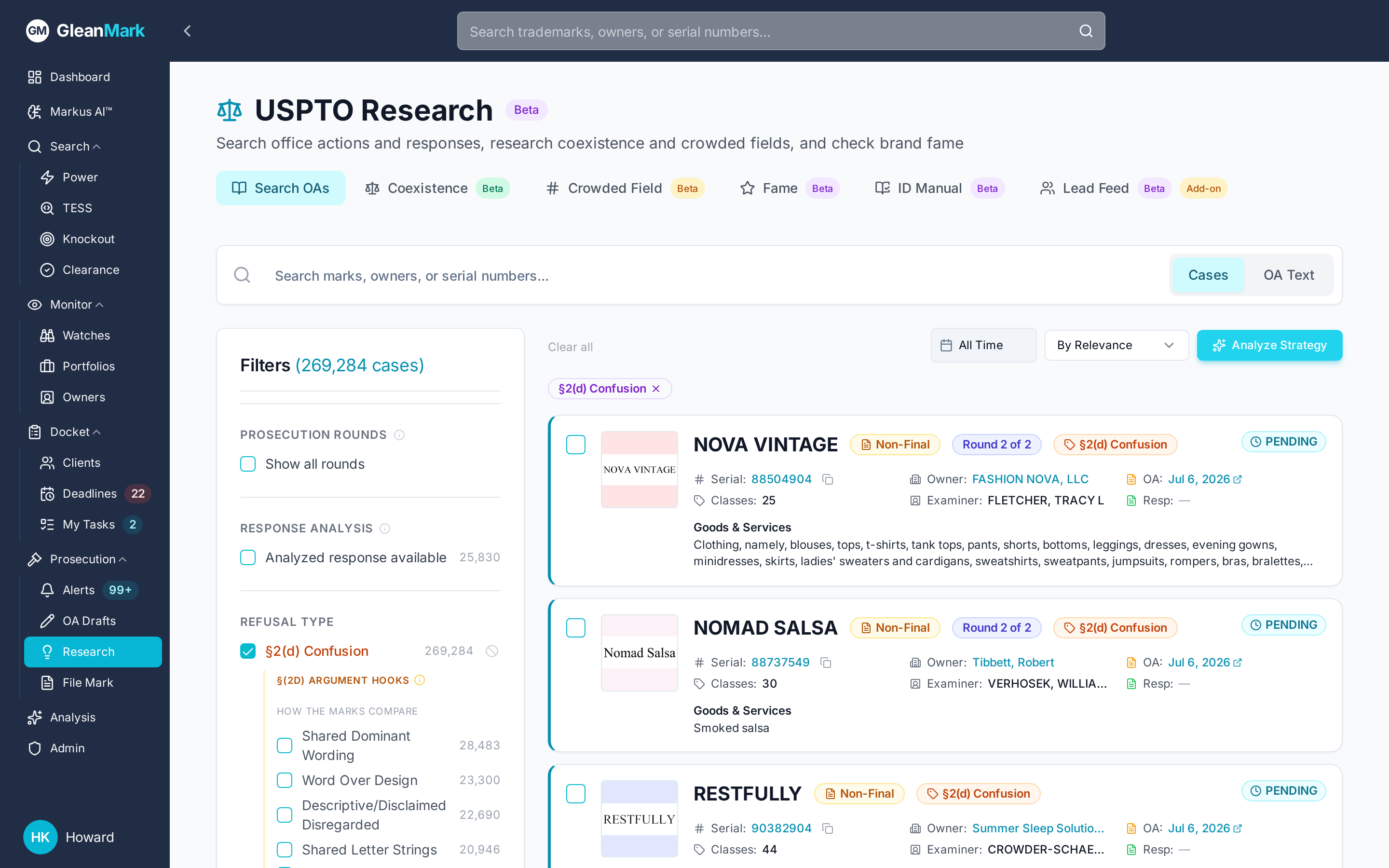
GleanMark’s Office Action Response Drafter takes on the part of prosecution attorneys describe as the biggest drain on their time: the research legwork and argument development behind a response. It produces the first take a firm would otherwise assign to a junior associate — an attorney-reviewed first draft of a response to a Section 2(d) or related refusal, with the legwork already done. Unlike tools that generate fluent argument and stop there, GleanMark backs its arguments with material pulled from the prosecution record — real third-party registrations, crowded-field evidence, coexistence examples, and prosecution events the attorney can verify, not citations a model invented.
It asks before it writes. The drafter opens by putting the strategic decisions to the attorney rather than guessing at them: which cure to elect, which client authorizations exist, and which facts the record does not contain. It surfaces only the cures doctrinally available for that refusal, and flags whether each recommendation is verified in the record or inferred. After a draft exists the attorney can redirect it in plain language — drop an amendment, lead with a different argument — and the response is rebuilt around that instruction. The gap between a hedged memo and a draft worth filing is usually one decision only the attorney can make, so the tool asks for it instead of assuming.
The drafter assembles its arguments from the record and supports each with named evidence, across five record-based arguments: crowded-field weakness (du Pont factor 6), term distinguishment (factor 1), registry coexistence (In re Thor Tech), applicant prior coexistence, and Section 2(e)(1) distinctiveness.
Just as important is when the tool declines to argue. Every argument runs behind an honesty gate that works in both directions: it withholds an argument the record cannot support, and it flags when supporting evidence is thin rather than asserting a crowded field or coexistence that does not hold up. A fabricated registration or a misstated cited-mark status does not save time; it creates fact-checking work and professional risk.
GleanMark positions the drafter as an attorney-reviewed first draft. It accelerates the work of a trademark practitioner. It does not replace one, and it makes no win-rate or guaranteed-outcome claims.
Markus: an AI that knows the register, not just the law
General-purpose AI models are genuinely good at trademark doctrine — they can recite the du Pont factors and draft a passable affirmative defense. What they cannot do is tell you what is actually on the register: which marks coexist, what an examiner allowed last month, or how a specific opposer has actually litigated. Asked anyway, they will guess, confidently.
Markus, GleanMark’s AI research assistant, is different by construction: it sits on the same USPTO corpus the rest of the platform runs on, and answers by querying it. An attorney can ask in plain English how often a specific opposer actually files an opposition rather than only an extension of time, how many independent owners hold live registrations for a crowded three-letter term, or what a proposed mark sounds like to a phonetic net rather than how it is spelled. Every table it returns carries real serial numbers the attorney can verify against the USPTO record — and when the data cannot support a statistic, Markus declines to produce one rather than inventing it.
Markus in Practice — verified AI sessions (PDF) collects real Markus sessions end to end, each answer traceable to the USPTO record behind it.
And much more
Around the two flagship products, GleanMark adds a platform that earns its keep for working trademark firms — much of it fully automated, so the firm does nothing to keep it running:
- Fast-track onboarding. A firm signs up with its correspondence email address, and GleanMark matches that against the USPTO correspondent record and maps the firm’s marks into its portfolio automatically — no manual import.
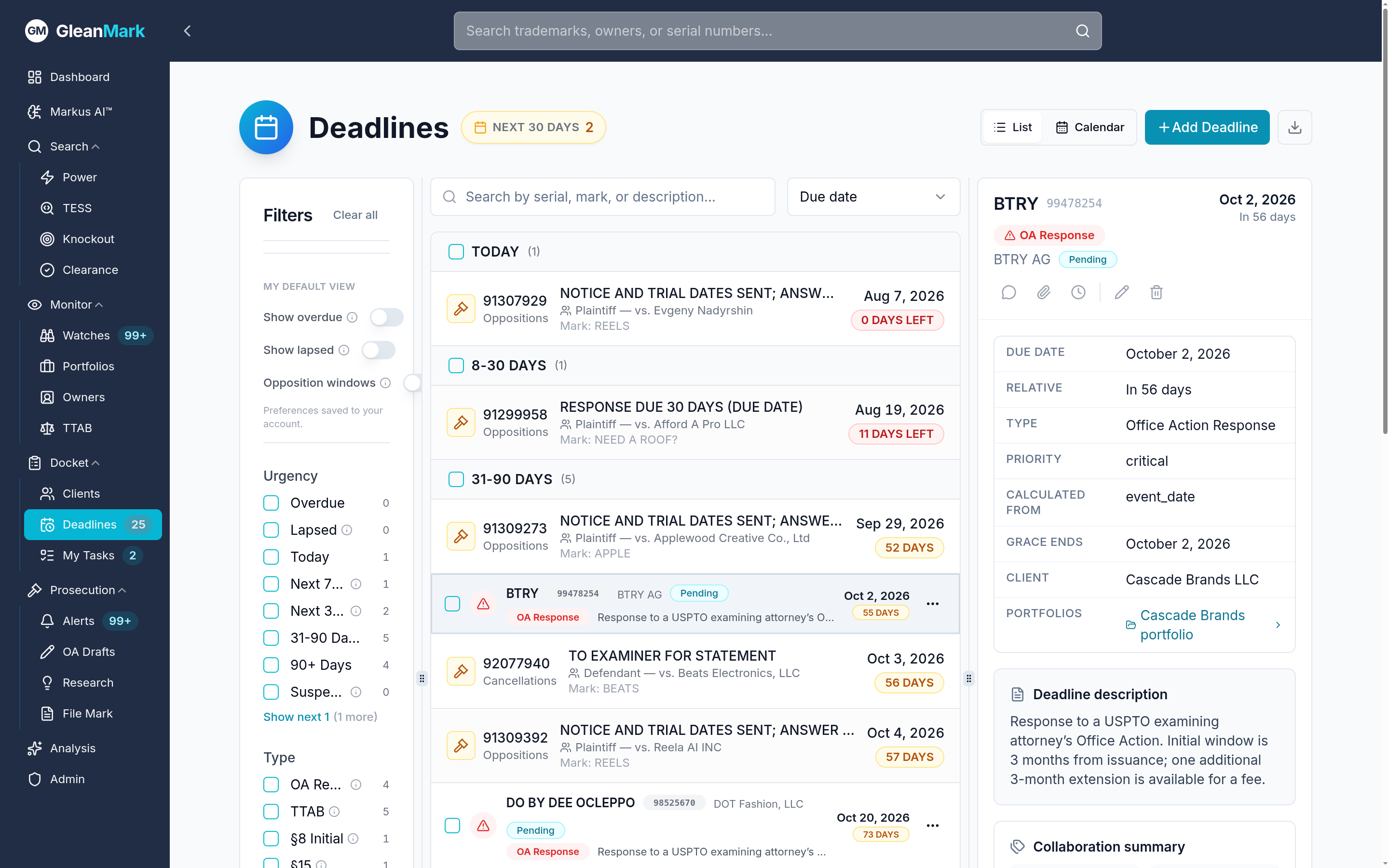
- Automated deadline tracking. Office action response, Statement of Use, and Section 8, 9 and 15 maintenance deadlines are generated from the USPTO record automatically as soon as a mark enters the portfolio, with reminders — a system-of-record backstop to the firm’s own docketing, not a replacement for it, so a missed entry does not become a missed deadline.
- Automated monthly client reports, carrying the firm’s logo and name, that the firm sends to its own clients.
- Watch-search alerts that match on sound-alike and design-image similarity, narrowed by class and goods keywords, for curated monitoring rather than an undifferentiated firehose.
- A Section 2(d)-integrated design search for logo and combined marks, and an office action research page over the same prosecution corpus that powers the drafter.
“Clearance and office action responses are where trademark practice gets hard and where the bills get big. Most tools hand you a confidence score and call it clearance, or hand you a generated argument and call it a draft. Neither one shows its work. We built GleanMark the other way around. The clearance analysis shows why each conflict surfaced and what the record already says about it, and the office action draft comes with the actual third-party registrations and on-register coexistence evidence the record supports. When the record does not support an argument, the tool says so instead of inventing one. Every factual assertion is sourced to the record, so an attorney can verify it before signing their name to it.”
“We handle trademarks for several thousand clients, and at that volume staying organized used to be most of the job. GleanMark keeps the whole portfolio straight and tells our clients automatically when something moves on their file. Clearance and day-to-day research now live in one place instead of across multiple vendors, and GleanMark’s prosecution summaries and overall visual experience are exceptionally useful. We run a more organized practice, our clients hear from us before they think to ask, and everything is included in one monthly fee.”
“Anyone who does trademark work has uspto.gov open in a tab all day — jumping between TSDR and the search page, never quite seeing the whole picture in one place. GleanMark puts it all in one place, organized the way you’d actually work a file. That was clear from the first session.”
“I use GleanMark across clearance, office action responses, and general research. What sets it apart from the other trademark tools is the depth of the record underneath GleanMark. On clearance, it surfaces the conflicting marks thoroughly and gives me enough on each one to make my own call and sign off with confidence, instead of relying on a black-box ranking. On office action responses, it brings not just the arguments but the actual evidence behind them. And for day-to-day research, I can get a straight answer on any owner, any proceeding, or any single mark in seconds.”
Product demo
A 77-second product demonstration video is available at youtu.be/VllrRq0k0kA.
About GleanMark
GleanMark is a U.S. trademark intelligence platform for attorneys and law firms, built on a canonical corpus of 14 million USPTO records, 650,000+ TTAB proceedings, 4.9 million+ trademark owners, 30,000+ active law firms, 266,000+ attorney profiles, and 240 million+ prosecution events. Every trademark, owner, law firm, correspondent and TTAB proceeding on the register has a research profile, and the same corpus powers GleanMark’s recurring monthly and quarterly data reports. Its two flagship products are a clearance engine and an evidence-grounded Office Action Response Drafter, supported by automated USPTO deadline tracking, fast-track portfolio onboarding, firm-branded client reporting, design search, and semantic watch-search monitoring. Founded in 2025 by Howard Katzenberg — an 11-year CFO, including at OnDeck, who founded the fintech company Glean before GleanMark — the company is self-funded. GleanMark is focused on the U.S. register by design and is live with paying customers. Plans start at $99 a month with a free tier; pricing is published at gleanmark.com/pricing. Learn more at gleanmark.com.