What Coca-Cola's "Spricy" Trademark Actually Tells You — and What It Doesn't
Coca-Cola filed to trademark "Spricy." A data look at how the company really files, why most of these names quietly die, and the one detail that says this one might be a real product.
 By Howard Katzenberg
Founder of GleanMark. Eleven years as a CFO, then founder of the fintech company Glean.
Updated August 10, 2026
A data look at how Coca-Cola really files, why most of these names quietly die, and the one detail that says this one might be different.
On July 9, Coca-Cola filed to trademark SPRICY — a standard word mark, a single class (Class 32, soft drinks), goods described in two words: "Soft drinks." The coverage read it as a signal that a new spicy-sweet soda is coming, a play on the "swicy" flavor trend, arriving after the company discontinued Coca-Cola Spiced last year.
Maybe. But a trademark filing tells you less than the headlines assume — and the parts of Coca-Cola's own record that do say something have almost nothing to do with the word "Spricy." We pulled Coca-Cola's full filing history. Here's what the register actually shows.
A filing like this signals less than you think
The instinct is to read a trademark application as a product announcement. It isn't. SPRICY was filed intent-to-use — the applicant only has to swear a good-faith intention to use the name someday. No product has to exist. No recipe, no launch date, no can on a shelf. There's no first-use date in the file because there's nothing in market yet.
And intent-to-use is how Coca-Cola files almost everything. Of the 108 applications Coca-Cola filed between January 2021 and June 2026, 95 — about 88% — were intent-to-use. For a company this size, reserving names before products exist is simply standard practice, not a tell. The filing basis tells you nothing unusual.
What it does tell you is narrower, and more useful: the name cleared Coca-Cola's internal legal screening, and someone decided it was worth the cost of locking down. That's a green light for the name — evidence the brand team likes it — not evidence a product is on the way.
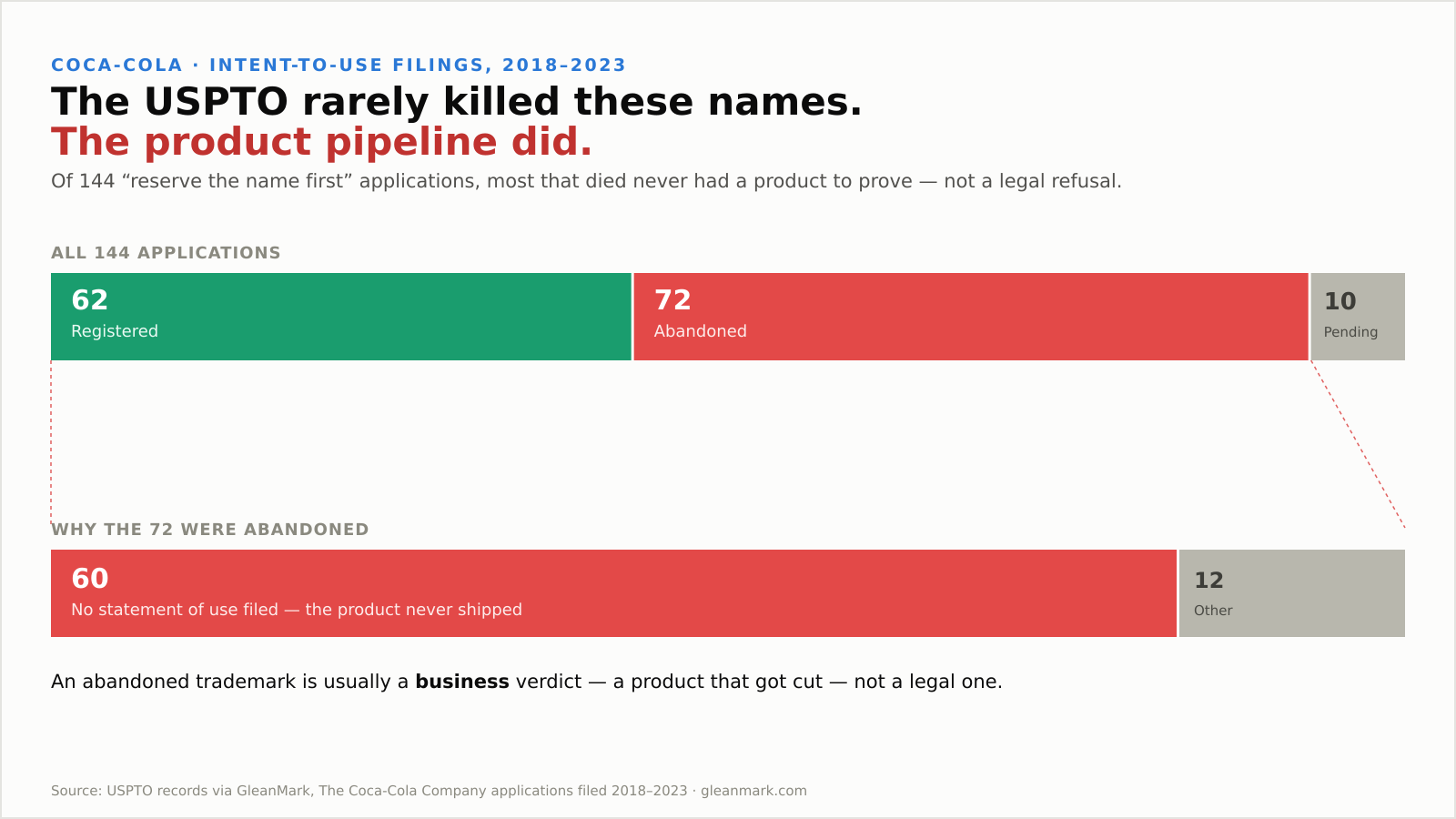
The trademark office rarely killed these names. Coca-Cola's product pipeline did.
What actually kills filings like this (hint: not the USPTO)
To see how these play out, look at an older cohort — the 144 intent-to-use applications Coca-Cola filed from 2018 through 2023, old enough that most have resolved. The scoreboard: 62 registered, 72 abandoned, 10 still pending.
Here's the part that matters. Almost none of the 72 abandoned names died at the hands of the trademark office. 60 of the 72 died for exactly one reason: Coca-Cola never filed a statement of use — the sworn proof, with a specimen, that it was actually selling the product. The examiner didn't refuse the name. The name cleared. What never showed up was the product.
That reframes what an abandoned trademark means. When one of these names dies, it's almost never a legal defeat. It's a commercial verdict — a product that got cut, delayed, or reformulated somewhere between the filing and the shelf. The USPTO rarely killed these names. Coca-Cola's own pipeline did.
The runway, and when to expect a real drink
If SPRICY does become a product, the record gives you a timetable. Among Coca-Cola's registered intent-to-use marks from 2018–2023, the median run from filing to registration was about 490 days — roughly 16 months — with the middle half landing between about 12 and 25 months.
Compare that to how fast Coca-Cola registers a mark for something it's already selling: a median of about 186 days — six months. The gap between six months and sixteen isn't legal process. It's the product pipeline — the year-plus a name spends waiting for an actual drink to exist so the company can prove use.
Map that onto SPRICY, filed July 9. If it's headed for shelves on the typical trajectory, expect evidence of a real product sometime between mid-2027 and early 2028. If it isn't, expect a quiet abandonment sometime after that — no announcement, just a statement of use that never gets filed. Coca-Cola Spiced is the cautionary tale: the product was discontinued, so the use will simply never be proven. SPRITE LIMELIGHT, a Sprite line extension filed in 2022, is another — filed, then abandoned.
The detail that suggests this one is real
Now the part of the record that genuinely leans toward "a product is coming" — and it's not the filing basis. It's the fact that SPRICY got its own filing at all.
Coca-Cola Spiced — the discontinued product everyone is comparing this to — never had its own trademark. Search the entire register and you'll find zero applications containing "Spiced" ever filed by The Coca-Cola Company. Spiced rode under the house COCA-COLA mark. Giving SPRICY a dedicated, standalone application is itself the signal: it suggests Coca-Cola sees independent brand equity in the name — something worth protecting on its own — that it never bothered to claim for Spiced.
The broader activity fits a company leaning into flavor extensions. Coca-Cola holds more than 250 live U.S. registrations and 36 pending applications, 13 of them filed just in 2026. The Sprite program in particular is unusually busy right now: HURTS REAL GOOD WITH SPRITE is registered, IT'S THAT FRESH, SPRITE is pending, and a fresh core SPRITE application landed in July 2025.
The smart part: "Spricy," not "swicy"
There's one more thing the register rewards Coca-Cola for — sidestepping a crowded fight.
The obvious name for a spicy-sweet product is "swicy," the trend term itself. That space is a pileup: among live marks containing "swicy," there's one registration and fifteen pending applications, spread across six different owners. Frito-Lay filed the bare word "SWICY" back in December 2023 and abandoned it; its slogan SAY HELLO TO SWICY is the only live registration in the bunch, and no one has managed to register the bare word at all.
"Spricy" walks around all of it. No one has ever filed SPRICY before — it's a clean coinage with an empty lane, which is exactly what you want when you're trying to own a name rather than fight over a trend.
The one thing to watch: "Spricy" is one letter off "spicy," and there are 16 live marks containing "spicy" in Class 32 alone. So a descriptiveness question — an examiner deciding "Spricy" is just a misspelling of a descriptive word — is at least conceivable. It's a small risk on an otherwise clean name.
The real lesson for brand builders
Strip away the fizz and the takeaways are general:
- A trademark filing is not a product announcement. Intent-to-use means someone liked the name enough to reserve it — nothing more. Read it as a shortlist, not a launch.
- An abandoned trademark is usually a business story, not a legal one. Most of these names die because the product never shipped, not because the office said no.
- A dedicated filing is a stronger signal than the filing itself. Coca-Cola gave "Spricy" the standalone mark it never gave "Spiced" — that's the tell worth watching.
- Clear the lane before you commit. The reason "Spricy" is a smart name isn't the sound. It's that the register was empty — while "swicy" is a six-owner scrum.
Every one of those facts was sitting in the public record the day the application posted — the filing basis, the pipeline history, the empty "Spricy" lane, the crowded "swicy" one — for anyone who reads trademark files instead of press releases.
What this looks like on GleanMark
This is exactly what we built GleanMark for.
- Owner + portfolio intelligence — to pull a company's entire filing history and see how it actually files, wins, and abandons.
- Register + prosecution search — to find who else is in a name's lane before you commit to it.
- Filing-basis and status data — to tell an intent-to-use placeholder from a product that's actually coming.
- Watch alerts — to catch a competitor's new filing the day it posts, while there's still time to react.
The most decision-relevant facts about a brand are usually public, and usually early — sitting in a trademark file, waiting for someone to read them.
Start free at gleanmark.com.
GleanMark is a trademark intelligence platform built on the full USPTO database. This post is commentary on public records for informational purposes and is not legal advice. Application data, filing bases, and status are drawn from USPTO records as of July 2026; a pending application may register or be abandoned, and nothing here predicts a product decision or an examination outcome.
Related Articles
Buc-ee's Isn't Suing Over Its Name. It's Claiming the Cartoon Animal.
August 5, 2026
Who Actually Filed 'The Shire'? Not Universal — and the USPTO Record Tells a Bigger Story
October 25, 2026
The USPTO Has Struck 100,000 Unused Goods and Services. Here Is How a Founder Can Ask for One.
October 14, 2026