Taylor Swift Didn't Just Get Sued Over "The Life of a Showgirl" — the USPTO Already Refused It
What the public trademark record shows about the reverse-confusion fight — and why the most important fact was sitting in the file months before the lawsuit.
 By Howard Katzenberg
Founder, GleanMark
What the public trademark record shows about the reverse-confusion fight — and why the most important fact was sitting in the file months before the lawsuit.
The headline version is tidy: Taylor Swift gets sued by a Las Vegas showgirl over an album name, and Swift's lawyers call the claim "absurd" and "meritless."
Here's the part the coverage mostly skips. Months before the lawsuit, the U.S. Patent and Trademark Office had already looked at Swift's application to register "THE LIFE OF A SHOWGIRL" as a trademark — and refused it, citing the plaintiff's existing registration by name and number. That refusal isn't a plaintiff's talking point. It's in the public trademark file. We pulled it.
This is a more interesting case than "can you own the word showgirl," and it turns on a doctrine most people have never heard of.
First — what is "reverse confusion"?
Ordinary trademark confusion is the story you know: a small company free-rides on a famous brand, and consumers think the knockoff is the real thing.
Reverse confusion is the mirror image. A large, later user floods the market with a similar mark and drowns out a small, earlier one — until consumers assume the original is the imitation. The little guy doesn't lose customers to a copycat; they lose their own identity to a giant who showed up second. Courts have protected senior users this way for decades (the classic case is a small tire company that beat Goodyear over "Bigfoot").
That's the theory at the center of this case — and it's the whole reason a working performer can sue the biggest pop star on earth and not be laughed out of court.
The record: a senior mark, and a refused one
Strip away the celebrity and look at the file.
- Maren Flagg — who performs as Maren Wade — owns CONFESSIONS OF A SHOWGIRL (Reg. No. 4,800,625). She's used it since 2014 — it started as a Las Vegas Weekly column and grew into a live show, a book, a podcast, and touring performances — and registered it for entertainment services in 2015. Per the complaint, the mark is now incontestable. That's a genuine, senior, federally registered right.
- Swift's THE LIFE OF A SHOWGIRL was filed by her company, TAS Rights Management, in 2025, across fourteen classes of goods. Its status in the register today: suspended. According to the complaint, that's because on November 5, 2025 the USPTO issued an Office Action refusing the application in two classes, finding it confusingly similar to Wade's mark — and naming her registration specifically.
So the sequence, from the public file: an earlier registered mark, a later application for a strikingly similar name, and an examiner who looked at both and refused the newcomer. The lawsuit came after that.
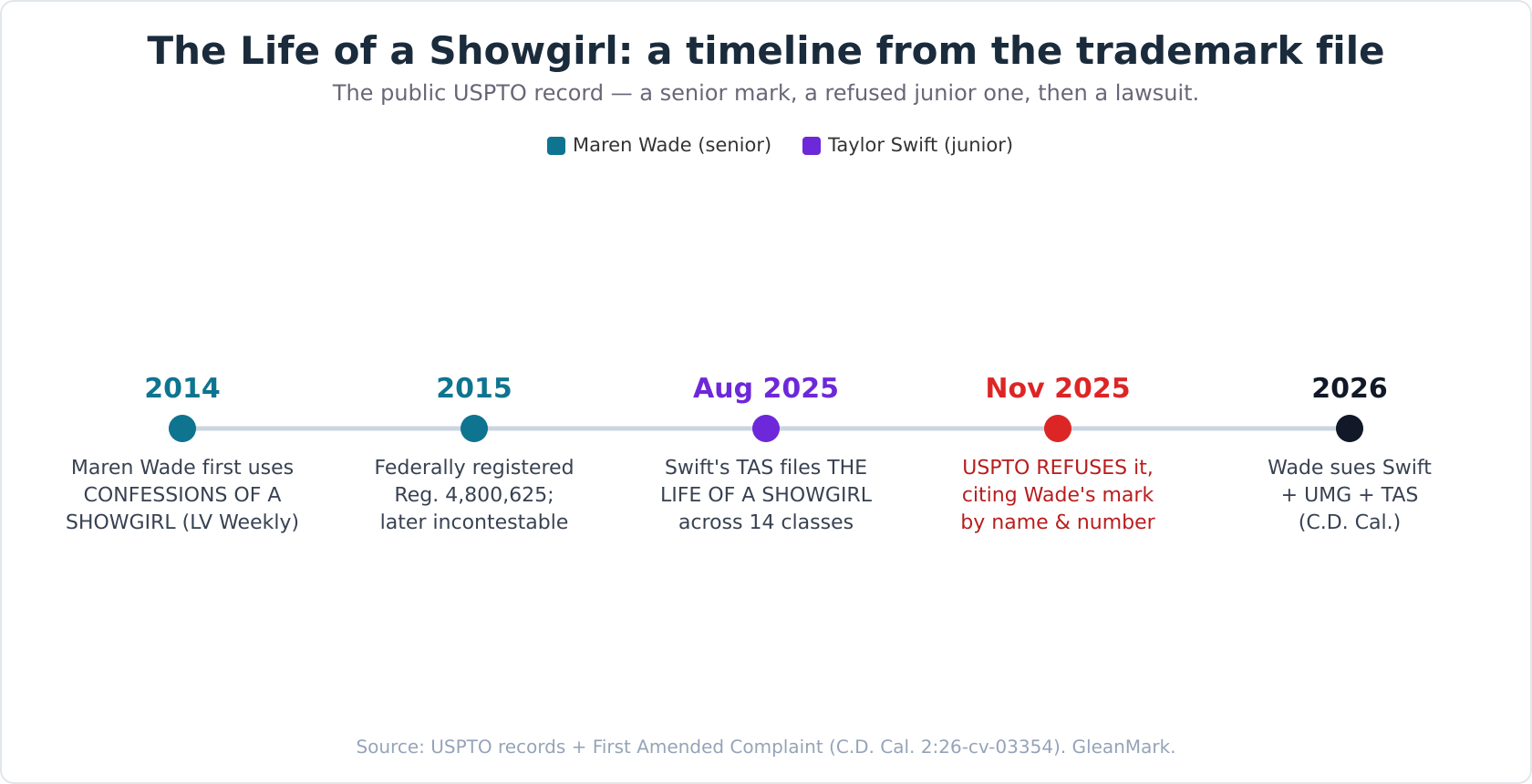
The public trademark file, on one line: a senior registered mark, a junior application the USPTO refused, and then a lawsuit.
Is "showgirl" even a weak word? The register says: not really
Swift's natural move is to argue that "showgirl" is a common, weak word nobody can fence off. The register only half-cooperates.
Count what actually matters — live registrations, not long-abandoned applications or pending ones — and "showgirl" appears in just 18 of them across the entire register, 13 of those in Class 41, the entertainment class Wade's mark sits in. And even that overstates it: those 13 belong to just seven owners, and a single strip-club licensor (the "Deja Vu Showgirls" chain) holds seven of the thirteen by itself. Strip out that one company's family of marks and you're down to a handful of independent owners — Wade among them. That's a term in use, not a hundred-deep thicket. Most of the "showgirl" filings that died, meanwhile, didn't die because the space is saturated; they were mostly abandoned for non-use — applicants who filed a name and never actually used it.
There's a smaller, telling signal too. When a word is merely descriptive, the USPTO routinely forces applicants to disclaim it — to concede they don't own that word by itself. Across the entire trademark register, "SHOWGIRL" has never once been disclaimed. It's a modest data point, but it cuts against the idea that the office treats "showgirl" as generic filler.
So the "it's just a common word" defense is available to Swift, but thinner than it looks — and it matters less than it seems anyway, because Wade isn't claiming the word. She's claiming a specific construction — "___ OF A SHOWGIRL" — with, as the complaint puts it, "the same grammatical structure," "the same dominant phrase," and "the same commercial impression": an inside, behind-the-scenes account of a showgirl's life.
The irony in Swift's own file
Here's the wrinkle that makes this more than a David-and-Goliath story.
Swift is not a trademark novice — she runs one of the most active enforcement operations in music. Her company, TAS Rights Management, holds 312 trademark applications and registrations in our data (the complaint pleads "more than 175, and growing"). And, as the complaint notes, Swift's team has itself gone to federal court to seize bootleg merchandise from vendors outside her concerts. She knows, better than almost anyone, what it means to police a brand — and what a trademark clearance search turns up.
That's the plaintiff's sharpest point: a standard clearance search would have surfaced Wade's registered, incontestable mark, and the USPTO surfaced it for them anyway. Whether Swift's team saw it and proceeded, or the theory holds up, is contested — but the register makes it hard to argue nobody could have known.
But isn't Taylor Swift too famous to be confused with a cabaret performer?
This is the intuition almost everyone has — and it's half right, which is exactly the trap.
"No one thinks a Las Vegas performer secretly released a Taylor Swift album" is true. But that's forward confusion — mistaking the small player's work for the famous one's — and it isn't really Wade's claim. Reverse confusion runs the other way: Swift's version is so enormous that it swamps Wade's senior mark, and consumers who come across Confessions of a Showgirl start to assume she's the imitator or an unauthorized tie-in — or Wade simply loses the ability to grow and control the brand she built over a decade, because the giant's version is everywhere.
In that frame, Swift's fame isn't a shield. It's the mechanism of the harm. The bigger the "Life of a Showgirl" rollout, the more it drowns out "Confessions of a Showgirl." Courts know this, which is why in reverse-confusion cases they flip the usual rule that a famous, commercially strong mark is hard to challenge — here, the junior user's sheer market power counts for the smaller senior owner, not against. The doctrine exists precisely so a household name can't say, "I'm too big to infringe."
Swift's real defenses
None of this means Wade wins. Swift has serious arguments — one of them potentially decisive.
The First Amendment / expressive-title defense. "The Life of a Showgirl" is the title of an album — an expressive work. Under a long line of cases (starting with Rogers v. Grimaldi), titles of expressive works get real First Amendment breathing room, and trademark law usually can't touch them unless the title has no artistic relevance or explicitly misleads about who made it. An album title is close to the core of that protection.
But there's a 2023 twist, and it's exactly where this case will be fought. In Jack Daniel's v. VIP Products, the Supreme Court held that the Rogers shield does not apply when a defendant uses the term as an actual source identifier — a trademark — rather than purely expressively. And that's precisely the plaintiff's move here. The complaint points out that TAS didn't just release an album; it applied to register "THE LIFE OF A SHOWGIRL" as a trademark across fourteen classes — "candles, shoe laces, disposable napkins, and other ordinary consumer goods that bear no expressive content at all." Its line: "One does not register expression. One registers a trademark."
So the real question isn't "can you trademark a song title." It's whether Swift used the phrase as an expressive title (protected) or as a brand on merchandise (not immunized) — and the fourteen-class filing is the plaintiff's Exhibit A.
Swift also has the difficulty of actually proving reverse confusion, and simple market reality — no one thinks a Las Vegas cabaret performer released a Taylor Swift album. Those are real. This is not a sure thing for either side.
The real lesson for brand owners
Strip away the two names and the lesson is universal.
- A USPTO refusal is a signal, not a speed bump. When an examiner refuses your application and names someone else's registration, that's the government telling you there's a senior mark in your lane. Ignoring it doesn't make the mark disappear — it hands the other side a "they knew" narrative.
- Fame doesn't clear a name. The most valuable brand team on earth is still subject to the same register as a solo performer. Clearance isn't beneath anyone.
- Seniority is a real asset — even against a giant. Reverse confusion exists precisely so that being small and first still counts for something.
- Crowded fields cut both ways. They weaken the mark you're trying to enforce and the one you're trying to clear. You need to know how crowded your space is before you commit.
Every one of those facts was knowable from the public record — the registration, the refusal, the crowded field — months before any of it made the news.
What this looks like on GleanMark
This is exactly what we built GleanMark for.
- Register + prosecution search — to find the senior mark and, crucially, the refusal in an application's file history before you build a brand on it.
- Crowded-field analysis — to see how common your phrase really is, and who owns the closest marks.
- Owner + portfolio intelligence — to see how a party has enforced (and been refused) before.
- Watch alerts — to catch new filings and disputes moving into your space while there's still time to act.
The Swift case is a reminder that the most decision-relevant facts in a brand dispute are usually public, and usually early — sitting in a trademark file, waiting for someone to read it.
Start free at gleanmark.com.
GleanMark is a trademark intelligence platform built on the full USPTO database. This post is commentary on public records for informational purposes and is not legal advice. Case and proceeding details are drawn from the public amended complaint (C.D. Cal. 2:26-cv-03354), USPTO records, and public reporting as of July 2026; the parties' positions are allegations and defenses, not findings.
Related Articles
The Supreme Court will decide who measures trademark strength. Here is what measuring it looks like.
August 30, 2026
Buc-ee's Isn't Suing Over Its Name. It's Claiming the Cartoon Animal.
August 5, 2026
Who Actually Filed 'The Shire'? Not Universal — and the USPTO Record Tells a Bigger Story
October 25, 2026