Samsung Filed Its CES Headliners Before the Keynote — and December Closed 2025 at a Post-2020 High
Samsung spent the last three days of December quietly putting its CES 2026 vocabulary on the federal trademark register. AI VISION (99571762) and FOODNOTE (99572665) landed Dec.
 By Howard Katzenberg
Founder, GleanMark
Updated October 6, 2026
Samsung spent the last three days of December quietly putting its CES 2026 vocabulary on the federal trademark register. AI VISION (99571762) and FOODNOTE (99572665) landed Dec. 30; AI MOTION WINGS (99569315) and AI MOTION WIND (99569343) the day before. Days later, at its "The First Look" press event on Jan. 4, Samsung unveiled the AI Vision food-recognition platform — built with Google Gemini — and a new DualVent microwave whose pitch is a front ventilation "wing." The names were on file before the cameras rolled.
That is the more interesting December story than the topline, though the topline is solid too: USPTO trademark applications reached 53,761 for the month, the strongest December since the 2020 filing spike and the second-highest December in the 2016–2025 same-month series. The full year finished at 624,805 filings, up 4.6% over 2024.
We think the year-end strength likely reflects a familiar mix — AI-startup formation, software-service launches, e-commerce brand-registry filings, and large companies locking in names before Q1 product calendars. Samsung's pre-CES cluster is the cleanest illustration. Naming is happening earlier in the product cycle, and the register is where it shows up first.
What We Found
- Samsung pre-loaded its CES 2026 lexicon. AI VISION, AI MOTION WINGS, AI MOTION WIND, and FOODNOTE were all filed Dec. 29–30 — days before Samsung's Jan. 4 CES reveal of AI Vision and a "ventilation wing" microwave.
- December was the strongest post-2020 finish: 53,761 applications, behind only December 2020's 93,040 in the same-month history.
- 2025 finished ahead of 2024: 624,805 filings for the year, up 4.6% from 597,361.
- Services drove the year-over-year growth. Class 42 rose 39% YoY and Class 41 rose 36% — two of the largest classes on the register, not fringe categories.
- OpenAI keeps policing "GPT." Six TTAB proceedings in December, consistent with a campaign that has targeted dozens of GPT-suffixed marks.
Filing Volume
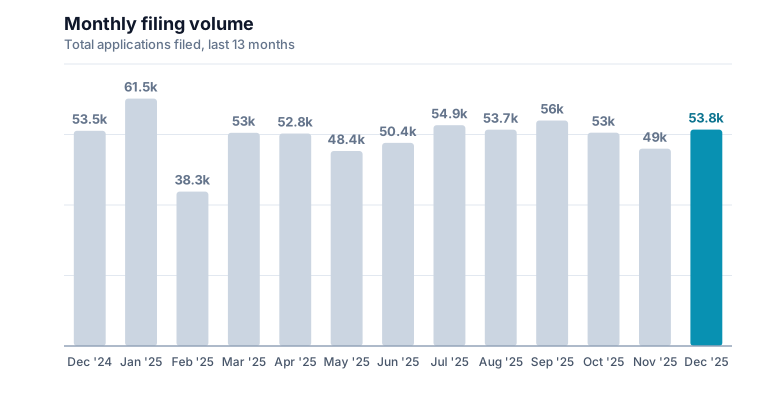
| Month | Total Filings | MoM Change |
|---|---|---|
| Dec. 2025 | 53,761 | 9.7% |
| Nov. 2025 | 49,015 | -7.5% |
| Oct. 2025 | 52,991 | -5.4% |
| Sep. 2025 | 56,026 | 4.3% |
| Aug. 2025 | 53,722 | -2.1% |
| Jul. 2025 | 54,850 | 8.7% |
| Jun. 2025 | 50,447 | 4.1% |
| May 2025 | 48,440 | -8.2% |
| Apr. 2025 | 52,785 | -0.3% |
| Mar. 2025 | 52,969 | 38.1% |
| Feb. 2025 | 38,348 | -37.6% |
| Jan. 2025 | 61,451 | 14.9% |
| Dec. 2024 | 53,459 | — |
The 9.7% rebound from November is the least interesting number here. The path through 2025 was choppy — a January high, a February trough, a March snap-back, then a long midyear-to-fall band roughly between 48,000 and 56,000. December's value is positional: only December 2020, an outlier inflated by pandemic-era e-commerce filing, beats it in a decade of same-month data.
Against December 2024 specifically, the month was nearly flat: 53,761 versus 53,459, up 0.6%. So this is not a breakout. It is a market holding near a post-pandemic high after a noisy year.
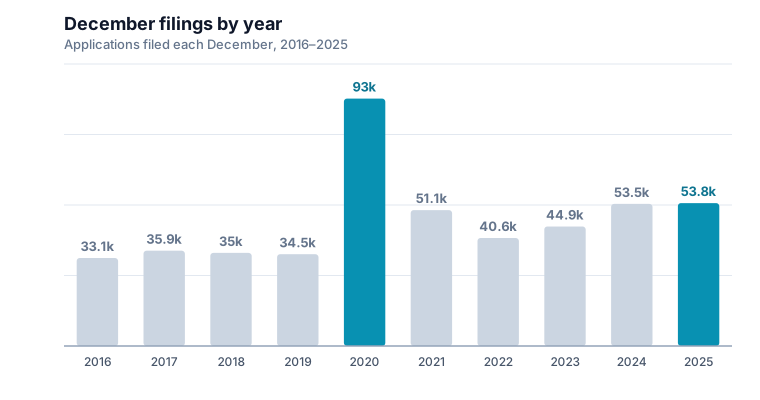
Every December, 2016–2025
| Year | December Filings |
|---|---|
| 2016 | 33,104 |
| 2017 | 35,860 |
| 2018 | 35,016 |
| 2019 | 34,540 |
| 2020 | 93,040 |
| 2021 | 51,112 |
| 2022 | 40,607 |
| 2023 | 44,949 |
| 2024 | 53,459 |
| 2025 | 53,761 |
December 2025 trails only the 2020 surge in this same-month series. The 2025 full-year total of 624,805 is the second-highest in the five-year YTD record, behind only 2021's 673,539.
NICE Class Leaderboard
| Rank | NICE Class | Description | Filings | MoM | YoY |
|---|---|---|---|---|---|
| 1 | 9 | Computer, scientific, electrical, and recorded media goods | 7,466 | 12.4% | 6.3% |
| 2 | 41 | Education, entertainment, and sporting/cultural services | 7,369 | 14% | 36% |
| 3 | 35 | Advertising, business management, and retail services | 6,150 | 9% | 13.5% |
| 4 | 42 | Scientific and technological services; software design and development | 5,749 | 13.6% | 39% |
| 5 | 25 | Clothing, footwear, and headgear | 5,486 | 9% | -0.7% |
| 6 | 3 | Cosmetics, cleaning preparations, and toiletries | 2,948 | 8.1% | 8.8% |
| 7 | 5 | Pharmaceuticals, medical, and veterinary preparations | 2,865 | 11.6% | 5.4% |
| 8 | 28 | Toys, games, sporting goods, and playthings | 2,667 | 19.3% | -7.2% |
| 9 | 21 | Household and kitchen utensils, containers, and related goods | 2,494 | 15.5% | -15.9% |
| 10 | 16 | Paper goods, printed matter, and office supplies | 2,317 | 6% | 2.7% |
| 11 | 36 | Insurance, financial, monetary, and real estate services | 2,140 | 8.7% | 19% |
| 12 | 44 | Medical, veterinary, beauty, agricultural, and forestry services | 1,827 | 8.8% | 16.6% |
| 13 | 20 | Furniture, mirrors, picture frames, and plastic goods | 1,683 | 3.9% | -24.3% |
| 14 | 11 | Lighting, heating, cooling, cooking, and sanitary apparatus | 1,540 | 9.8% | -21.3% |
| 15 | 30 | Coffee, tea, cocoa, staple foods, and confectionery | 1,476 | -1.5% | -8.7% |
Class 9 stayed the largest class, but the year-over-year action is in services. Class 42 (software and tech services) grew 39% and Class 41 (education and entertainment) grew 36% — and these aren't small-base anomalies inflating a percentage. They are the second- and fourth-largest classes on the entire register, growing at rates the goods classes can't touch.
The goods side tells the opposite story. Class 25 apparel was flat year over year, and the home categories fell hard: furniture (Class 20) down 24%, lighting and appliances (Class 11) down 21%, housewares (Class 21) down 16%. The split is the whole point. Brand formation in late 2025 was coming from software, services, and digital platforms — not retail shelves.
"If you want to know what a company is shipping next quarter, don't read the press release. Read the trademark register — they tell you there first, and usually weeks earlier."
Top Filing Owners
| Owner | Filings | Prior Month | MoM |
|---|---|---|---|
| GANNETT VENTURES, LLC | 57 | 50 | 14% |
| San Francisco Downtown Development Corporation | 42 | 0 | — |
| Guangzhou Qiji Trading Co., Ltd. | 40 | 7 | 471.4% |
| Compton Unified School District | 38 | 0 | — |
| KONAMI GAMING, INC. | 37 | 3 | 1133.3% |
| I420 LLC | 37 | 0 | — |
| Zhiqu Li | 36 | 42 | -14.3% |
| ALLIANCE DEFENDING FREEDOM | 33 | 2 | 1550% |
| DUKE UNIVERSITY | 33 | 0 | — |
| Glaxo Group Limited | 33 | 0 | — |
| GUANGHUI, CHEN | 29 | 5 | 480% |
| Wenhao Li | 28 | 0 | — |
Gannett topped the table, but the eye-catching rows are the spikes from a near-zero base: KONAMI Gaming jumped from 3 filings to 37, and Alliance Defending Freedom went from 2 to 33. Those are batch events — a portfolio push or a single coordinated campaign — not a sustained monthly cadence. Read this table for who showed up in volume, then check whether the spike is a real program or a one-time dump. Several rows here, particularly the individual-name owners, carry the fingerprints of e-commerce seller filings rather than conventional brand launches.
Top Correspondent Firms
| Firm | Filings | Prior Month | MoM |
|---|---|---|---|
| Swyft Legal LLC | 1,037 | 1,105 | -6.2% |
| LZ Legal Services, LLC | 691 | 646 | 7% |
| Alioth Law P.C. | 617 | 568 | 8.6% |
| Overseas Operation Services, Inc. DBA Flatfee Corp. | 616 | 626 | -1.6% |
| Grogan, Tuccillo & Vanderleedeen, LLP | 400 | 210 | 90.5% |
| SOLORIO LEGAL PC | 286 | 71 | 302.8% |
| Sparring Legal LLP | 258 | 228 | 13.2% |
| LegalForce RAPC Worldwide, P.C. | 250 | 193 | 29.5% |
| BAYRAMOGLU LAW OFFICES LLC | 245 | 184 | 33.2% |
| All West Law Group, PLLC | 200 | 273 | -26.7% |
| ASCUS IP LAW, PC | 199 | 150 | 32.7% |
High-throughput filing shops still own the top of this table. Swyft Legal led with 1,037 mapped filings even after a 6.2% decline. The sharper movers were Grogan, Tuccillo & Vanderleedeen (up 90.5% to 400) and SOLORIO LEGAL (up 303% to 286) — month-over-month jumps that almost always signal a single large client onboarding rather than organic growth, and worth a glance for anyone tracking where bulk filing volume is consolidating.
Notable Filings
The marks were more pitchable than the volume — and the pattern this month is timing. Several big-tech filings cluster right against announcement dates, which is exactly where the register earns its value as a forward indicator.
Samsung Electronics: AI VISION, FOODNOTE, AI MOTION WINGS, AI MOTION WIND, ENSS, DHBM
This is the cluster worth covering. SAMSUNG ELECTRONICS filed ENSS (99558032) on Dec. 19, AI MOTION WINGS (99569315) and AI MOTION WIND (99569343) on Dec. 29, AI VISION (99571762) and FOODNOTE (99572665) on Dec. 30, and DHBM (99574320) on Dec. 31.
The filing dates beat the stage. At CES 2026, Samsung unveiled an upgraded AI Vision platform — its Family Hub refrigerator's food-recognition system, built with Google Gemini — and a new DualVent over-the-range microwave that adds a front "ventilation wing" to capture smoke from front burners. AI VISION maps directly to the announced kitchen-appliance feature; AI MOTION WINGS and AI MOTION WIND sit squarely in that ventilation-and-airflow vocabulary; FOODNOTE fits the food-management push. Samsung had pre-announced the AI Vision name in a Dec. 23 press release, but the trademark filings still preceded the full Jan. 4 reveal. ENSS and DHBM are opaque four-letter strings with no obvious public product match in our checks — placeholders, internal codenames, or marks whose meaning isn't yet public.
Amazon Technologies: AWS and NOVA FORGE
AMAZON TECHNOLOGIES filed AWS (99569421) on Dec. 29, now showing registered status — routine maintenance around one of the most valuable brands in tech, not a product signal.
NOVA FORGE (99557794) was filed Dec. 19 — but contrary to a "what could this be" read, it is already a shipping AWS product. Amazon announced Nova Forge on Dec. 2, a service for building custom "frontier" models from Nova checkpoints, alongside the broader Nova 2 launch. So the trademark trailed the announcement by about two weeks. The interesting wrinkle is the lag: the product went public before the federal application went in, which is the opposite of the Samsung pattern and a reminder that big-tech filing discipline varies wildly by team.
Google: ALPHAEARTH
GOOGLE LLC filed ALPHAEARTH (99559636) on Dec. 21. This is not a mystery mark: it corresponds to AlphaEarth Foundations, the Google DeepMind geospatial AI model announced back in July 2025 as part of Google Earth AI. By the December filing, the underlying Satellite Embedding dataset had already been live in Google Earth Engine for months. So this filing is brand protection catching up to a launched product, not a preview of one — the "Alpha" prefix joining AlphaGo and AlphaFold in Google's research-branding lineage.
Meta Platforms: GLASSWORKS STUDIOS
META PLATFORMS filed GLASSWORKS STUDIOS (99563538) on Dec. 23. We could not tie this to any announced Meta product; the only "Glassworks Studios" in public search is an unrelated, long-defunct UK fashion label. Given Meta's hardware bets, the "Glass" element invites obvious speculation about eyewear or display work, but we found no public confirmation — so we're flagging it as genuinely unmatched in our checks rather than guessing at a roadmap.
TTAB Activity
| Type | Filings | Prior Month | MoM |
|---|---|---|---|
| Oppositions | 769 | 604 | 27.3% |
| Cancellations | 244 | 224 | 8.9% |
Oppositions jumped 27.3% to 769, the kind of month-end surge that usually reflects publication-cycle timing as much as a genuine uptick in disputes. McDonald's led with 7 proceedings — standard housekeeping for a global brand with short, heavily licensed names.
OpenAI's six proceedings are the modern entry on this list, and they're not random. OpenAI has spent 2025 systematically opposing "GPT"-suffixed marks — by mid-2025 it had moved against more than 60 of them — even as the USPTO declared "GPT" itself too generic to register and refused OpenAI's own application. That's the bind worth watching: a company aggressively policing a term the trademark office has effectively ruled it cannot own.
Registration Rates
| Cohort Month | Total Filed | Registered | Registration Rate |
|---|---|---|---|
| Dec. 2024 | 53,459 | 26,210 | 49% |
| Nov. 2024 | 47,795 | 22,895 | 47.9% |
| Oct. 2024 | 52,967 | 26,167 | 49.4% |
| Sep. 2024 | 51,308 | 23,184 | 45.2% |
| Aug. 2024 | 50,411 | 16,219 | 32.2% |
| Jul. 2024 | 50,715 | 18,534 | 36.5% |
| Jun. 2024 | 46,732 | 18,825 | 40.3% |
| May 2024 | 51,570 | 25,544 | 49.5% |
| Apr. 2024 | 51,609 | 25,430 | 49.3% |
| Mar. 2024 | 48,993 | 25,018 | 51.1% |
| Feb. 2024 | 43,788 | 21,610 | 49.4% |
| Jan. 2024 | 48,014 | 25,921 | 54% |
Mature 2024 cohorts cluster in the high-40s to low-50s, peaking at 54% for January 2024. The lower summer figures aren't a quality story — those cohorts simply haven't finished maturing. The takeaway for practitioners is discipline about which cohorts you read: December 2025's applications are ~99% pending and tell you nothing yet about outcomes.
Practitioner Takeaways
-
Watch the calendar, not just the count. Samsung's Dec. 29–31 filings landed days before its CES reveal. Late-December big-tech clusters are often product previews hiding in plain sight.
-
Class 42 and 41 are crowded and getting more so. With software and entertainment services up ~36–39% YoY, clearance and conflict risk in those classes is rising faster than anywhere else on the register.
-
A 471% or 1,133% owner spike is usually one event. Treat batch jumps (KONAMI, ADF) as programs to investigate, not trends to extrapolate.
-
The GPT problem is now precedent. OpenAI's enforcement posture against a term the USPTO calls generic is the cautionary tale for any AI brand built on a descriptive root.
Methodology: figures cover USPTO trademark applications by filing date, from GleanMark's mirror of the full USPTO dataset (~14M records). Recent-month filings are ~99% pending, so they reflect prosecution timing, not outcomes; registration rates use cohorts old enough to have matured. NICE class figures count class claims, not applications, so the class table does not map one-to-one to filing volume. Firm totals cover filings mapped to a law firm (about 60% of the month). Informational, not legal advice.
Explore more USPTO data analysis on the GleanMark Insights blog.
More in this series
Previous: November 2025 · Next: January 2026 · Browse all filing reports
Related Articles
Class 42 Filings Up 32% Year Over Year as September 2026 Tops September 2025
October 5, 2026
Amazon Filed a Trademark for DUCKLABS the Same Day It Announced Buying DuckLabs
September 5, 2026
July 2026 Trademark Filings Top Every July Since 2016
August 5, 2026