Amazon Filed a Trademark for DUCKLABS the Same Day It Announced Buying DuckLabs
On August 26, Amazon Technologies filed a trademark application for DUCKLABS — the same day AWS announced it had signed a definitive agreement to acquire DuckLabs, the Amsterdam company behind the
 By Howard Katzenberg
Founder, GleanMark
Updated October 6, 2026
On August 26, Amazon Technologies filed a trademark application for DUCKLABS, the same day AWS announced it had signed a definitive agreement to acquire DuckLabs, the Amsterdam company behind the fast-growing open-source database DuckDB. The trademark register, as usual, was the paper trail running alongside the press release.
That is the kind of filing that makes this data worth reading: a well-known corporate name lining up its trademark paperwork against a real, dated corporate event. It is the same pattern we saw in June, when Meta's new smart glasses showed up on the register the day they launched. The broader month was strong too. August produced 55,705 filings, the second-strongest August in the 2016 to 2026 record, behind only the pandemic-era spike of August 2020, and 2026 is running 11.4% ahead of last year through August. August looked quieter than spring. It was not quiet.
We think the year-to-date strength likely reflects a mix of AI-startup formation, high-volume e-commerce seller filings, and established companies reserving product and campaign names ahead of launch. The DuckLabs filing is a clean example of the last category, timestamped to the day.
What We Found
- August 2026 was the second-strongest August in the 2016 to 2026 record: 55,705 applications, behind only August 2020's 62,525.
- 2026 is running well ahead of last year: 460,143 filings through August, up 11.4% from 413,160 a year earlier, trailing only 2021 in the six-year year-to-date comparison.
- Amazon filed DUCKLABS the day it announced the DuckLabs acquisition. The register moved in lockstep with the deal.
- Software and technology services keep climbing: Class 42 rose 14.3% year over year, the fastest gain among the top five classes.
- LEAF BRANDS, the revived candy company behind Astro Pops and Hydrox, was the month's most active TTAB plaintiff: 8 proceedings, all of them petitions to cancel existing registrations, ahead of Alo, Chanel, Fluke, and Snap at 6 each.
Filing Volume
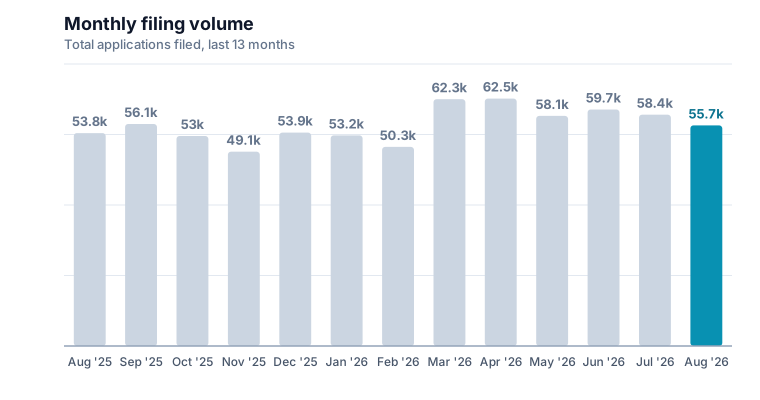
| Month | Total Filings | MoM Change |
|---|---|---|
| August 2025 | 53,754 | — |
| September 2025 | 56,065 | 4.3% |
| October 2025 | 53,033 | -5.4% |
| November 2025 | 49,075 | -7.5% |
| December 2025 | 53,895 | 9.8% |
| January 2026 | 53,169 | -1.3% |
| February 2026 | 50,285 | -5.4% |
| March 2026 | 62,309 | 23.9% |
| April 2026 | 62,464 | 0.2% |
| May 2026 | 58,095 | -7% |
| June 2026 | 59,708 | 2.8% |
| July 2026 | 58,408 | -2.2% |
| August 2026 | 55,705 | -4.6% |
The 4.6% slide from July is the least interesting thing about August. The historical placement is the story: this was the second-strongest August in an 11-year same-month view, clearing August 2025 by 1,951 filings. July told the same story a month earlier, finishing as the second-highest July in the same 11-year series.
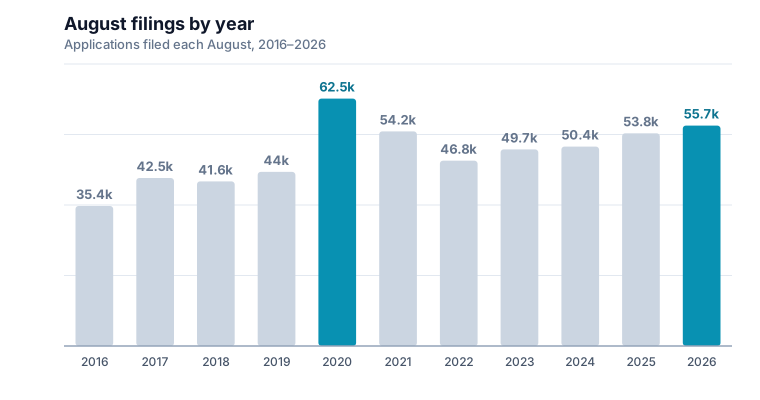
Every August, 2016 to 2026
| Year | August Filings |
|---|---|
| 2016 | 35,376 |
| 2017 | 42,453 |
| 2018 | 41,601 |
| 2019 | 44,002 |
| 2020 | 62,525 |
| 2021 | 54,245 |
| 2022 | 46,835 |
| 2023 | 49,702 |
| 2024 | 50,403 |
| 2025 | 53,754 |
| 2026 | 55,705 |
August 2026 ranks second in the same-month comparison, behind only August 2020's outlier.
Strip out 2020 and there is no close second: 2026 is now the busiest normal August the register has seen. Year to date, 2026 has produced 460,143 filings versus 413,160 at the same point in 2025, an 11.4% jump that leaves only 2021's 474,257 ahead of it in the six-year comparison. We first flagged that pace in the April edition, and it has held through the summer.
The monthly path is why "down from July" undersells it. Filings crested above 62,000 in March and April, dipped, rebounded in June, then eased through the summer to August. That is a slide off the spring peak, not a demand collapse, and it lands on a historically high floor.
Read the recent-month status data as prosecution timing, not outcomes: 55,662 of August's filings are still pending, which simply means the USPTO has not finished examining them yet.
NICE Class Leaderboard
Every application is sorted into one or more of the 45 Nice classes, the international categories of goods and services. The table counts class claims, so an application that names three classes appears three times.
| Rank | NICE Class | Description | Filings | MoM | YoY |
|---|---|---|---|---|---|
| 1 | 9 | Electrical and scientific apparatus; software | 7,265 | -3.6% | 3.6% |
| 2 | 41 | Education and entertainment services | 7,237 | -3.1% | 9.9% |
| 3 | 42 | Scientific and technology services | 6,188 | -7.8% | 14.3% |
| 4 | 35 | Advertising and business services | 6,082 | -2.4% | 1.2% |
| 5 | 25 | Clothing | 6,018 | -0.4% | 9.7% |
| 6 | 3 | Cosmetics and cleaning preparations | 2,998 | -9.2% | 1.7% |
| 7 | 28 | Toys and sporting goods | 2,810 | -0.7% | 6% |
| 8 | 5 | Pharmaceuticals and medical supplies | 2,775 | -9.8% | 1.6% |
| 9 | 21 | Household and kitchen utensils | 2,511 | -4.7% | 0.2% |
| 10 | 16 | Paper goods and printed matter | 2,297 | -3% | 1.4% |
| 11 | 36 | Insurance and financial services | 2,051 | -1.5% | -6% |
| 12 | 20 | Furniture | 1,870 | -5.5% | -5.4% |
| 13 | 44 | Medical, beauty, and agricultural services | 1,693 | -7.7% | -5.8% |
| 14 | 30 | Staple foods | 1,607 | 2.4% | -2.7% |
| 15 | 43 | Restaurant and lodging services | 1,429 | -5.9% | -1.3% |
Class 9 edged Class 41 by 28 rows, 7,265 to 7,237, which is a rounding error, not a ranking. Software and devices on one side, entertainment and education on the other, have been trading the top spot for months.
The real move is Class 42: third by volume but up 14.3% year over year, the fastest gain in the top five. That is where AI tooling, developer infrastructure, SaaS, data services, and productized R&D brands land first, and it is one of the two classes Amazon's DUCKLABS filing claims. One caveat, stated once: Nice rows count class claims, while the monthly headline counts applications, and a single application can claim several classes. The two numbers are not interchangeable.
Class 25 is the counterweight: 6,018 filings, up 9.7% year over year, essentially flat month over month. Apparel volume this durable, running alongside software and entertainment, tells you the register's strength is not purely a tech-cycle artifact. Marketplace sellers, creator brands, and sports merch are all feeding the same pipe.
Top Filing Owners
| Owner | Filings | Prior Month | MoM |
|---|---|---|---|
| Xiaolei Xin | 58 | 0 | — |
| Ganggang Zheng | 52 | 0 | — |
| Sanjun Zhu | 48 | 0 | — |
| 3 STEP SPORTS LLC | 42 | 0 | — |
| LIGHT & WONDER, INC. | 39 | 24 | 62.5% |
| Jilun Shen | 38 | 0 | — |
| Sun,Xingyao | 36 | 4 | 800% |
| REGENERON PHARMACEUTICALS, INC. | 35 | 1 | 3400% |
| ZHEJIANG ZHENGTE CO., LTD. | 28 | 0 | — |
| MATTEL, INCORPORATED | 27 | 4 | 575% |
| Yiwei Zhao | 27 | 0 | — |
| Hongsheng Beverage Group Co., Ltd. | 26 | 0 | — |
Raw volume is not brand significance. The top of this table, individual filers appearing from a standing start of zero, reads like batch or seller activity: it matters for USPTO workload, less so for anyone tracking product strategy.
The corporate names further down are the useful signal. Light & Wonder filed 39, Regeneron 35 (up from a single filing the month prior), and Mattel 27. Regeneron's jump from one to 35 is the row worth a phone call. A pharma company does not multiply its filing footprint 35 times in a month without a reason, whether that is a naming push around a pipeline asset or a portfolio cleanup.
Top Correspondent Firms
The correspondent is the law firm or filing service the USPTO writes to about an application. About three-quarters of August's filings map to a named firm.
| Firm | Filings | Prior Month | MoM |
|---|---|---|---|
| Swyft Legal LLC | 873 | 924 | -5.5% |
| LZ Legal Services, LLC | 844 | 924 | -8.7% |
| Alioth Law P.C. | 422 | 397 | 6.3% |
| Trademark Highway LLC | 421 | 478 | -11.9% |
| SOLORIO LEGAL PC | 407 | 357 | 14% |
| JT IP Law PC | 311 | 475 | -34.5% |
| One Juris PC | 307 | 462 | -33.5% |
| Overseas Operation Services, Inc. DBA Flatfee Corp. | 303 | 344 | -11.9% |
| Sparring Legal LLP | 273 | 240 | 13.8% |
| Law On Call, LLC | 255 | 172 | 48.3% |
| Attorneyx | 250 | 274 | -8.8% |
| BAYRAMOGLU LAW OFFICES LLC | 246 | 221 | 11.3% |
High-throughput, flat-fee filing shops own this leaderboard, and the two leaders both slipped: Swyft Legal and LZ Legal Services each fell from 924 filings in July.
The churn underneath is louder than the top. JT IP Law and One Juris both shed roughly a third of their volume (-34.5% and -33.5%), while Law On Call jumped 48.3% to 255. That kind of double-digit swapping among mid-tier filing mills, not a shift among blue-chip law departments, is what actually moves this list month to month. Trademark demand here is distributed across a long tail of sellers and small businesses using filings as the front door to commerce.
Notable Filings
Amazon: DUCKLABS and I WOULD RATHER DIE
The DUCKLABS filing, dated August 26 and claiming Classes 9 and 42 (software, and technology services), is not a playful internal codename. It maps directly to a corporate event. On the same day, AWS announced it had agreed to acquire DuckLabs, and that the DuckLabs team, including DuckDB creators Hannes Mühleisen and Mark Raasveldt, would join AWS. One detail worth getting right: the DuckDB open-source project, along with its trademarks and the related DuckLake and Quack projects, stays with the DuckDB Foundation, an independent Dutch non-profit. So Amazon is acquiring the team and filing its own DUCKLABS mark while the underlying open-source trademarks stay with the foundation. It is a clean illustration of how a talent-and-brand acquisition and the trademark register can move on the same day without touching the same IP.
Amazon Technologies also filed I WOULD RATHER DIE on August 31, the last day of the month, in Class 41, entertainment services. We found no public counterpart to the phrase. The class says it is a title, a show, or a campaign line rather than a marketplace utility, and that is as far as the data goes.
Nike: ACG PICKLEJUS is a real shoe, not a mystery mark
Nike filed ACG PICKLEJUS on August 24, and this is a named, unveiled product, not a coined term to speculate about. Nike ACG's new top-of-the-line trail runner is called the Picklejus, designed for grueling 100-plus-mile mountain efforts like those around Mont Blanc. The name is a deliberate misspelling of pickle juice, the folk remedy runners reach for when muscles cramp. The filing landed within days of Nike's public unveiling during UTMB week in Chamonix, and Nike says the shoe will be available in late 2027 at nike.com and select retailers. A trademark filed more than a year ahead of the shelf date is exactly the clearance-ahead-of-launch pattern this report exists to surface.
Samsung: FLEX TITANIUM, LP OLED, and code-name filings
Samsung filed FLEX TITANIUM on August 20, after, not before, the product reveal. Samsung unveiled Flex Titanium on July 15, 2026, as the display technology for its next generation of Galaxy foldable phones. It combines two titanium-based components, a titanium-alloy film and a titanium plate, to balance slimness, flexibility, and strength inside the folding screen. The August filing is Samsung papering the trademark behind a technology it had announced five weeks earlier.
LP OLED, filed August 25, is the most technically legible mark in the set. OLED is an established display term and "LP" reads as a variant or feature modifier, but we found no announced product tied to the exact string, so we will not guess at what it brands. Two more Samsung filings round out the month: ZHBF (August 24), a compact letter mark of the kind companies use for code-name or defensive filings, and Samsung Electronics America's PASTRY PARTY MERGE (August 20), which reads like a mobile game title rather than hardware.
Disney: MAD LOVE, IMAGINE THE REST, and .YNSD
Disney filed three marks in a tight late-August cluster: MAD LOVE on August 26 in Class 41, entertainment services, and on August 24 both IMAGINE THE REST and the dot-prefixed .YNSD, each in Class 18, which covers leather goods, bags, and luggage. We found no public product tied to any of the three, so we will resist reading tea leaves. But the pairing of a broad slogan and a compressed, stylized letter mark, both filed for bags rather than for films or parks, is the standard Disney pattern of filing merchandise language and cryptic brand architecture in the same window.
TTAB Activity
The TTAB is the Trademark Trial and Appeal Board, the USPTO's internal court. An opposition is a formal objection to a pending application. A cancellation asks the Board to strike a registration that already exists.
| Type | Filings | Prior Month | MoM |
|---|---|---|---|
| Oppositions | 748 | 791 | -5.4% |
| Cancellations | 254 | 242 | 5% |
Enforcement did not cool with filing volume. Oppositions eased to 748 from 791, but cancellations rose to 254 from 242. Brand owners were clearing the register, not just blocking new applications.
The most active plaintiff is also the most interesting. Leaf Brands led with 8 proceedings, and every one of them was a cancellation petition against an existing registration, which follows directly from its business model. Leaf Brands is a revived American candy company built on heritage brands; it re-formed in 2011 to reclaim products from the original Leaf Candy Company, and it later registered the Hydrox cookie trademark after former owner Kellogg's let it lapse. A company whose entire strategy is resurrecting lapsed nostalgia marks has structural reasons to police the register aggressively. Chanel's 6 fit the luxury pattern of constant anti-lookalike policing. Fluke, the test-and-measurement instrument maker, matched that count. Snap and Meta bring the platform pattern of defending short, portable software marks, and McDonald's, Alo, and Gap add the consumer-brand layer.
Registration Rates
| Cohort Month | Total Filed | Registered | Registration Rate |
|---|---|---|---|
| August 2025 | 53,754 | 21,935 | 40.8% |
| July 2025 | 54,878 | 23,291 | 42.4% |
| June 2025 | 50,470 | 22,225 | 44% |
| May 2025 | 48,468 | 21,741 | 44.9% |
| April 2025 | 52,829 | 25,740 | 48.7% |
| March 2025 | 53,019 | 27,944 | 52.7% |
| February 2025 | 38,399 | 18,193 | 47.4% |
| January 2025 | 61,343 | 36,331 | 59.2% |
| December 2024 | 53,461 | 30,500 | 57.1% |
| November 2024 | 47,791 | 26,804 | 56.1% |
| October 2024 | 52,934 | 29,749 | 56.2% |
| September 2024 | 51,328 | 29,116 | 56.7% |
Do not read the descending rates as a tightening register. These are cohorts at different stages of maturity: the 2024 months have had time to finish examination and sit in the mid-to-high 50s, while the 2025 cohorts are still working through office actions, publication, and abandonment. Give the recent cohorts another year and expect them to climb toward the same band.
Practitioner Takeaways
-
Do not let the July-to-August dip drive the story. August 2026 was still the second-strongest August on record. Treat demand as elevated.
-
Watch Class 42. A 14.3% year-over-year rise in a top-three class means crowded naming conditions for software, data, and technical-service brands. Amazon's DuckLabs filing is a live example.
-
Filing dates are roadmap clues. Nike filed ACG Picklejus more than a year before its 2027 release; Amazon filed DUCKLABS the day the deal broke. The register runs ahead of, and alongside, the news.
-
Enforcement stays active even when applications soften. Oppositions fell but cancellations rose, and revived-brand owners like Leaf Brands are policing the register as aggressively as any luxury house.
Methodology: figures cover USPTO trademark applications by filing date, from GleanMark's mirror of the full USPTO dataset (more than 14 million records), measured September 5, 2026. Nice-class rows count class claims, not applications; one application can claim multiple classes. Recent-month filings are about 99% pending, which reflects prosecution timing, not outcomes, and registration rates use cohorts old enough to have matured. Firm totals cover filings mapped to a correspondent, about 74% of the month. TTAB plaintiff counts combine oppositions and cancellations filed in the month. Informational, not legal advice.
Explore more USPTO data analysis on the GleanMark Insights blog.
Related Articles
Class 42 Filings Up 32% Year Over Year as September 2026 Tops September 2025
October 5, 2026
July 2026 Trademark Filings Top Every July Since 2016
August 5, 2026
Fighting Back, Part 1: What the Cure-Rate Data Actually Says About Beating a Refusal
September 2, 2026