Nike Filed Bronny James's 'B9' Logo in February. By April, the USPTO Said No.
The most newsworthy thing on the February register isn't a number — it's a two-character mark.
 By Howard Katzenberg
Founder, GleanMark
Updated October 6, 2026
The most newsworthy thing on the February register isn't a number — it's a two-character mark. On February 27, Nike filed B9 (99673726), the stylized logo tied to Bronny James's emerging signature line. On April 13th, the USPTO refused the application; Nike had filed seeking protection of the 'B9' logo for use on footwear, clothing, and sports jerseys, on an intent-to-use basis, meaning Nike hadn't yet launched products with the logo.
The problem: an existing 'B9' trademark is already registered, belonging to Back 9 Golf Apparel, an Austin-based company selling golf apparel under similar 'B9' branding. So when GleanMark's database flags a cryptic alphanumeric Nike filing, the right move isn't to call it "one to watch" — it's to find the conflict that was already sitting on the register.
That is the whole pitch for reading this data closely. February 2026 produced 49,884 USPTO trademark applications, and the monthly total is the least interesting fact in it.
"The register is the cleanest public preview of a company's product roadmap — and companies routinely talk months before they mean to. Nike told the world it wanted Bronny's logo in February. The government told Nike no in April. Both facts were filings before either was a headline."
We think the broader February strength likely reflects a mix of AI and software-startup formation, continued e-commerce and brand-registry behavior, and fee-sensitive timing still working through filing calendars. The register is not a perfect proxy for the economy. It is a very good early-warning system for what companies are trying to name — and, occasionally, for what they will fail to own.
What We Found
- Nike's B9 filing was dead on arrival. The February 27 application for Bronny James's signature logo was refused weeks later over a prior registration — a clearance failure visible in the data before it was news.
- February was historically strong, not weak. At 49,884 applications, it was the second-strongest February in the 2016–2026 same-month history, behind only 2021.
- Year-to-date volume leads everything but 2021. 2026 reached 102,947 filings through February, up 3.2% from 99,799 at the same point in 2025.
- Software services broke out. Class 42 logged 6,031 class claims, up 60.2% year over year — the largest annual jump in the top five.
- Samsung Display's QUANTUMBLACK was filed a month before the company announced it. The February 26 filing preceded the March 26 product reveal.
Filing Volume
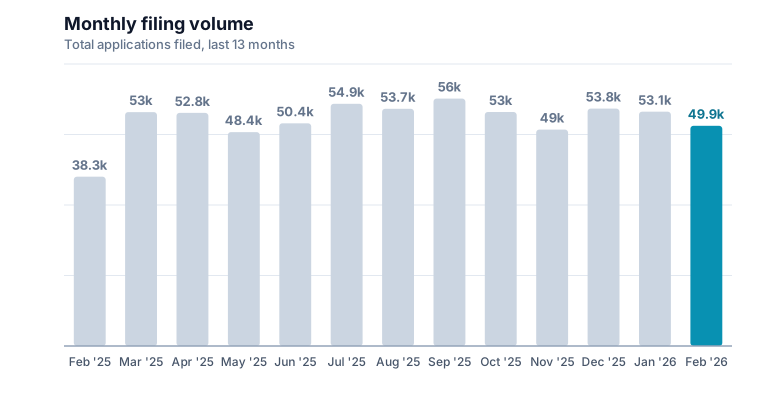
| Month | Total Filings | MoM Change |
|---|---|---|
| Feb. 2026 | 49,884 | -6% |
| Jan. 2026 | 53,063 | -1.3% |
| Dec. 2025 | 53,761 | 9.7% |
| Nov. 2025 | 49,015 | -7.5% |
| Oct. 2025 | 52,991 | -5.4% |
| Sep. 2025 | 56,026 | 4.3% |
| Aug. 2025 | 53,722 | -2.1% |
| Jul. 2025 | 54,850 | 8.7% |
| Jun. 2025 | 50,447 | 4.1% |
| May 2025 | 48,440 | -8.2% |
| Apr. 2025 | 52,785 | -0.3% |
| Mar. 2025 | 52,969 | 38.1% |
| Feb. 2025 | 38,348 | — |
Yes, February fell 6% from January. Ignore it. The month-over-month line is the wrong frame for a month that just posted the second-highest February total in eleven years.
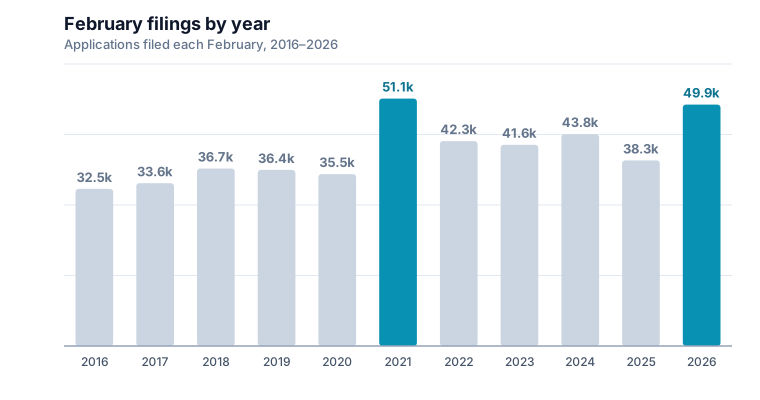
Every February, 2016–2026
| Year | February Filings |
|---|---|
| 2016 | 32,462 |
| 2017 | 33,636 |
| 2018 | 36,671 |
| 2019 | 36,375 |
| 2020 | 35,514 |
| 2021 | 51,108 |
| 2022 | 42,341 |
| 2023 | 41,566 |
| 2024 | 43,788 |
| 2025 | 38,348 |
| 2026 | 49,884 |
Only February 2021 — the post-pandemic filing boom — topped February 2026 in this same-month history.
Year-to-Date Filings, Jan. 1–Feb. 28
| Year | Year-to-Date Filings |
|---|---|
| 2021 | 107,633 |
| 2022 | 90,945 |
| 2023 | 79,310 |
| 2024 | 91,802 |
| 2025 | 99,799 |
| 2026 | 102,947 |
The year-to-date line matters as much as the monthly rank. Through February, 2026 sits at 102,947 filings, ahead of 2025 by 3.2% and second only to the 2021 anomaly. Year over year, February alone jumped 30.1%, from 38,348 applications to 49,884. That is too large a gap to wave off as filing noise. The cleaner read: last February was the soft outlier, depressed below every other February since 2018, and 2026 simply returned the month to where the recent trend already pointed.
NICE Class Leaderboard
| Rank | NICE Class | Description | Filings | MoM | YoY |
|---|---|---|---|---|---|
| 1 | 41 | Education; entertainment; sporting and cultural activities | 7,220 | 4.5% | 45.3% |
| 2 | 9 | Scientific, electronic, audiovisual, and software goods | 6,305 | -2% | 37.8% |
| 3 | 42 | Scientific and technological services; software design and development | 6,031 | 14.4% | 60.2% |
| 4 | 35 | Advertising; business management; business administration | 5,878 | 8.5% | 23.7% |
| 5 | 25 | Clothing, footwear, and headwear | 5,292 | -8.5% | 30.5% |
| 6 | 5 | Pharmaceuticals and medical preparations | 2,597 | -2.4% | 18% |
| 7 | 3 | Cosmetics, toiletries, perfumery, and cleaning preparations | 2,545 | -12.5% | 26.2% |
| 8 | 28 | Games, toys, sporting articles, and playthings | 2,253 | -6.8% | 27.5% |
| 9 | 36 | Insurance, financial, monetary, and real estate services | 2,113 | 6.5% | 15.5% |
| 10 | 16 | Paper goods, printed matter, stationery, and office requisites | 1,898 | -12.2% | 33.6% |
| 11 | 21 | Household and kitchen utensils, containers, and glassware | 1,823 | -23.3% | 23.8% |
| 12 | 44 | Medical, beauty, agricultural, and veterinary services | 1,799 | 11.9% | 20% |
| 13 | 30 | Coffee, tea, cocoa, bakery goods, and staple foods | 1,679 | 14% | 32.2% |
| 14 | 43 | Food and drink services; temporary accommodation | 1,435 | 1% | 28.1% |
| 15 | 20 | Furniture, mirrors, picture frames, and non-metal containers | 1,364 | -21.6% | 27.7% |
The front of the register tells a coherent story: the top three classes are entertainment (41), software goods (9), and software services (42). Class 42 is the one to flag. A 60.2% year-over-year increase in a class already clearing 6,000 claims is not small-base trivia — it is the single fastest-growing category in the top five, by a wide margin over second-place Class 41's 45.3%. Our hypothesis: AI and SaaS formation are doing the heavy lifting here, since "software design and development" is precisely where an AI startup's first application lands.
The consumer classes held up too. Apparel, cosmetics, toys, household goods, and food were all up year over year even where month-to-month numbers softened. One unit note, stated once and not repeated: this table counts class claims, not applications — a single application can claim several classes — so read it for mix and direction, not as a slice of the monthly filing total.
Top Filing Owners
| Owner | Filings | Prior Month | MoM |
|---|---|---|---|
| ROC PARTY CO.,LTD. | 45 | 0 | — |
| Glaxo Group Limited | 38 | 18 | 111.1% |
| Biaowu Huang | 31 | 4 | 675% |
| Futrus, Ltd. | 31 | 0 | — |
| Elixirgen Therapeutics, Inc. | 30 | 0 | — |
| WALMART APOLLO, LLC | 30 | 31 | -3.2% |
| LIGHT & WONDER, INC. | 28 | 29 | -3.4% |
| NASDAQ, INC. | 28 | 0 | — |
| MEDICALINE Sp. z o.o. | 28 | 0 | — |
| FULCRUMQ LLC | 26 | 0 | — |
| Aristocrat Interactive S.a r.l | 25 | 8 | 212.5% |
| Sen Jia | 24 | 0 | — |
The owner leaderboard always mixes recognizable companies with batch-heavy filing behavior, and February is no exception. Glaxo, Walmart, Light & Wonder, Nasdaq, and Aristocrat are the names with obvious corporate logic; the zero-to-30 rows — ROC Party, Futrus, several single-name filers — read more like concentrated registration pushes than household-name product strategy. The most interesting tell is gaming: Light & Wonder and Aristocrat Interactive together signal an interactive-entertainment naming cycle, a category that mints marks fast across titles, platforms, and feature names. Aristocrat's jump from 8 to 25 filings is the kind of move that usually precedes a content slate, not a single launch.
Top Correspondent Firms
| Firm | Filings | Prior Month | MoM |
|---|---|---|---|
| Swyft Legal LLC | 943 | 884 | 6.7% |
| LZ Legal Services, LLC | 837 | 595 | 40.7% |
| Overseas Operation Services, Inc. DBA Flatfee Corp. | 636 | 599 | 6.2% |
| MEDIA LAW GROUP | 259 | 207 | 25.1% |
| Grogan, Tuccillo & Vanderleedeen, LLP | 251 | 478 | -47.5% |
| Sparring Legal LLP | 236 | 297 | -20.5% |
| Alioth Law P.C. | 231 | 458 | -49.6% |
| LegalForce RAPC Worldwide, P.C. | 184 | 197 | -6.6% |
| Law On Call, LLC | 180 | 137 | 31.4% |
| Kearston Grace Everitt | 179 | 215 | -16.7% |
| LOWELL LEE CARSON JR | 176 | 176 | 0% |
| One Juris PC | 173 | 160 | 8.1% |
High-throughput filing channels own the top of this table: Swyft Legal, LZ Legal Services, and Flatfee Corp. sit far ahead of everyone else, with LZ Legal's 41% month-over-month jump the standout move. But look at the middle of the table, where the volatility is. Grogan, Tuccillo & Vanderleedeen and Alioth Law both roughly halved month over month — drops of that size in a single month usually mean a large client portfolio shifted timing or counsel, not that demand collapsed. Among specialist names, Media Law Group's 25% gain to 259 filings is the one moving the right direction.
Notable Filings
| Owner | Filing Date | Mark | Serial Number | Status |
|---|---|---|---|---|
| SAMSUNG DISPLAY CO., LTD. | Feb. 24, 2026 | LEAD THE NEXT WAVE OF DISPLAY 2.0 | 99668048 | Pending |
| SAMSUNG DISPLAY CO., LTD. | Feb. 26, 2026 | QUANTUMBLACK | 99672178 | Pending |
| SAMSUNG DISPLAY CO., LTD. | Feb. 26, 2026 | QUANTUMVIEW | 99672338 | Pending |
| SAMSUNG DISPLAY CO., LTD. | Feb. 26, 2026 | INTELLISENSE 3.0 | 99672430 | Pending |
| SAMSUNG DISPLAY CO., LTD. | Feb. 26, 2026 | DUAL-HZ CLARITY | 99672490 | Pending |
| NIKE, INC. | Feb. 27, 2026 | B9 | 99673726 | Pending |
| NIKE, INC. | Feb. 27, 2026 | CH | 99673728 | Pending |
| NETFLIX STUDIOS, LLC | Feb. 25, 2026 | SCHOOLED! | 99670307 | Pending |
Nike: B9 (and CH)
The B9 mark is the month's best worked example of why filing data has a shelf life. Nike filed it February 27; the logo is Bronny James's. Nike introduced a stylised version of the "B9" logo that had already been featured on Bronny's on-court sneakers this season. Then the register did what the register does. The USPTO sent a letter of refusal citing "likelihood of confusion" with an already-registered mark by the Back9 Golf Apparel company, stating that Nike's mark is confusingly similar to the registered mark.
Nike could argue the goods target different sports, but that argument is difficult here: because Back 9 Golf's registration doesn't limit itself to golf channels, the USPTO presumes the goods overlap — an issue Nike is not likely to argue around. Even a flat status field — "Pending" in February — was hiding a clearance problem that any conflict search would have surfaced. Nike's companion filing the same day, CH (99673728), is the genuinely opaque one; two-letter marks rarely telegraph intent, and we found no public product tied to it.
Samsung Display: QUANTUMBLACK and the display-feature cluster
Samsung Display filed five marks across three late-February days, and one of them lets us do the timing trick that makes this data valuable. The company filed QUANTUMBLACK (99672178) on February 26. A month later, Samsung Display announced QuantumBlack as a low-reflection, high-durability film for QD-OLED monitors, confirmed it would be applied to all new QD-OLED monitor products launched this year, and noted it had recently completed trademark registration. The reveal landed March 26 — the trademark filing beat the press release by a month. Samsung claims the coating reduces light reflectance by 20% versus its previous generation and raises QD-OLED surface hardness from 2H to 3H.
The rest of the cluster reads as supporting branding for the same display push: QUANTUMVIEW, the refresh-rate-flavored DUAL-HZ CLARITY, INTELLISENSE 3.0, and the slogan-style LEAD THE NEXT WAVE OF DISPLAY 2.0. None of those four had surfaced publicly when we checked. If QUANTUMBLACK is any guide, expect them to appear in 2026 monitor marketing, not on the filing date.
Netflix Studios: SCHOOLED!
Netflix filed SCHOOLED! (99670307) on February 25 — and this is another filing-ahead-of-announcement case, though a shorter lead. On March 2, Netflix detailed SCHOOLED!, a kids-and-family competition show in which former NASA engineer Mark Rober opens a gamified laboratory where teams of young innovators face off in science experiments, produced by Rober's CrunchLabs with Jimmy Kimmel's Kimmelot. The exclamation point in the mark was the tell that this was a title, not a house mark; the filing simply got there five days before the publicity did.
TTAB Activity
| Type | Filings | Prior Month | MoM |
|---|---|---|---|
| Oppositions | 705 | 647 | 9% |
| Cancellations | 238 | 225 | 5.8% |
Both tracks rose: oppositions from 647 to 705, cancellations from 225 to 238. The tie at the top is the story. McDonald's leading with 8 proceedings is unsurprising — a global brand polices across food, retail, and promotions as a matter of routine. The co-leader is not a household name but has a notable history: Fuente Marketing, the Arturo Fuente cigar entity, has fought over the use of the letter "X" in trademarks, including a dispute sparked by a rival's product that drew a cease-and-desist over Fuente's X marks.
In fact, the cigar company spent nearly five years opposing a dab-rig company's effort to register a trademark. Eight proceedings in a single month from a cigar marketer is exactly the kind of outlier the leaderboard exists to catch.
One housekeeping note on the table: Hugo Boss appears under three related owner records, each with 6 proceedings. That is a single brand family fragmented by ownership structure, not three separate campaigns — worth de-duplicating before anyone reads it as the register's most litigious entity.
Registration Rates
| Cohort Month | Total Filed | Registered | Registration Rate |
|---|---|---|---|
| Feb. 2025 | 38,348 | 14,651 | 38.2% |
| Jan. 2025 | 61,451 | 31,448 | 51.2% |
| Dec. 2024 | 53,459 | 26,210 | 49% |
| Nov. 2024 | 47,795 | 22,895 | 47.9% |
| Oct. 2024 | 52,967 | 26,167 | 49.4% |
| Sep. 2024 | 51,308 | 23,184 | 45.2% |
| Aug. 2024 | 50,411 | 16,219 | 32.2% |
| Jul. 2024 | 50,715 | 18,534 | 36.5% |
| Jun. 2024 | 46,732 | 18,825 | 40.3% |
| May 2024 | 51,570 | 25,544 | 49.5% |
| Apr. 2024 | 51,609 | 25,430 | 49.3% |
| Mar. 2024 | 48,993 | 25,018 | 51.1% |
Read this table for matured cohorts, not fresh ones. The 2024 cohorts mostly settle in the high-40s to low-50s; the younger February 2025 cohort at 38.2% hasn't finished prosecuting and will keep climbing. Judging February 2026 outcomes off this table would be a mistake — those applications are barely out of the gate.
Practitioner Takeaways
- Clear the mark before the athlete wears it. Nike's B9 refusal is a reminder that a high-profile rollout doesn't move the register — a prior registration in the same goods will stop even Nike.
- Software clearance stays crowded. Class 42's 60.2% year-over-year jump means heavier competition around software, AI, data, and platform naming. Search budgets should reflect it.
- Watch feature names, not just house marks. Samsung Display's QUANTUMBLACK filed a month ahead of its announcement — competitive intelligence often hides in the boring technical descriptors.
- More filings, more collisions. TTAB oppositions and cancellations both rose; rising application volume mechanically widens the surface for disputes.
Methodology: figures cover USPTO trademark applications by filing date, from GleanMark's mirror of the full USPTO dataset (~14M records). Recent-month filings are ~99% pending — that reflects prosecution timing, not outcomes; registration rates use cohorts old enough to have matured. NICE class figures count class claims, not applications. Firm totals cover filings mapped to a law firm (about 62% of the month). Informational, not legal advice.
Explore more USPTO data analysis on the GleanMark Insights blog.
More in this series
Previous: January 2026 · Next: March 2026 · Browse all filing reports
Related Articles
Class 42 Filings Up 32% Year Over Year as September 2026 Tops September 2025
October 5, 2026
Amazon Filed a Trademark for DUCKLABS the Same Day It Announced Buying DuckLabs
September 5, 2026
July 2026 Trademark Filings Top Every July Since 2016
August 5, 2026